
Signups can fool you: Webflow launched on Hacker News to 25,000 signups and $5K of monthly revenue in 2 weeks. By 2015 it faced a "do or die" moment, because it wasn't default alive.
The 40% survey: If fewer than 40% of recently active users would be "very disappointed" without your product, the fit isn't there yet. Slack scored 51% when 731 of its users were asked in 2015.
The cohort curve: Plot each month's new users on their own line. Sequoia's data science team says a product without fit shows a curve that keeps falling toward zero.
Revenue against spend: Paul Graham's default alive test asks whether your current growth gets you to profitability on the cash you have, and steady growth can still fail it.
The request behind the request: Webflow's customers asked for a WordPress plugin. The team asked why until it found the real job, and the visual CMS it shipped lifted monthly revenue 25% within a month.

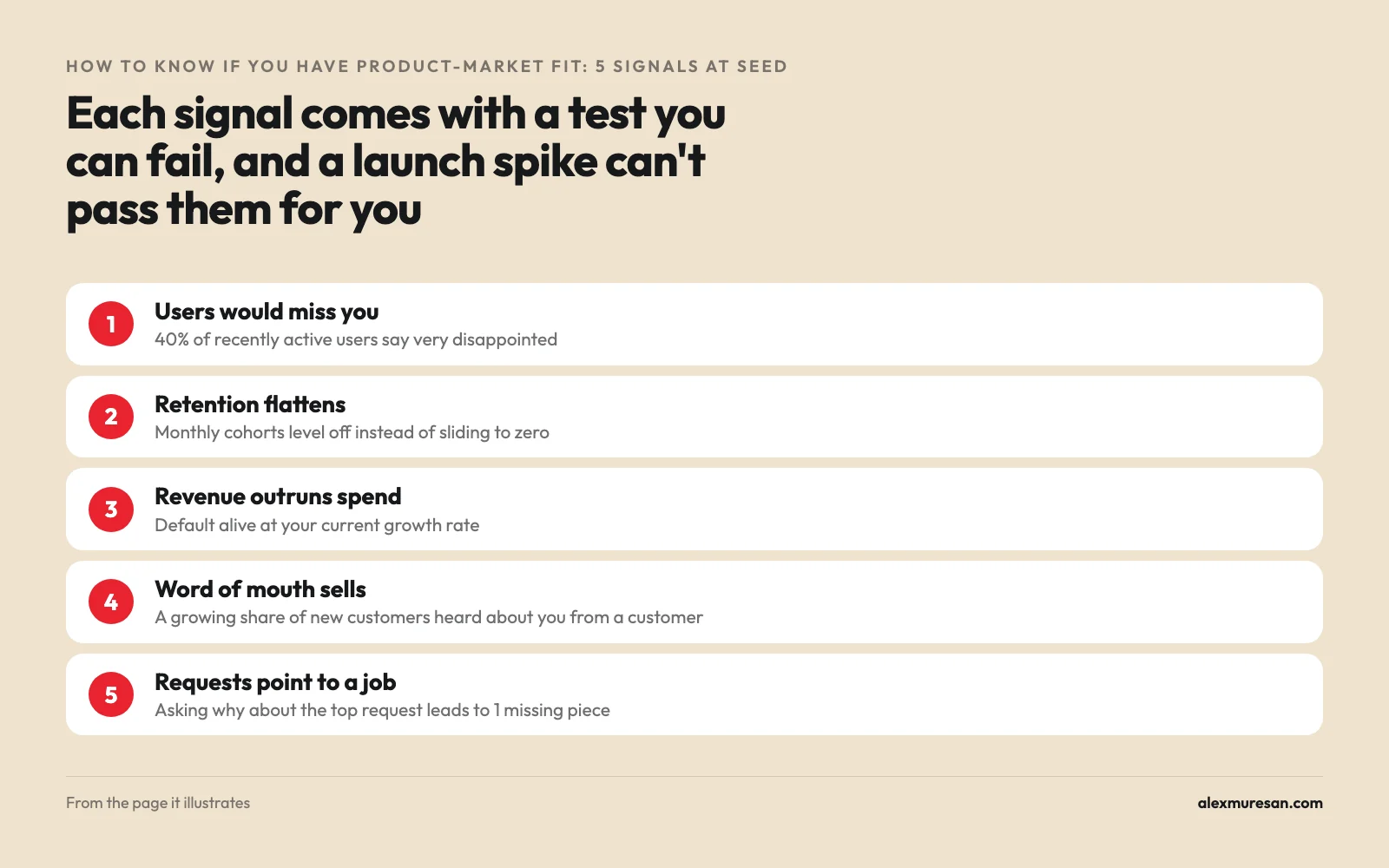
How to know if you have product-market fit: the 5 signals at a glance
You know the afternoon. The launch goes up, the signup counter won't stop moving, and someone drops a screenshot in the team channel with 3 fire emojis on it (you've all seen that screenshot... some of you have posted it). The 5 signals below tell you whether that afternoon was product-market fit, and each one comes with a number you can fail.
| Signal | The test you can fail | Where the signal comes from | What fools founders |
|---|---|---|---|
| 1. Users would miss you | At least 40% of users active twice in the last 2 weeks say "very disappointed" | Sean Ellis, as Rahul Vohra ran it at Superhuman | Surveying every signup since launch day |
| 2. Retention flattens | Each monthly cohort levels off, near 60% at 6 months for SMB and mid-market SaaS | Sequoia's data science team, plus Lenny Rachitsky and Casey Winters | A total-users chart that new signups hold up |
| 3. Revenue outruns spend | Default alive at your current growth rate | Paul Graham | Steady growth with no burn rate next to it |
| 4. Word of mouth sells | A growing share of new customers heard about you from a customer | Marc Andreessen's 2007 essay | A launch spike from Hacker News or a press hit |
| 5. Requests point to a job | Asking why about your most repeated request leads to 1 missing piece | Webflow's support inbox, per Bryant Chou | Building the request word for word |
Webflow's 25,000 signups, and the 2 years after them
Webflow had that afternoon in 2013. It launched the full product on Hacker News 2 weeks before its Y Combinator Demo Day, and First Round's account of the company says it brought in 25,000 signups and $5K of monthly recurring revenue in the first 2 weeks. That October it closed a $1.2 million seed round. If you'd shown me that dashboard, I'd have called it product-market fit, because 25,000 people in 2 weeks is a lot of people wanting something.
Then came 2 years of what co-founder Bryant Chou calls "stable growth." Revenue grew, but by 2015 it still wasn't outpacing what the team spent, and Webflow was burning through its cash without being default alive. Chou called it a "do or die" moment. Raising again felt risky after how hard the seed had been ("we couldn't put together much of a seed round at all," he says), so profitability was the only way out.
Webflow got through it, and the way out turned up in its support inbox. I'll come back to that in signal 5, because it's the 1 signal the team was already reading every morning. Chou now puts product-market fit at the point Webflow broke through $1 million in ARR, which came about 2 years after the launch that looked like it.
Think about what that means for your own dashboard. The signups were real, and so was the early revenue, but neither one told Webflow whether the money would outrun the burn. The 5 signals below would have, and every one of them is a test somebody published so you could run it on a Tuesday afternoon.
What is product-market fit?
Product-market fit means your product satisfies a market that's worth being in. The phrase comes from Marc Andreessen's 2007 essay The only thing that matters, where he defines it as "being in a good market with a product that can satisfy that market."
He also wrote down how it feels from the inside. When it isn't happening, "word of mouth isn't spreading" and "the sales cycle takes too long." When it is, money from customers is "piling up in your company checking account," and you're hiring sales and support people as fast as you can.
The trouble with most lists of product-market fit signs is that you only feel them once you're there. Rahul Vohra, the founder of Superhuman, wrote that the descriptions he found "all seemed so post hoc, so unactionable," which is why he went looking for a number instead. Each signal on this page comes with something you can check before the feeling arrives.
This page goes deeper on the first move in the seed-stage guide, and it sits in the seed lane of my startup growth playbooks, which run from pre-seed to Series C.
Signal 1: 40% of active users would be very disappointed without you
The test
Sean Ellis asks your users 1 question: how would you feel if you could no longer use the product? Users pick from "very disappointed" down to "not disappointed," and the number that matters is the share who pick the first answer. Ellis benchmarked nearly 100 startups, and Vohra's account in First Round Review says the ones that struggled to find growth almost always came in under 40%, while companies with strong traction almost always cleared it.
Slack is the data point I'd pin above your desk. When Hiten Shah put Ellis's question to 731 Slack users in 2015, 51% said they'd be very disappointed without it. Slack only cleared the bar by 11 points, which tells you 40% is meant to be hard to hit. If you land in the 20s, you're in good company (Superhuman started at 22%) and you're not there yet.
What fools founders: surveying every signup
Vohra only surveyed people who had "used the product at least twice in the last two weeks." That filter is the whole point, because the question is about losing something you use. Send it to everyone who signed up on launch day and you're measuring the launch, because plenty of those people tried the product once and moved on.
Superhuman's full climb to 58%, by narrowing in on the users who loved it most, is in the pre-seed guide, so I won't retell it here.
Signal 2: your retention curve flattens
The test
Take everyone who started using the product in the same month and plot what share of them is still active in each month after. Sequoia's data science team describes what a product without fit looks like on that chart. In their words, "the retention curve will continuously decline, eventually reaching very few or zero users." A curve that bends and then goes flat means a group of people found value and keeps coming back, and the higher it flattens, the healthier the product.
For where it should flatten, Lenny Rachitsky and Casey Winters asked 20 experts and landed on about 60% of users still active at 6 months as good for SMB and mid-market SaaS, and about 40% for consumer SaaS. Treat those as targets to aim at, because your own curve going flat matters more than hitting either one exactly.
What fools founders: the total-users chart
A chart of total users goes up as long as new signups outnumber the people leaving. A big launch can hold that line up for months while every cohort underneath it slides toward zero, and nobody in the team channel ever posts a screenshot of a cohort chart. I took an AI startup from zero to $600K ARR in 5 months, so I know how good a fast total looks, and that's exactly when I'd want the cohort view open in the next tab.
Signal 3: revenue outruns what you spend
The test
This is the test Webflow failed in 2015. Paul Graham calls it default alive, and it works like this: assume your expenses stay where they are and revenue keeps growing at the rate it has for the last several months. If that gets you to profitability on the money you have left, you're default alive.
Webflow's growth was real, and that's the trap. A steady line on the revenue chart tells you nothing until you put the burn next to it. Andreessen's version of the same signal is money "piling up in your company checking account," and in 2015 Webflow's account was going the other way.
What Webflow did after it failed the test
It turned the test into a hiring rule. Chou says that before each hire, they'd tally up the incoming payments from Stripe and check whether they beat expenses, and they only hired if the answer was yes. Webflow didn't raise again until a $72M Series A in 2019, so for years every new hire was paid for by customers.
Signal 4: word of mouth starts doing the selling
The test
Andreessen's signs that fit isn't happening include word of mouth that isn't spreading, and I'd turn that into a question you ask every new customer: how did you hear about us? Log the answer in your CRM on the day they sign. When fit is real, a growing share of them name a customer or a colleague, and a shrinking share name your outreach.
Webflow had the early version of this in its inbox. Chou says "every so often we'd get a love letter," and that each one was "more and more validation that we're doing the right thing." I'd treat a love letter as the start of word of mouth, because the customer who writes to you is usually the one who tells a colleague about you next.
What fools founders: the launch spike
A Hacker News launch or a press hit brings people who heard about you from the post, which is attention you borrowed for a day. I grew a media company to an 800K audience on organic alone before I sold it this year, and an audience is the easiest thing to mistake for fit, because it claps whether or not anyone would pay. Word of mouth means something else, because a customer spent their own reputation on you.
Signal 5: customers keep asking for the same missing piece
The test
Webflow's founders spent hours every morning answering support tickets, and they read those tickets as a sign of who was still using the product. "We actually used customer support tickets as a corollary to retention," Chou says. It makes sense, because nobody writes in about a tool they've stopped opening.
The test is to take the request you hear most from your best customers and ask why it matters to them, then ask why again, until you reach the job they're trying to get done. Chou's lesson is that you shouldn't take a customer request "word-for-word," and Webflow's own inbox is the reason he says it.
How Webflow found the missing piece
In 2015, with the company in its "do or die" year, customers were asking for a WordPress plugin. The team kept asking why until it saw what people were really doing, which was designing in Webflow and then managing the content in WordPress with a custom fields plugin. So instead of building the plugin, they spent about 6 months building their own visual CMS.
It launched in October 2015. Within a month, monthly recurring revenue was up 25% and ARR had reached $1 million, and the company turned profitable soon after that. Over the next 4 years ARR went from $1 million to $18 million, which is what it looks like when the market starts pulling the product out of you.
What fools founders: the loudest request
A list of feature requests from everyone pulls the product in as many directions as you have customers. I'd only weigh requests from the users who'd be very disappointed without you, because they're the ones whose job you're already halfway doing.
How to know if you have product-market fit in your first 6 months after seed
If you raised a seed round this quarter, the first 6 months are when you find out which of these signals you pass, before you spend the round on scale. In month 1, send the 40% survey to everyone active twice in the last 2 weeks, and build the cohort chart by signup month. Both take an afternoon, and both give you a baseline before you've changed anything.
Every month after that, do the default alive math with your real burn, and read the how-did-you-hear log and the request log side by side. When the same type of customer shows up in both, you've found the people the product is for.
Until the survey and the curve both pass, I'd keep the round away from scale hires and paid acquisition. Once they do, the 5 seed-stage moves tell you what to do with the money, starting with 1 channel to grow, and the Series A guide picks up when the trend holds.
And the next time a signup screenshot lands in the team channel, enjoy it (the fire emojis are earned). Then put a reminder in your calendar for 2 weeks out, and survey whoever is still logging in.
Hear how VCs decide whether a seed company has fit
Every guest in season one of Sell That S*it! is a VC, and we break down how a fund graduates a company. Telling real fit from a good launch is a call every one of those investors makes at seed, from the other side of the table. Season one is filming now, so there's nothing to play yet, and the newsletter box at the end of this page is the other way to keep up (it only goes out when there's something real to send).
FAQs about product-market fit
How do you know you have product-market fit at seed stage? Look for 2 numbers first: at least 40% of recently active users saying they'd be very disappointed without you, and monthly cohort curves that flatten instead of sliding to zero. Then check that revenue grows fast enough to keep you default alive, because Webflow had steady growth and still faced a "do or die" moment in 2015.
What should a startup do in the first 6 months after raising a seed round? Find out whether product-market fit is real before spending on scale. Run the 40% survey and build a cohort chart in month 1, then do the default alive math every month. Hold off on scale hires until the survey and the curve both pass.
What are the top 5 things a seed-stage startup should do to grow revenue? Prove product-market fit, keep the founders selling until deals repeat, make 1 channel work, hire a marketer to scale it, then raise the Series A on a trend. The seed-stage guide covers each move with its own threshold, and this page is the deep version of the first one.
What is the Sean Ellis test? It's 1 survey question: how would you feel if you could no longer use the product? If at least 40% of active users answer "very disappointed," you're above the line Ellis found separating companies with strong traction from the ones that struggled.
What does a retention curve look like with product-market fit? It drops in the first months and then goes flat, because a core group of users keeps coming back. Without fit, Sequoia's data science team says the curve keeps declining toward zero.
Can a startup grow revenue without product-market fit? For a while, yes. Webflow grew steadily for 2 years after its launch and still wasn't default alive in 2015, and Bryant Chou puts its product-market fit at the point it broke through $1 million in ARR, right after the CMS shipped.
About the author

Alex Muresan is a 4x founder with 2 exits. He built his first company, a physical entertainment center, to 60 employees and $2M in annual revenue in his early 20s. His second exit came in 2026, when he sold a media company. He took an AI startup from 0 to $600K ARR in 5 months, and at his current startup he took revenue from $800K to $1.4M ARR in his first 3 months. He also hosts Sell That S*it!, where every guest in season one is a VC.
Part of the stage playbooks: what to do for growth at pre-seed, seed, Series A, Series B and Series C. The glossary →