
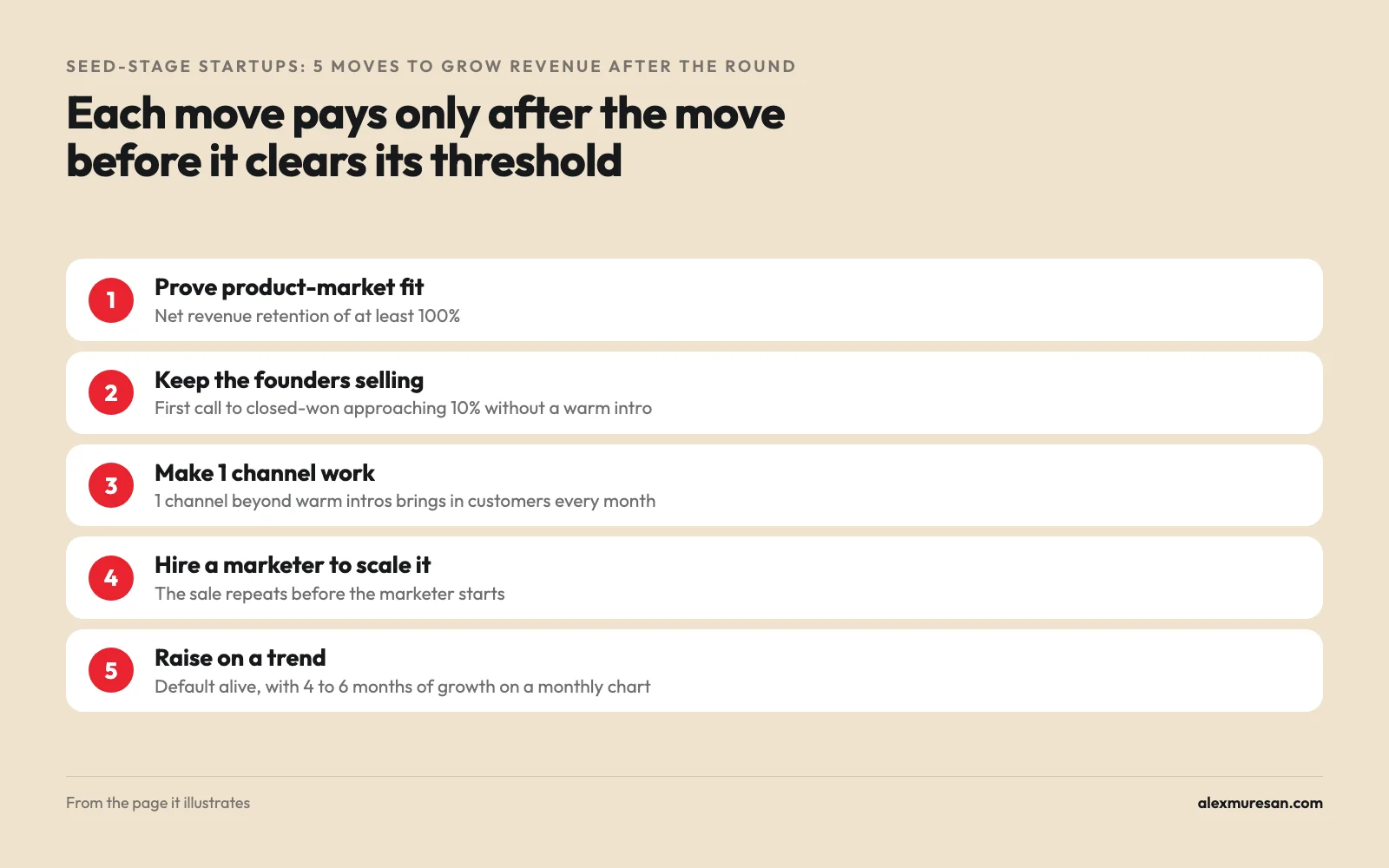
The order is the advice: A seed-stage startup should prove product-market fit, keep the founders selling, make 1 channel work, hire to scale it, then raise.
Fit shows up in usage: Clay kept hearing "Wow, this is so powerful!" from users who often didn't come back the next day, until it committed to 1 buyer.
Founders sell first: Merge's founders ran every sales conversation for 8 months, then raised a $15 million Series A a year after the seed.
1 channel, pushed hard: Zapier built a landing page for every pair of apps people wanted to connect, on a $1.3M seed it treated as its last round.
The Series A bar is a trend: Show 4 to 6 months of growth on a monthly chart, on a company that's default alive.

The 5 moves at a glance
Read the threshold column first. The first threshold you fail is the move you're on, whatever month of runway you're in.
| Move | The threshold you can fail | Who did it | The mistake to avoid |
|---|---|---|---|
| 1. Prove product-market fit | Net revenue retention of at least 100% | Clay, once it sold to 1 buyer | Counting demo excitement as fit |
| 2. Keep the founders selling | First call to closed-won approaching 10% without a warm intro | Merge, whose founders ran every deal for 8 months | A senior sales exec before deals repeat |
| 3. Make 1 channel work | 1 channel beyond warm intros brings in customers every month | Zapier, with a page for every pair of apps | Copying a channel everyone has already copied |
| 4. Hire a marketer to scale it | The sale repeats before the marketer starts | Vanta, 600 customers before a marketing team | A VP hired to find the channel for you |
| 5. Raise on a trend | Default alive, with 4 to 6 months of growth on a monthly chart | Looker, Series A a year after its seed | Letting the runway pick the raise date |
What is a seed-stage startup?
A seed-stage startup has raised its first institutional round and is spending it to find product-market fit and a repeatable way to sell before a Series A. First Round's Levels of PMF put seed companies anywhere from 3 customers and under $500K in ARR up to 25 customers and $5M.
The clock is short. YC's Series A benchmarks assume you raise 18 to 24 months after the seed. Carta's Peter Walker found that only 24% of US startups that raised a seed in 2022 had reached a Series A by November 2025, against a historical norm of about 50% (ouch).
This guide is part 2 of 5. Part 1 covers pre-seed and landing your first customers, and part 3 picks up at Series A.
How a seed-stage startup should spend the first 6 months
Most advice on what to do after seed funding starts with hiring, which is the expensive part to get wrong. Paul Graham called hiring too fast "by far the biggest killer" of startups that raise money. His test is whether you're default alive: with flat expenses and revenue growing at its recent rate, do you reach profitability on the money you have left?
So the first 6 months belong to moves 1 and 2. Hiring for scale waits, because you can't scale a sale you can't describe yet. The pressure to look busy peaks right after a raise (the announcement post is still collecting likes...), and headcount is the easiest way to look busy.
Move 1: Prove product-market fit with usage
The threshold: net revenue retention of at least 100%
The 40% survey from the pre-seed guide still works, but at seed your customers have paid you, so you have better evidence. First Round's bar at this level is net revenue retention of at least 100%, which means the customers you signed a year ago, as a group, pay you as much or more today.
Clay mistook excitement for fit
Clay raised its first round in 2017 and was still close to $0 in revenue in spring 2022. Kareem Amin says users got excited by what it could do, then often didn't come back the next day. Recruiters and salespeople pulled the product in different directions until Clay committed to outbound sales teams and sold the same product every time. By June 2024 it had more than 2,500 customers and a $46M Series B.
The mistake: counting excitement as fit
Excitement in a demo is free for the buyer and usage costs them time, so only usage tells you anything (the demo goes great... and nobody logs in on Tuesday). Sequoia's Arc model adds a second check. A product that meets "a clear, urgent need" calls for a great product and a great go-to-market push in quick succession, while a pain buyers have learned to live with needs the market educated first.
Move 2: Keep the founders selling until deals repeat
The threshold: close to 10% from first call to closed-won
First Round's benchmark is blunt: without a warm intro, your first call to closed-won rate is approaching 10%. A founder should be on those calls (yes, even if you hate selling), because only a founder can change the product or the pitch the same afternoon a prospect says no.
Merge's founders ran every deal for 8 months
Merge raised a $4.5 million seed led by NEA in August 2020. Shensi Ding and Gil Feig ran every sales conversation themselves for 8 months before hiring a head of sales. A year after the seed, Merge raised a $15 million Series A with 600 customers, and Ding credits founder-led selling with "a tighter feedback loop" on the product.
The mistake: a sales exec before the sale repeats
Martin Casado at a16z describes the pattern: a senior sales exec sets up Salesforce and a process built for scale before the company has closed a deal, then leaves ("and they almost always do"). His rule is to hire a head of sales once your reps consistently sell to similar buyers with similar use cases.
Meanwhile, write down every objection from every call. That doc becomes your first rep's onboarding and your first marketer's brief, because it holds the exact sentences that made a buyer lean in.
Move 3: Make 1 channel work before you add a second
The threshold: 1 channel that brings in customers every month
A seed-stage go-to-market plan with 6 channels usually funds none of them properly. First Round looks for early signs of a scalable channel that doesn't depend on warm intros. My version of the test: 1 channel brings in customers every month without you sourcing them by hand.
Zapier built a page for every pair of apps
Zapier raised a $1.3M seed in 2012 and treated it as the last round it would ever raise. When people searched for a way to connect 2 apps, Wade Foster says the results were "junk pages". So Zapier built a landing page for each pair, like Salesforce and Zendesk, and every new integration added pages. Foster says that engine let Zapier grow fast without spending much on sales and marketing, and it has been profitable since 2014.
The mistake: copying a channel everyone has already copied
Foster also says you couldn't replicate it today, because everyone has copied it. That's the trouble with running someone else's playbook. The part worth copying is the question Zapier asked: where are your buyers already searching, with nobody answering them well?
I sold a media company this year that grew to an 800K audience on organic alone, so I'm biased toward channels you don't rent. If you run paid at seed, write down a CAC ceiling first and treat it as a test. I also compared 9 inbound channels by what each costs in the first 90 days.
Move 4: Hire a marketer to scale what already works
The threshold: the sale repeats before the marketer starts
Arielle Jackson, First Round's marketing expert in residence, splits the timing by motion. If marketing drives your conversions, she says to bring on a marketer around the time you hit 10 people. If you sell enterprise software, get a repeatable sales model in place first, which usually lands around when you start looking for a sales leader to take over from the founder.
That's the timing for your first marketing hire. Maya Spivak, who ran marketing at Mux, warns against anyone too far from hands-on work, because they'll do the work themselves for at least a few quarters.
Vanta signed 600 customers before it had a marketing team
Vanta closed its seed by April 2018 and spent 3 years at that stage, with Christina Cacioppo running the sales calls herself. Its first 600 customers came through word of mouth, with no marketing team and a barebones homepage that showed a company email address (that's it). Vanta's first hires beyond engineering went to support and customer success, and it only invested in marketing after its $50 million Series A in May 2021.
The mistake: a VP hired to find the channel for you
A VP of marketing at seed has no team to run and no proven channel to scale, so the first quarter goes into a plan. If you need hands on a channel you already understand, an agency can be the right buy.
At my current startup I took revenue from $800K to $1.4M in my first 3 months, so I know this job from the hire's side. You're judged on a number within a quarter. That number moves fastest when the founders already know who buys and why.
Move 5: Raise the Series A on a trend you can chart
The threshold: default alive, with 4 to 6 months of trend
Janelle Tam, YC's Series A program manager, puts the trend ahead of the snapshot: growing 25% a month off $200K is a start, and sustaining it at $1M is what impresses. Investors want at least 4 to 6 months of it. Add Graham's default alive test and the bar is a monthly chart that climbs, on a company that would reach profitability without the next round.
AI companies get held to a steeper curve: Bessemer's State of AI 2025 describes "Shooting Stars" that reach about $3M in ARR in year 1 and $12M in year 2. I took an AI startup from $0 to $600K ARR in 5 months, and a curve like that still needs the monthly chart behind it.
Looker raised its Series A a year after its seed
Looker raised a $2 million seed from First Round and PivotNorth in August 2012, after waiting almost a year to be sure it was a venture business. By the end of Q1 2013 the 9-person team had $357K in ARR from 15 customers. After a $16M Series A in August 2013, Looker passed $1M in ARR by November with more than 40 customers.
The mistake: letting the runway pick the raise date
Carta found that the 75th percentile company moving from seed to Series A in Q4 2024 had waited more than 3 years. Plan the raise around the trend you can show, and cut burn early enough that a slow quarter can't force you to raise on 2 months of data. Vanta waited 3 years and raised at $10M in ARR while running at roughly cash flow breakeven, because money wasn't what was blocking its growth.
When the trend holds, the Series A guide picks up from there.
Hear how VCs got their companies through seed
Every guest in season one of Sell That S*it! is a VC, and we break down how a fund graduates a company from seed to Series A. Season one is filming now. The newsletter box at the end of this page is the other way to keep up, and it only goes out when there's something real to send.
FAQs about seed-stage startups
What are the top 5 things a seed-stage startup should do to grow revenue? Prove product-market fit through usage, keep the founders selling until deals repeat, make 1 channel beyond warm intros work, hire a marketer to scale it, then raise on 4 to 6 months of trend. The order matters, because each move pays once the move before it clears its number.
What should a startup do in the first 6 months after raising a seed round? Measure product-market fit and keep the founders on every sales call. Hold off on hiring for scale, because Paul Graham calls hiring too fast the biggest killer of startups that raise money.
How do seed-stage B2B startups find a repeatable go-to-market channel? Find the place your buyers already search with nobody answering them well, and build for it until it brings in customers every month. Zapier found it in integration searches that returned junk pages.
When should a seed-stage startup hire its first marketer? A sales-led B2B company should hire once the sales model repeats, around when it starts looking for a sales leader to take over from the founder. If marketing drives your conversions, First Round's Arielle Jackson puts it around 10 people.
How do you know you have product-market fit at seed stage? Customers use the product without a nudge, and net revenue retention sits at 100% or above, which is First Round's bar at this level. Deals also start closing without a warm intro.
How do seed-stage startups grow without a big marketing budget? Pick 1 organic channel where buyers already look and own it, the way Zapier did with integration pages on a $1.3M seed. Run paid only as a test with a written CAC ceiling.
About the author

Alex Muresan is a 4x founder with 2 exits. He built his first company, a physical entertainment center, to 60 employees and $2M in annual revenue in his early 20s. His second exit came in 2026, when he sold a media company. He took an AI startup from 0 to $600K ARR in 5 months, and at his current startup he took revenue from $800K to $1.4M ARR in his first 3 months. He also hosts Sell That S*it!, where every guest in season one is a VC.
Part of the stage playbooks: what to do for growth at pre-seed, seed, Series A, Series B and Series C. The glossary →