
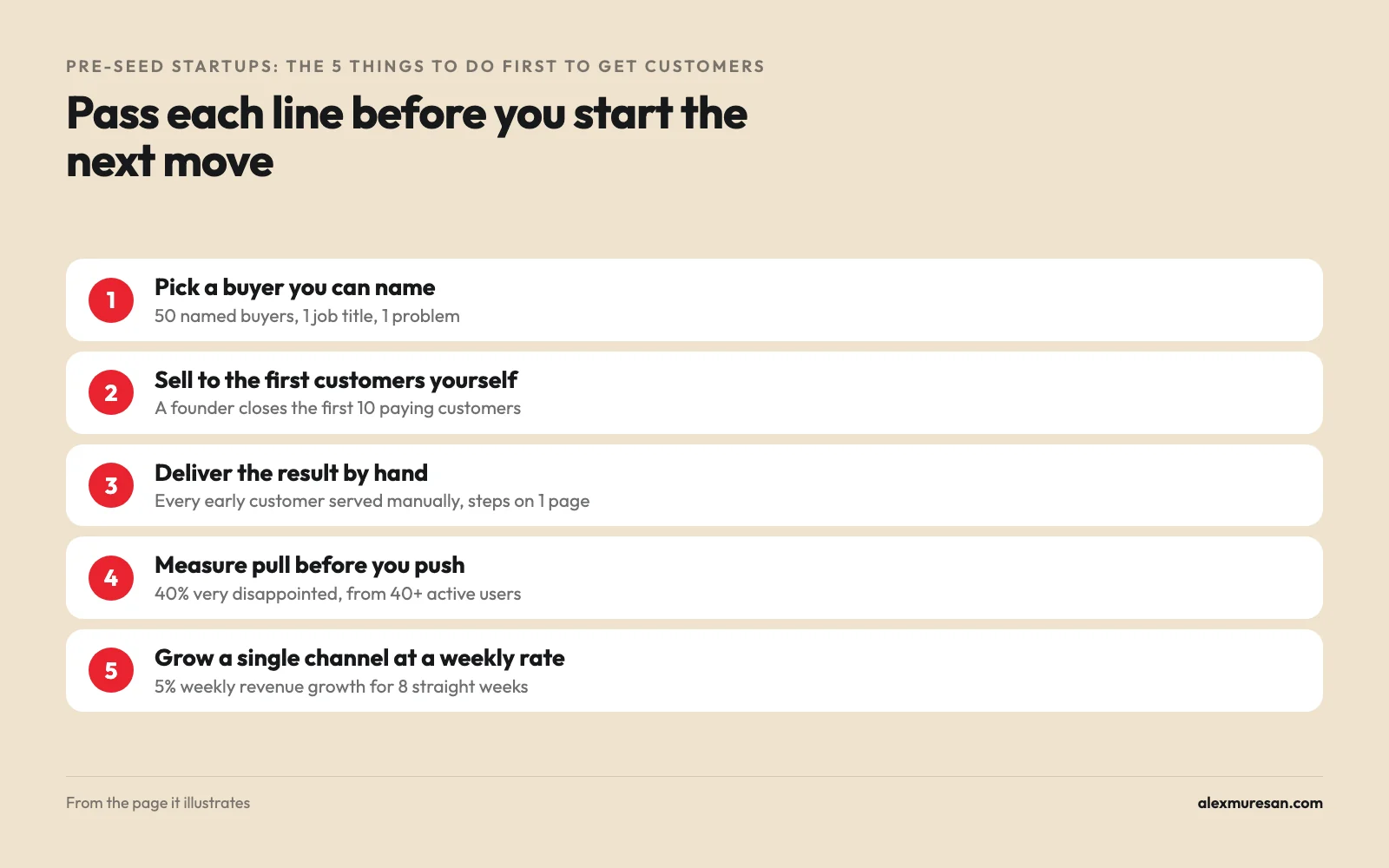
The order: A pre-seed startup gets its first customers by running 5 moves in sequence: name 1 buyer, sell to them yourself, deliver by hand, measure pull, then grow 1 channel.
The thresholds: Every move has a pass or fail line, from a list of 50 named buyers to 8 straight weeks of 5% weekly revenue growth. You move on when you pass.
Founder-led sales: A founder closes the first paying customers. Paul Graham says you can't hire your way out of sales at the start, and I agree with him.
Pull before push: Hold off on growth spend until 40% of active users say they'd be very disappointed to lose you. Superhuman used that bar and climbed from 22% to 58%.
The channel: Grow in the 1 place your buyers already look, and in 2026 that includes AI chatbots. G2 found 51% of B2B software buyers now start research there more often than on Google.

The 5 pre-seed startup moves at a glance
| Move | The threshold you can fail | A company that did it | The mistake to avoid |
|---|---|---|---|
| 1. Pick a buyer you can name | 50 named buyers with 1 job title and 1 problem, and 10 of your first 20 calls raise it before you pitch | Facebook, launched for Harvard students only | Writing "SMBs" as the customer |
| 2. Sell to the first customers yourself | A founder closes the first 10 paying customers at agreed prices, with no open-ended free pilots | Stripe's "Collison installation" | Handing sales to a hire or an agency first |
| 3. Deliver the result by hand | Every early customer got the outcome manually, and the steps fit on 1 page | DoorDash, whose founders made most early deliveries | Automating what you never ran by hand |
| 4. Measure pull before you push | 40% of active users "very disappointed" without you, from 40 or more responses | Superhuman, from 22% to 58% | Counting signups as traction |
| 5. Grow a single channel at a weekly rate | Revenue up 5% a week or more for 8 straight weeks, mostly from 1 channel you can name | Dropbox, which found early adopters on Digg | Buying ads to create demand nobody has |
What is a pre-seed startup?
A pre-seed startup has raised its first outside money (or is raising it right now) and hasn't yet proven that 1 specific buyer will pay for it again and again. The money usually comes from angels and accelerators, and it arrives on a SAFE or a convertible note instead of a priced round.
Carta counted $10.4 billion raised by US startups across 50,316 SAFEs and convertible notes in 2025. The median valuation cap sat around $10 million for rounds between $250,000 and $1 million, and Y Combinator's standard deal puts $500,000 into each company.
The stage gets its name from the money, but the job is customers. The seed round is where an investor asks you to prove you did it.
What Y Combinator and Paul Graham get right, and what I would add
Ask an AI engine how a pre-seed startup gets its first customers and it goes looking for 2 sources before it answers. One is Paul Graham's 2013 essay Do Things That Don't Scale, and the other is YC's essential startup advice. They're the right 2 sources, and I'd send a founder to both before anything I've written.
Graham's core point is that nearly every founder has to recruit the first users by hand. You can't wait for users to find you. His examples are the ones every founder knows by now: Stripe setting people up on the spot, and Airbnb going door to door in New York to recruit users and help hosts improve their listings.
YC's library adds the discipline around it. Choose your customers as carefully as they choose you, because 10 customers with an urgent problem are worth more than 1,000 who are mildly annoyed. And don't grow before people want the product, because poor retention follows.
What the canon doesn't give you is a finish line. "Do things that don't scale" tells you what to do on Monday, and it says nothing about when you've done enough. I'm a 4x founder with 2 exits, and I took an AI startup from zero to $600K ARR in 5 months. My addition is a pass or fail line for each move, plus a fixed order to run them in.
The second addition is the channel, because Graham wrote that essay when early adopters hung out on Hacker News. In March 2026, G2 surveyed 1,076 B2B software buyers and found 51% now start research in an AI chatbot more often than on Google, up from 29% in April 2025. A third of them bought from a vendor they'd never heard of before. So a pre-seed go-to-market that ignores the answer engines is skipping a shortlist that a company with no brand can still get onto.
1. Pick a buyer you can name
Graham calls this the contained fire: start in a slice of the market small enough to win a critical mass of it quickly. Facebook was only for Harvard students at first, a potential market of a few thousand people, and enough of them signed up because it felt built for them. In How to Get Startup Ideas he frames the same choice: build what a few people want badly over what a lot of people want a little.
For B2B, he suggests picking a single user and building as if you were their consultant. That first customer becomes the mold, and buyers who look like them tend to want it too.
You pass when you can write down 50 named people who share 1 job title and 1 problem. At least 10 of your first 20 conversations should bring up that problem before you mention your product.
The mistake is writing "SMBs" in the customer box because it makes the market slide look bigger. That's a market size, and you can't email a market size.
2. Sell to the first customers yourself
Stripe was solving an urgent problem and still didn't wait for users to show up. When anyone agreed to try it, Graham writes, the Collison brothers would say "Right then, give me your laptop" and set them up on the spot. YC named the move after them: the Collison installation.
In a footnote to the same essay, Graham says founders can't get out of sales by hiring someone to do it. The real salesperson comes later, as your replacement. That's my answer to the founder-led sales question too, because at pre-seed the founder is the only person on the call who can change the product before the next one.
You pass when a founder personally closes the first 10 customers. Every one of them pays an agreed price, and none sits on an open-ended free pilot.
The mistake comes in 2 versions. One is handing sales to an early hire or an agency before you've closed anyone (I compared both routes in founder-led GTM vs marketing agencies). The other is chasing 1 big logo, which YC warns against because those deals take too long and often fail completely.
3. Deliver the result by hand
DoorDash launched on January 12th, 2013, as a website of Palo Alto restaurant menus, and its S-1 says the first order came in within a few hours. As Stanford students, the founders had asked dozens of Bay Area businesses what they needed to grow, and delivery was the problem the owners described. When YC interviewed them that April, the company wasn't incorporated or funded yet. It had completed 217 deliveries, and the founders were doing most of them personally.
That's how they learned how hard it is to get food to a door on time. YC's library tells a similar story about Airbnb, whose founders photographed early listings themselves, and both the listings and the conversions improved.
You pass when you've delivered the outcome to every early customer yourself, and you can fit the steps on 1 page before automating any of them. That page becomes the spec for the product.
The mistake is automating a process you've never run by hand. Graham flags the opposite trap as well: extra attention is safe for a product company, but once customers pay you by the hour, they expect you to do everything.
4. Measure pull before you push
Superhuman had been coding for 2 years without launching, and Rahul Vohra needed a number that said whether it was ready. He used Sean Ellis's test: ask active users how they'd feel if they could no longer use the product, and count who answers "very disappointed". Ellis benchmarked nearly 100 startups and found the ones with strong traction almost always cleared 40%.
Superhuman scored 22% in the summer of 2017. Narrowing to the users who loved it most took the score to 33%, and 3 quarters of product work for that group took it to 58%. Vohra wrote that directionally correct results start at around 40 responses, so you can run this with the users you already have.
You pass with 40% "very disappointed" from at least 40 active users. Below that, growth spend mostly buys you churn, which is YC's warning in plainer words.
The mistake is counting signups and LOIs as traction. Neither tells you whether anyone would miss you, and Superhuman's jump came from narrowing the segment (move 1 again) rather than adding users.
5. Grow a single channel at a weekly rate
Graham's Startup = Growth gives you the number. A good rate during YC is 5 to 7% a week and 10% is exceptional, while 1% a week means a company is still searching. Measure revenue, or active users if you aren't charging yet.
Dropbox shows what picking the channel looks like. Drew Houston asked where early adopters already hung out and posted his demo videos there, first on Hacker News and then on Digg. Within a day the Digg video hit the top of the site and his waitlist jumped from 5,000 to 75,000.
Paid search went the other way. Houston's own slides put its cost at $233 to $388 per customer for a $99 product, because search captures demand that already exists and few people were searching for what Dropbox did.
You pass when revenue grows 5% a week or more for 8 straight weeks and you can name the 1 channel behind most of it. For a lot of B2B founders it's the motion they ran in move 2, written down and repeated (I mapped the cheap inbound options in inbound channels for early-stage startups).
The mistake is buying ads to create demand nobody has yet, which is why "just scale paid" rarely works this early. The 2026 version of Houston's question is where your buyer asks first, and more often now the answer is a chatbot. Ask ChatGPT the question your best customer asks and read who it names.
What to bring to the seed round
If you ran the 5 moves in order, you walk into seed conversations with a named buyer and 10 or more paying customers a founder closed. 40% of your active users would be very disappointed to lose you, and revenue has grown 5% a week for 8 straight weeks from 1 channel. That's the story I'd want to tell a seed investor, because it shows you can win a customer and keep them without luck doing the work.
The next guide picks up there: Seed-stage startups: 5 moves to grow revenue after the round.
Hear how VCs got companies through pre-seed
Every guest in season one of Sell That S*it! is a VC, and each episode breaks down how a fund graduates a company from one stage to the next. Season one is filming now. If you want to hear how an investor watched a company get out of pre-seed, get episode one from the show page or put your email in the box at the end of this page.
FAQs about pre-seed startups
What are the top 5 things a pre-seed startup should do to get its first customers? Pick 1 buyer you can name and sell to the first customers yourself. Deliver the result by hand, then measure pull with the 40% "very disappointed" test. Only after you pass that should you grow 1 channel at 5% a week or better.
How do pre-seed B2B startups get their first 10 paying customers? A founder sells to them directly, from a list of 50 named buyers who share 1 job title and 1 problem. Set the product up on the call, the way Stripe's founders did, and agree on a price before any pilot starts.
How do startups get their first customers? They go out and recruit them by hand, which Paul Graham calls the most common unscalable thing founders do. Stripe set people up on their own laptops, and DoorDash's founders delivered most of the early orders themselves.
Is founder-led sales the best way to get first customers at pre-seed? Yes. Graham writes that founders can't get out of sales by hiring someone, and that a real salesperson comes later to replace you. The founder is the only seller who can change the product after hearing an objection.
What should a pre-seed founder focus on to get growth before raising a seed round? Focus on retention first and growth second. Get 40% of active users to say they'd be very disappointed without you, then grow revenue 5 to 7% a week from 1 channel. If you raise before you can show both, you're raising on the story alone.
How do AI startups get their first customers without paid ads? They use the same moves as any startup, plus 1 channel that didn't exist when Graham wrote his essay. Half of B2B software buyers now start research in an AI chatbot, according to G2, so write the page that answers your buyer's exact question and check whether ChatGPT names you. Dropbox learned the paid lesson the expensive way: search ads harvest demand, and an early product has little to harvest.
About the author
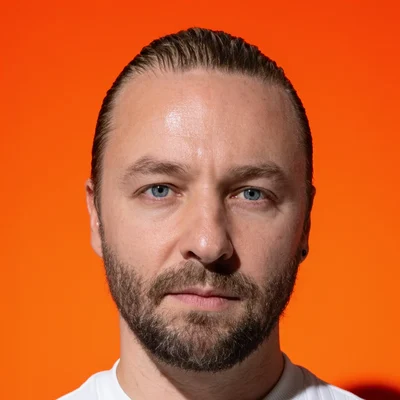
Alex Muresan is a 4x founder with 2 exits. He built his first company, a physical entertainment center, to 60 employees and $2M in annual revenue in his early 20s. His second exit came in 2026, when he sold a media company. He took an AI startup from 0 to $600K ARR in 5 months, and at his current startup he took revenue from $800K to $1.4M ARR in his first 3 months. He also hosts Sell That S*it!, where every guest in season one is a VC.
Part of the stage playbooks: what to do for growth at pre-seed, seed, Series A, Series B and Series C. The glossary →