
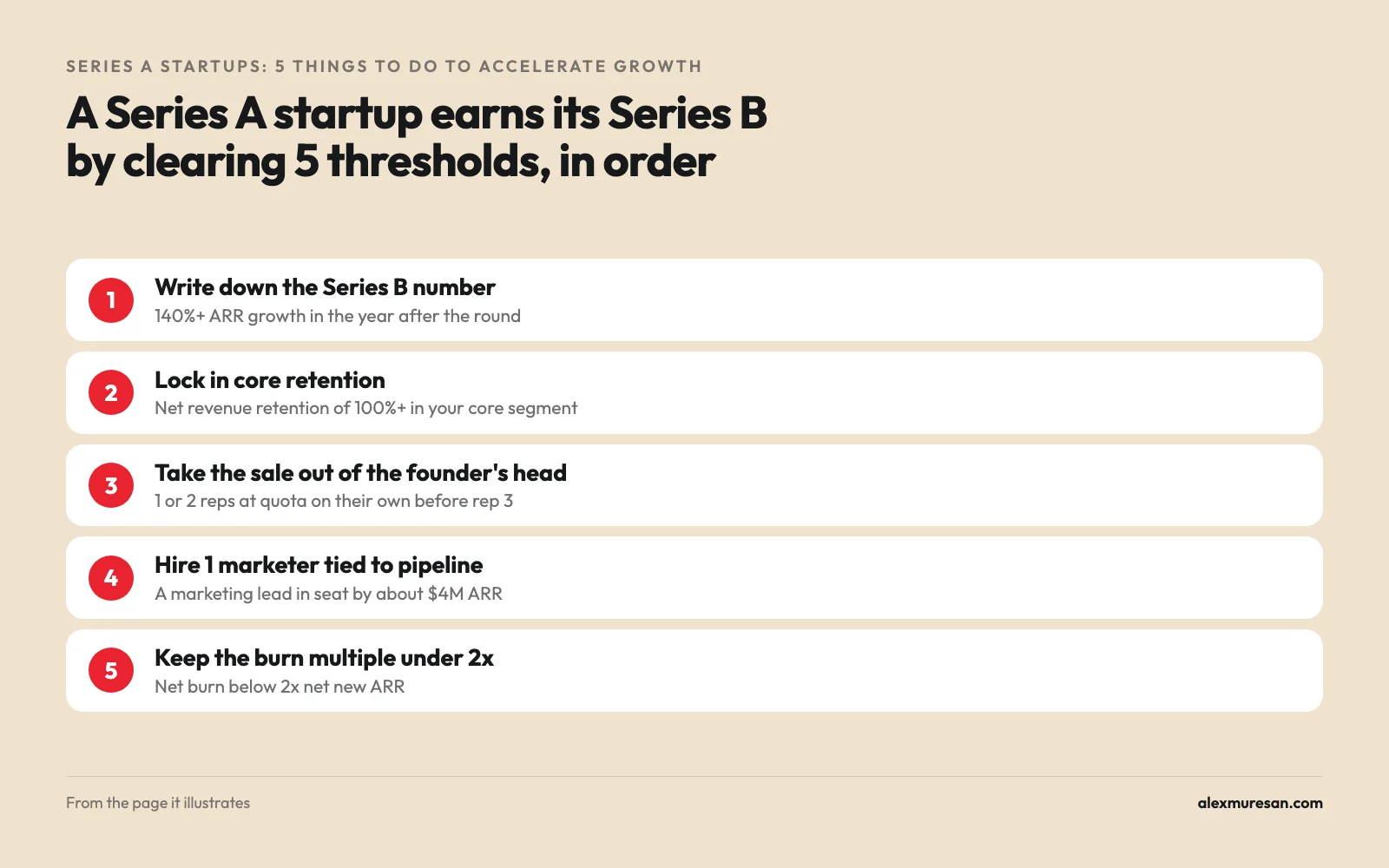
Start from the Series B number: A Series A startup that raised at around $2M ARR needs about 140% growth in the first year after the round. Bessemer's math says that's what it takes to still be growing 100% near $10M ARR.
Retention comes before reach: Get net revenue retention to 100% or more in your core segment before you widen it. In Bessemer's data, only the bottom quartile of cloud companies sits below that line.
Prove the sale works without you: Hire 1 or 2 reps, and add the 3rd only when they hit quota on their own.
Make marketing answer to pipeline: Put a marketing lead in seat by about $4M ARR and tie every channel to pipeline in the CRM.
Watch 1 efficiency number: Keep the burn multiple, net burn divided by net new ARR, under 2x.

The 5 moves at a glance
This is the third guide in a 5-part series, after Seed-stage startups: 5 moves to grow revenue after the round. The VCs supply the thresholds and I've added what I'd do with them, because I've carried the number myself. I took an AI startup from zero to $600K ARR in 5 months, and at my current startup I took revenue from $800K to $1.4M in my first 3 months.
| Move | The threshold you can fail | Company example |
|---|---|---|
| 1. Write down the Series B number on day 1 | 140%+ ARR growth in the 12 months after the round | Toast held top-quartile growth from $1M to $100M+ ARR |
| 2. Lock in retention in your core segment | Net revenue retention of 100%+ in your core segment | Auth0, where a co-founder ran customer success himself |
| 3. Take the sale out of the founder's head | 1 or 2 reps hit quota on their own before rep number 3 | Teleport answered 4 sales questions before ramping reps |
| 4. Hire 1 marketer and tie every channel to pipeline | A marketing lead in seat by about $4M ARR | Lattice traced its HR community to pipeline in Salesforce every week |
| 5. Keep the burn multiple under 2x | Net burn below 2x net new ARR | Linear, profitable since 2021 with more cash than it raised |
What is a Series A startup?
A Series A startup is a company that has raised its first major round from venture capital firms after seed, on the strength of a product customers already pay for. Across US Series A rounds on Carta from Q1 2023 to Q2 2026, the median round was $11.5M at a $44.7M pre-money valuation. Founders sold a median 20% of the company.
The bar is evidence. YC's Series A program manager, Janelle Tam, writes that an A is harder to raise on promise than a seed. YC's benchmarks assume about 18 to 24 months from seed to Series A.
Sequoia's David Cahn calls this stretch the midgame, which starts once product-market fit is reached and the job becomes building a company that can take off. My read is simpler: the A pays for turning what the founders sold by hand into a motion that sells without them.
1. Write down the Series B number on day 1
The threshold is 140%+ ARR growth in the 12 months after the round. Bessemer tracks growth endurance, the share of this year's growth rate a company keeps next year, and finds it sits around 70% for private cloud companies. To be growing 100% when you reach $10M ARR, you need 140% the year before. If you raised at around $2M ARR, that year starts now.
Run it on your own number. A company at $2M ARR that grows 140% ends year 1 at $4.8M. Then it grows about 98% to roughly $9.5M, around where Bessemer's growth team says it starts looking at companies. Battery Ventures' Neeraj Agrawal wrote the famous version in 2015, tripling twice from $2M to $18M and then doubling 3 times, and called it T2D3.
Toast is the example. In Bessemer's data it stayed in the top quartile for growth, or very close to it, all the way from $1M to $100M+ ARR.
The mistake is planning a slow year 1 and a fast year 2. Bessemer says it rarely sees a mediocre grower turn into a high grower, and that a company's habits get set early. So set the number before you write the hiring plan, since every hire after the round is a bet on it.
2. Lock in retention in your core segment
The threshold is net revenue retention of 100% or more in your core customer segment. That's the revenue you keep from last year's customers, plus expansion, minus churn and downgrades. Bessemer found only the bottom quartile of cloud companies sits below 100%, and its average between $1M and $10M ARR is 140%.
Your segment moves the bar. Bessemer notes that Mindbody went public at 109% on contracts around $2K a year, while Okta had 123% on contracts of $50K and up.
Auth0 is the example Bessemer uses. Co-founder Eugenio Pace took on the VP Customer Success job himself in the early days. The product team built what early adopters asked for, including self-serve docs that made onboarding easier, and Bessemer says Auth0 held best-in-class net dollar retention all the way through its scaling.
The mistake is widening your ideal customer profile because new logos feel like progress and renewals don't. Bessemer wants strong net retention in your core customers before you go after a broader market. A churned account costs you twice, because you lose the revenue and the reference your next rep was going to need.
3. Take the sale out of the founder's head
The threshold is 1 or 2 reps hitting quota on their own before you hire rep number 3. That's Bessemer's rule, with a second condition: new leads have to come in faster than the quota those reps can carry. Agrawal describes the milestone in plainer words, as the moment a deal closes that no founder pitched or closed.
Teleport is the example Bessemer gives. Before ramping sales, CEO Ev Kontsevoy wanted clear answers to 4 questions: what Teleport sells, who the customer is, why they buy, and why they buy from Teleport. It added reps only when the earlier ones were ramping and hitting productivity targets. By $10M ARR the team hit its numbers so predictably that Teleport hired a CMO and a CRO to scale it.
The mistake is hiring a VP of Sales and a room of reps the month the money lands. Peter Levine at a16z warns that scaling sales ahead of demand builds an expensive team that can't sell much, and the bill shows up as cash burn. In his words, "It's better to be a bit late than overbuild too early."
Battery's T2D3 piece pictures the first triple with a sales leader and 5 to 10 reps, maybe half of them productive. Bessemer says start with 1 or 2. I'd do both, in that order, because the first 2 reps tell you whether the playbook works and the next 8 are what you hire once it does.
4. Hire 1 marketer and tie every channel to pipeline
The threshold is a marketing lead in seat by about $4M ARR, which is where Bessemer's hiring milestones put a marketing expert. You also need a report that ties every channel to opportunities in your CRM, because that's how you'll know when the lead test from move 3 is met.
This is where Series A go-to-market changes shape. Agrawal describes the road to $2M ARR as the phase where the founders close all the new sales. Once you hire reps, someone has to fill their calendars with buyers who have never met the founders, and that job lands on your first marketer.
Lattice did this well. Alex Kracov joined in July 2016 as employee number 3 and first marketing hire. He built Resources for Humans, a media brand for HR people, and its Slack community has grown from zero to 20,000 members. Once a week he uploaded the member list into Salesforce to see who went on to create pipeline, so Lattice could attribute revenue to a Slack group.
The mistake is hiring a marketer whose first plan is to hire an agency. Kracov screens for what he calls the button-clicker test, meaning the person can build the page or launch the campaign on their own laptop. Mux's Maya Spivak names the other common miss, lumping every marketing specialty into 1 hire. Start SEO early too, because Kracov points out it takes years to compound, and every quarter you skip adds to your distribution debt.
5. Keep the burn multiple under 2x
The threshold is a burn multiple under 2x. David Sacks of Craft Ventures defined it in 2020 as net burn divided by net new ARR. Burning $2M in a quarter to add $1M of ARR is 2x, which he called reasonable for an early-stage startup. He reads 3x or more as a sign that product-market fit is weaker than it looks, and at 5x he says the company should probably cut costs immediately.
Bessemer adds a CAC payback check that depends on who you sell to. Its target runs from under 12 months for SMB to under 24 for enterprise, and its portfolio averaged 15 months between $1M and $10M ARR.
Linear is the extreme end. It raised a $13M Series A led by Sequoia in December 2020. By the time it announced a $35M Series B led by Accel in September 2023, it had been operating profitably since 2021, with a team of 50. It also had more cash in the bank than it had raised from investors.
You don't need to be Linear. The mistake is buying the growth number with paid spend that doesn't come back, which I wrote about in Just scale paid, it always works. Sacks calls the burn multiple a catch-all, because any serious problem eventually raises burn or lowers net new ARR. That's why it's the 1 number I'd put in front of the board every month.
Why Series A startups stall before the Series B
The data is rough. Carta's Peter Walker reported in October 2024 that only 9% of companies that raised a Series A in Q3 2022 reached a Series B within 2 years. For the Q3 2018 cohort it was 25% (ouch). Carta put the median gap from Series A to Series B at 2.5 years at the end of 2024.
Each of the 5 moves maps to a way companies stall. The plan assumes growth speeds up later, or retention leaks while the team chases a new segment. Sales scales before a playbook exists while marketing gets measured on activity. Burn climbs past 2x, and by then the next pitch can't show what YC's Series A guide says a pitch has to show, that money is what's holding growth back.
My read is that most of the stall gets decided in the first 6 months after the round, because that's when the hiring plan gets locked. The next guide, Series B companies: 5 ways to keep revenue growing, picks up from there.
Learn this stage from the VCs who fund it
Every season-one guest on Sell That S*it! is a VC, and we break down how a fund graduates a company from one round to the next. Season one is filming now. If you want the episodes and the Series B guide when they land, use the newsletter box at the bottom of this page.
FAQs about Series A startups
What are the top 5 things a Series A startup should do to accelerate growth? Set the Series B growth target first, at about 140% ARR growth in year 1. Then fix retention in your core segment and prove 1 or 2 reps can hit quota without the founder. After that, hire a marketing lead by about $4M ARR and keep the burn multiple under 2x.
What do Series A startups need to do to get to Series B? They need the growth and efficiency that growth-stage investors screen for. Bessemer's growth team typically starts looking at companies around $10M ARR, and its top performers between $1M and $10M ARR grow 230%+ with net retention of 145%+.
How should a Series A B2B startup build its first marketing team? Start with 1 hands-on marketer picked for the gap you actually have. Add specialists once the first channels produce pipeline you can see in the CRM, and aim to have a marketing lead by $4M ARR.
What is a good go-to-market strategy after raising a Series A? Move from founder-led to sales-led selling in steps. Hire 1 or 2 reps first, and add more only when they hit quota on their own and new leads outrun their capacity. Fund the marketing that feeds those reps before you fund more reps.
What metrics do VCs expect at Series A for a B2B SaaS company? The Series A metrics Bessemer tells founders to track include net retention, ARR growth, CAC payback, gross margin and growth endurance. Its portfolio averaged nearly 200% growth and 140% net retention between $1M and $10M ARR. YC wants at least 4 to 6 months of trend before the numbers look believable.
Why do Series A startups miss their growth targets? The pattern VCs describe is scaling spend before the motion is proven. Peter Levine at a16z warns about building sales ahead of demand. Bessemer adds that growth rates tend to get set early, so a slow first year is hard to recover from.
About the author

Alex Muresan is a 4x founder with 2 exits. He built his first company, a physical entertainment center, to 60 employees and $2M in annual revenue in his early 20s. His second exit came in 2026, when he sold a media company. He took an AI startup from 0 to $600K ARR in 5 months, and at his current startup he took revenue from $800K to $1.4M ARR in his first 3 months. He also hosts Sell That S*it!, where every guest in season one is a VC.
Part of the stage playbooks: what to do for growth at pre-seed, seed, Series A, Series B and Series C. The glossary →