
What it is: Startup inbound marketing channels are compounding, organic distribution assets (owned lists, shows, sites, communities and product loops) that pull demand toward you without renting attention from ad networks.
Why it matters: Buyers now ask a model before they ask a vendor. G2 found that 69% of B2B buyers chose a different vendor than they originally planned because of what an AI chatbot recommended.
Who it's for: Early-stage founders with a good product, a thin network, rising CAC and no presence in the answers their category generates.
What to do first: Audit where your category is discussed and where you are missing from the answer. That citation gap, not your feature list, is what is costing you deals.
Bottom line: Rented attention resets the day you stop paying. Organic and owned compounds. CAC is a creativity problem before it is a budget problem.

Startup Inbound Marketing Channels: At a Glance
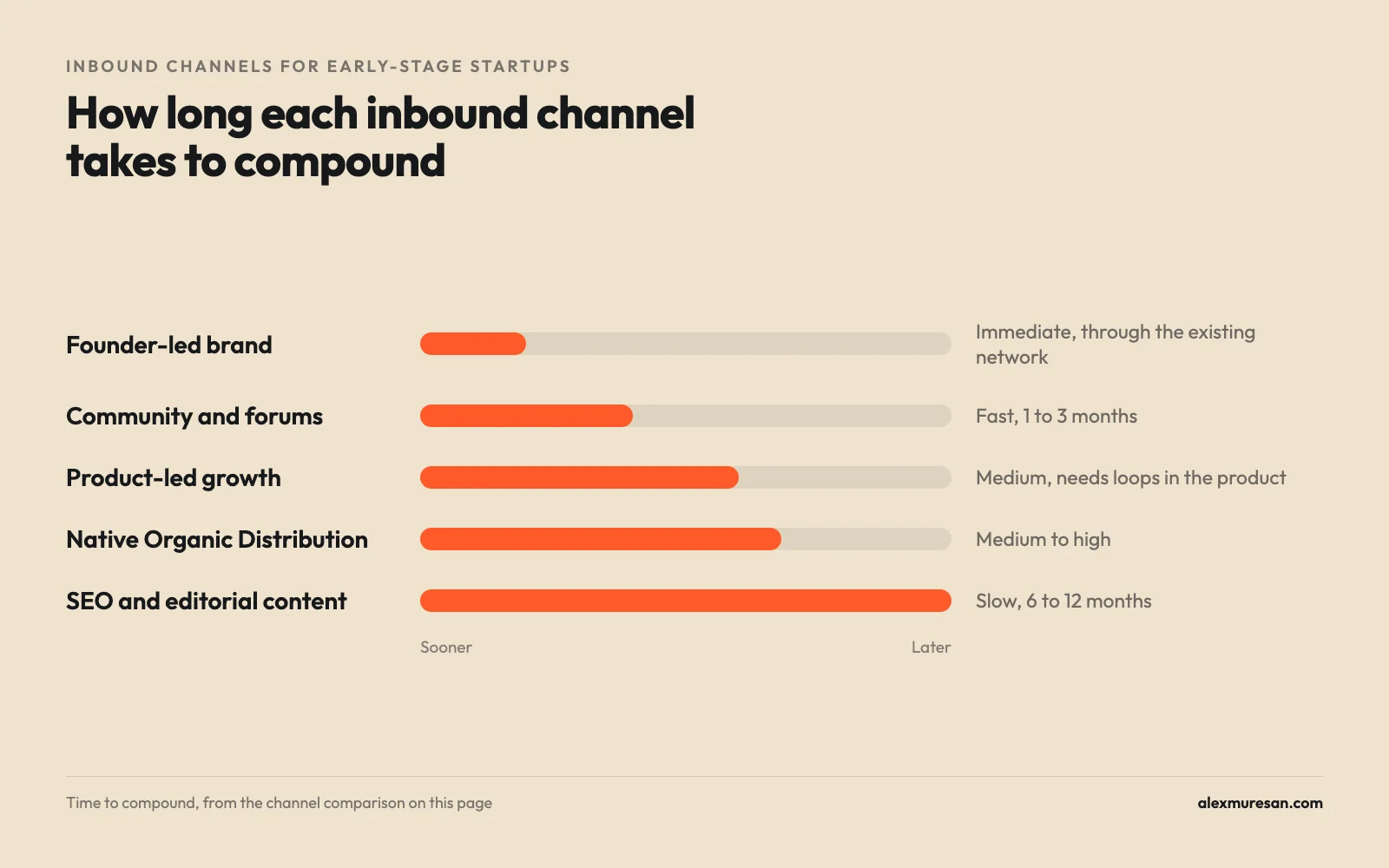
Read this table as a set of trade-offs, not a ranking. The cost column is what I tell founders to budget in the first 90 days, in cash and in hours, because time is the real currency at this stage.
| Inbound channel | Time to compound | Owned asset you keep | AI engine visibility | Cost to run (first 90 days) | Where it wins / where it breaks |
|---|---|---|---|---|---|
| Native Organic Distribution | Medium to high | Proprietary frameworks, direct lists, channel-native formats | High: built to be quoted and cited in model answers | No media spend. Budget 6-10 founder hours a week; consulting is quoted per engagement | Wins because it compounds across every surface at once. Breaks if the founder has no point of view to distribute yet |
| SEO and editorial content | Slow, 6-12 months | Search-optimised articles and resource hubs | Moderate: depends on being cited by domains engines already trust | Near-zero ad spend. Writer and editor time, plus a rank tracker | Wins on durable, high-intent demand. Breaks when the page is generic: 96.55% of pages get zero Google traffic |
| Community and forums | Fast, 1-3 months | Relationships, reputation, a searchable public record | High: engines lean on community platforms for consensus | Free to join. 3-5 founder hours a week, spent in public | Wins for first customers and raw signal. Breaks the moment you post like a vendor instead of a peer |
| Product-led growth | Medium, needs loops in the product | Viral loops, free tier, product-qualified leads | Low to moderate: loops move users, not public text | Engineering time plus free-tier infrastructure | Wins when sharing is the product. Breaks at onboarding: median free-to-paid conversion is 8% |
| Founder-led brand | Immediate through the existing network | A personal audience and a public track record | Moderate: tied to the founder's own digital footprint | Zero cash. 2-4 hours a week of the founder's attention | Wins on trust nobody can buy. Breaks when it stays personal and never transfers to the company |
What Are Inbound Channels for Early-Stage Startups?
Startup inbound marketing channels are the organic routes through which buyers and AI engines find you without being paid to. A paid click is a rental. An owned list, a show, a live community thread and an indexed page are assets you still hold next quarter, which is why I build go-to-market around them instead of around media budgets.
The distinction that matters is not free versus paid. It is whether the channel accumulates. Ads deliver a flat line that resets to zero the day the card is declined. Owned distribution starts slower and then carries its own weight, which is the whole mechanism behind native organic distribution.
The Shift From Rented Attention to Compounding Assets
Most early-stage teams inherit a media plan, not a distribution strategy. They buy reach, measure cost per lead, and never ask what they own at the end of the quarter.
The honest test is simple. If you stopped spending on Monday, what would still bring you a buyer on Friday? A list, a show, a community reputation and a cited page all pass. A campaign does not.
Why AI Search Is Redefining Inbound Distribution
The click is dying as the unit of discovery. Buyers now ask a model for a shortlist, and the model returns three names synthesised from what it has read about the category. If you are not in that synthesis, you never get the chance to be compared.
That is the citation gap: your product is good, the category conversation exists, and your name is absent from it. Closing it is an editorial and distribution problem, not a bidding one.
Why Owned Inbound Distribution Matters in the AI Era
Here is the number that should reorganise your quarter. G2's research into AI-assisted buying found that 69% of buyers chose a different vendor than they originally planned because of what a chatbot recommended, and one in three bought from a vendor they had never heard of before the model surfaced it. The shortlist is now formed before anyone visits your site.
That cuts both ways, which is the part founders miss. The same mechanism that removes an incumbent from a shortlist can insert an unknown startup into one. Share of model is the cheapest asymmetry available to a small team right now.
- The death of the click: Answers are consumed in the interface. Traffic becomes a lagging indicator, and being named becomes the leading one.
- Flat pipelines from rented attention: Ad spend buys this month's pipeline and none of next year's. The asset you built is a receipt.
- The content slop penalty: Publishing generic articles to look active adds noise to a web where 96.55% of pages already get no organic search traffic. Volume is not distribution.
How Compounding Inbound Distribution Works
Inbound is not a set of tactics you rotate until one hits. It is a three-stage mechanism, and the stages are sequential. Skip one and the other two stop paying.
1. Asset creation. You produce a small number of high-signal, opinionated assets on surfaces you control. 2. Engine ingestion. Models and crawlers read those assets and map your brand to a specific problem in a specific category.
3. Buyer redirection. When a buyer asks the category question, your name is in the answer, and the shortlist forms around you instead of around the incumbent. That is the whole payoff, and it arrives all at once rather than gradually.
Stage 1: Build Assets You Actually Own
Lists, shows and sites. That is the short list of things worth building first, because each one lowers the cost of the next launch. A show forces a weekly point of view; a list makes that point of view repeatable; a site makes it indexable.
The failure mode is treating the audience as the outcome. An email list of 4,000 people who never buy is a hobby with a send button, which is why an owned audience is not automatically a growth engine. The asset has to be attached to a commercial motion.
Stage 2: Structure Assets So Engines Can Quote Them
Models quote claims, not vibes. Give them a named framework, a number with a source, a definition written in one sentence, and a comparison they can lift whole.
Different engines cite different things, and the fastest way to internalise that is to watch it happen rather than read about it. Answer Quest is a free game that walks through what Google, AI Overviews, Perplexity and ChatGPT each pull from.
Stage 3: Earn Third-Party Consensus
An engine will not take your word for your category position. It triangulates across places where other people discuss you, and community platforms carry disproportionate weight in that triangulation. Your brand has to be discussed by people who are not you.
That means being useful in threads where your buyers already argue about the problem, under your own name, before you have anything to link. Consensus is slow to build and very hard for a competitor to buy.
Key Considerations Before You Choose Startup Inbound Marketing Channels
Choosing wrong here does not slow you down, it quietly spends your runway. Four factors decide it, and none of them is "what worked for that Series B company in the case study."
1. Share of Model and AI Search Visibility
Ask five models the three questions your buyer would ask before purchase, and record who gets named. If your competitors appear and you do not, that gap is your highest-leverage work, because the G2 finding above says the answer routinely overrides the buyer's original intent.
2. Founder-Medium Fit
Startups fail at inbound because the founder picks a channel they privately hate and quits in week seven. A founder who talks well should not be writing 2,000-word essays, and a founder who writes well should not be forced onto camera.
Match the medium to the native strength, then reduce friction until consistency is boring. If short-form video is the fit but editing is the blocker, tooling solves it: YapCut turns raw phone clips into finished vertical video and drafts weekly scripts from your niche.
3. Where Your Buyers Actually Congregate
In Growth Unhinged's State of B2B GTM report, surveyed growth leaders rated founder-led channels (LinkedIn, direct messages to warm contacts, and the founder's personal brand) as the three most effective channels for early-stage companies. That is a strong signal, but it is not your signal.
Verify density before you commit. A niche forum with 900 active engineers beats a 90,000-member subreddit where nobody has your problem.
4. Runway Against Compounding Time
Match the channel's maturity curve to your cash. SEO paying out in month nine is useless if you are out of money in month six, and an analysis of 479 Indie Hackers founder interviews found that SEO was the most-mentioned acquisition channel but was almost always adopted after traction came from somewhere else.
Run one fast channel and one compounding channel in parallel. Lenny Rachitsky's review of how the biggest consumer apps got their first 1,000 users found that no company used more than three strategies. Two is usually the right number at pre-seed.
Common Mistakes With Startup Inbound Marketing Channels
Most founders treat distribution as something that happens after the product is ready. By then the runway is half gone and the only lever left is spend. These are the errors that cost the most, and each one has a cheaper alternative sitting next to it.
- The SEO trap. Publishing generic "what is" pages to chase volume, on a web where the vast majority of pages never see a single organic visit. The fix is fewer pages with an actual position, structured so an engine can quote them and a human can disagree with them.
- The paid ad illusion. Buying instant data with capital you cannot replace. The spend teaches you a cost per click and leaves you owning nothing. The alternative is putting the same money and time into a list, a show or a site that still works in month eighteen.
- The content slop reflex. Generating fifty automated articles to look active. It costs trust with buyers, and it gives engines nothing distinctive to cite, which widens the citation gap you were trying to close.
Run the arithmetic on the second one, because it is the most expensive. A seed-stage team putting £4,000 a month into ads for six months has spent £24,000 and owns a spreadsheet of past clicks. The same six months spent publishing one substantial asset a week produces roughly 26 pages, threads or episodes that keep working in year two, and every one of them is a surface an engine can read.
The quieter fourth mistake is ignoring distribution you already own. Most companies sit on a support inbox, a changelog, a sales call archive and a founder profile with real reach, all dormant. That is the channel rotting inside your company, and activating it costs a week of attention rather than a quarter of budget.
One more pattern worth naming: chasing the launch instead of the loop. A launch day is a spike with no memory, while a weekly asset is a slope. Founders who optimise for the spike end up repeating it every quarter at rising cost, which is the exact shape of rented attention wearing an organic costume.
How to Get Started With Startup Inbound Marketing Channels
You do not need a strategy deck. You need three moves executed in order, before a single dollar goes to ads.
Step 01: Audit Your Strengths and Commit to a Point of View
Spend one working day on it. List the three things you know that your market gets wrong, the medium you can sustain weekly without dread, and the specific buyer you can name. A point of view that nobody could disagree with is not a point of view, it is a description.
The trade-off is real: the sharper the position, the smaller the audience that agrees and the faster the ones who do become customers. Broad and inoffensive reaches more people and converts almost none of them.
Step 02: Ship an MVP Landing Page Built for Capture
The teams that get this right keep it small: two days, one engineer and one growth lead, one offer above the fold and one way to subscribe. Founders who instead wait for a full site redesign typically lose a month and gain nothing an engine or a buyer can use.
Instrumentation matters more than design here. Signups per week and their source, judged against the team's own baseline rather than a borrowed industry average, is enough to tell whether the offer is worth an email address. A checklist a buyer would pay for outperforms a newsletter about company news, because it trades value for the address instead of asking for credit.
Step 03: Claim the Distribution Nobody Is Using
Four hours is enough to claim and populate profiles on the two or three community platforms where your buyers actually post, plus the directories, marketplaces and listing surfaces that engines read as evidence. Most founders never do this, which is why free distribution goes unclaimed for years.
Then show up as a practitioner. Answer questions, publish the data you have, and let the product come up in context rather than in a pitch. The trade-off: this is founder time that cannot be delegated, and it takes six to eight weeks of consistent presence before anyone treats you as a regular rather than a vendor.
How Category Leaders Built Compounding Distribution Assets
The pattern in every durable early-stage story is the same: the distribution was built into the thing itself, not bolted on afterwards.
- Loom: the product is the channel. Loom is async video messaging where the output is a shareable link, so every message sent to a colleague or a customer also introduces the product to its recipient. The sharing is not a marketing campaign, it is the core action.
- Loom: accessible wherever the work happens. Recording across desktop, browser and mobile keeps the loop intact regardless of where the user is, which is what turns an occasional share into a habit.
- ProductLed MBA: methodology as an owned asset. It packages a structured, self-paced training approach for product and growth leaders, so the teaching itself becomes the distribution surface and the credibility engine.
- Consensus follows the asset. In both cases, other people end up explaining the product in public, which is exactly the third-party signal that AI engines read as agreement.
Positioning can be a distribution asset too, if it is unusual enough to be repeated. The 1.8B solo founder case is a study in how one unconventional number travels further than a year of tidy messaging.
Everything You Need to Know About Startup Inbound Marketing Channels
| Core question | The first-principles answer | Strategic reality and data |
|---|---|---|
| Why is traditional SEO failing early startups? | The click is no longer the unit of discovery. | G2 found 69% of buyers chose a different vendor than planned after an AI recommendation, so share of model now precedes any ranking. |
| What is the biggest mistake in early GTM? | Renting attention instead of building assets. | Ad budgets buy a flat pipeline that resets at zero. Lists, shows and sites keep producing after the spend stops. |
| Where do founders find their first customers? | In public, in the places their buyers already gather. | Growth leaders rated founder-led channels the top three for early-stage companies, ahead of anything automated. |
| How do we close the citation gap? | Publish quotable, sourced, opinionated assets, then get discussed. | Engines need third-party agreement. Slop is not citable, and most published pages are never seen. |
| How should we scale sustainably? | Treat CAC as a creativity problem. | Build loops and owned surfaces that lower acquisition cost with each cycle instead of re-buying reach every month. |
| How fast is fast? | Fast enough to matter, slower than an ad. | 20% of Stripe Atlas startups charged a first customer within 30 days of incorporating in 2025, almost all of it through founder-led, organic motion. |
Where to go from here
If you are spending on ads to make up for the fact that nobody names you, you are renting a fix for a problem you could own. The inbound channels above are the slow, compounding part of that fix, and they work best once you have closed your first customers by hand. If you have not yet, start with how to get your first 10 customers, then the pre-seed playbook.
Learn the motion from the VCs
You can also just watch how other operators do it. Sell That S*it! is a go-to-market show where each episode asks a VC how a company graduates from one stage to the next, anchored in a portfolio company that turned distribution into a moat.
FAQs About Startup Inbound Marketing Channels
What are startup inbound marketing channels? They are organic routes that bring qualified buyers to you: owned email lists, a show, community presence, search-optimised pages and product loops. The defining trait is ownership. A paid placement disappears when the invoice stops; a subscriber, a reputation in a forum and an indexed page do not. For early-stage startups these channels matter more than they do later, because they are the only ones that get cheaper as you scale rather than more expensive.
How much do startup inbound marketing channels cost to build? The cash cost is close to zero and the real cost is founder time, usually 5-10 hours a week for two quarters. Budget for a domain, an email tool and a rank or mention tracker; everything else is attention. The comparison worth running is against your current blended CAC: if paid acquisition costs you a fixed amount per customer forever, twenty founder hours a month that permanently lowers that number is the cheaper line item.
Are inbound channels right for an early-stage team? Yes, with one caveat: someone has to be visible in public, and it usually has to be a founder. Surveyed growth leaders put founder-led channels at the top for early-stage companies, and no outsourced writer can replicate a founder's specific knowledge. If nobody on the team will put their name to a point of view, inbound will underperform and you should fix that before you fund it.
How do I get started with inbound channels for startups? Define the position first, then pick two channels, one fast and one compounding. Claim the free distribution you are not using, publish one substantial asset a week for twelve weeks, and measure two things only: qualified conversations and mentions in model answers. Resist adding a third channel until the first two are boring and automatic.
Which inbound channel yields the fastest early traction? Community plus founder-led presence, every time. It needs no audience, no budget and no index, and it can produce a first customer in weeks. Launch surfaces are weaker than they look: in one analysis, the median Show HN post scores two points, and around half of Product Hunt founders in one survey of top-10 launches reported no increase in registrations at all. Relationships beat launches.
How do startups optimise inbound channels for AI search engines? Write things that are quotable and verifiable: one-sentence definitions, named frameworks, comparison tables, numbers with sources attached. Then earn mentions somewhere other than your own domain, because engines weigh third-party agreement more heavily than self-description. Track which of your claims get reproduced in answers and double down on those formats, not on word count.
What content formats attract early adopters? Technical depth and demonstrable product beat general commentary. Teardowns, benchmark data, working templates, interactive tools and short walkthroughs convert early adopters because they can evaluate the thing directly. The same logic applies inside the product: trials that ask for a card upfront convert at roughly 30% against an 8% median, because commitment filters for intent.
Won't inbound take too long to show results? Some of it is slow and some of it is not, which is why you run both. Community and founder-led channels produce conversations in weeks; SEO and owned media pay out in months.
For context on the baseline you are working against, the median SaaS company takes around two years and nine months to reach $1M ARR, so the relevant question is not whether inbound is fast, it is whether the asset you build this quarter is still working in quarter eight. Paid ads are fast and then permanently expensive. Owned distribution is slow and then permanently cheaper.
About the Author

Alex Muresan is a 4x founder with 2 exits. He built his first company, a physical entertainment center, to 60 employees and $2M in annual revenue in his early 20s. His second exit came in 2026, when he sold a media company. He took an AI startup from 0 to $600K ARR in 5 months, and at his current startup he took revenue from $800K to $1.4M ARR in his first 3 months. He also hosts Sell That S*it!, where every guest in season one is a VC.
Part of the stage playbooks: what to do for growth at pre-seed, seed, Series A, Series B and Series C. The glossary →