
Where they come from: Your first 10 customers come from people who already know you and from a cold list you build yourself, and only rarely from the launch. Retool had around 40 customers and around $2 million in ARR before it launched publicly in 2018.
Warm first, then cold: Use friends and your accelerator batch to get a broken first version working. Count a stranger's yes as your proof, because a warm intro tends to end in a vague maybe.
The list and the line: Retool's few hundred cold emails to FileMaker developers got about 3 replies. A list of the people who felt the problem, and a plainer first line, got a CTO to ask for a call within 15 minutes.
Founder-led sales: The founder sells the first 10, because only the founder can rewrite the pitch in an afternoon and ship the fix overnight. Every one of those 10 should pay a price you agreed on.
Over-serve them: Treat each customer like the last one you'll ever find, then ask them for the next name. At Retool, the CEO called within a minute of a customer hitting an error.

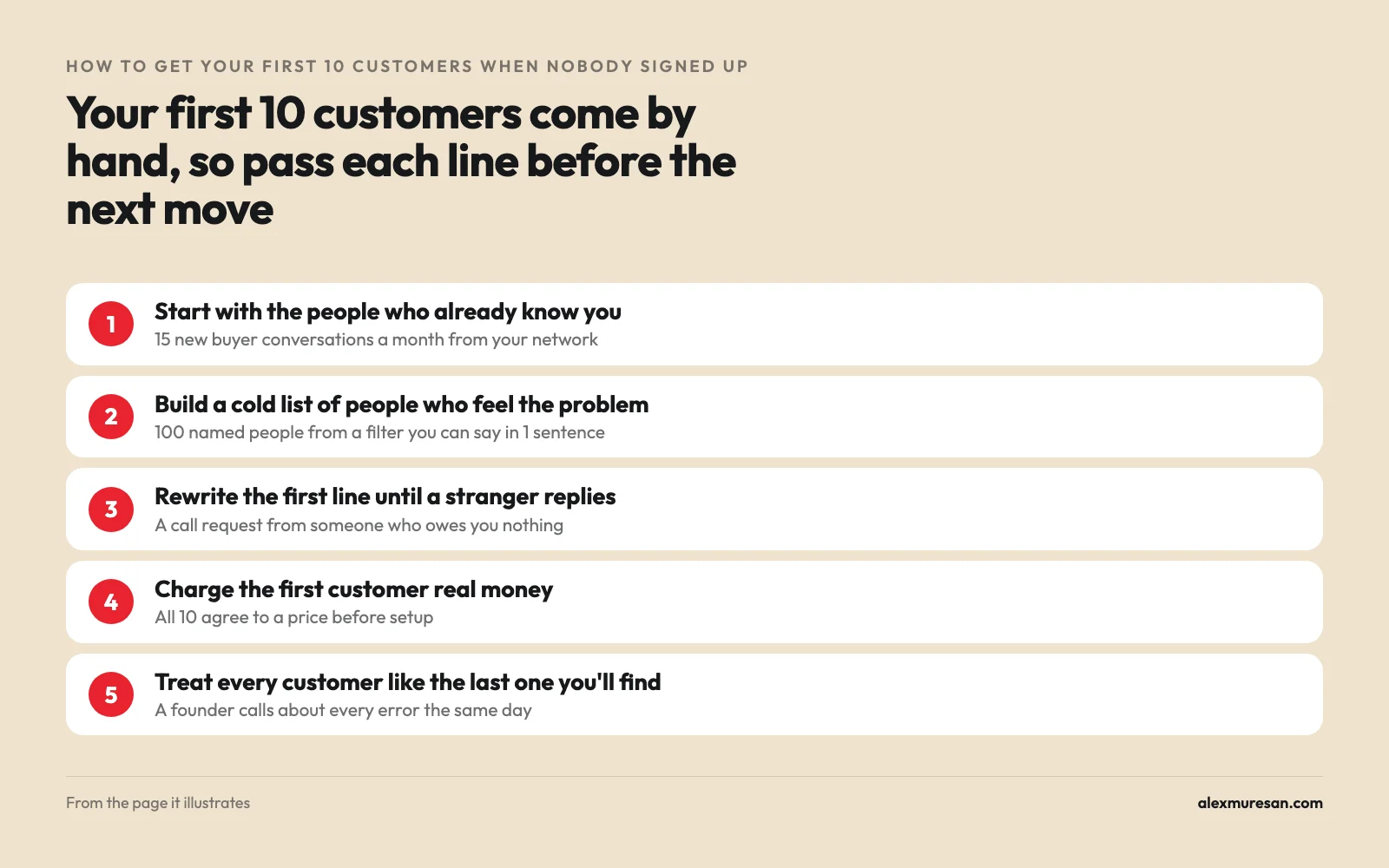
How to get your first 10 customers at a glance
| Move | Where the customers come from | The line you can fail | Who did it |
|---|---|---|---|
| 1. Start with the people who already know you | Former colleagues, your accelerator batch and your investors' contacts | 15 new conversations a month with buyers who match your customer | Retool, which tested its first version on its YC batch |
| 2. Build a cold list of people who feel the problem | A database filter you can say in 1 sentence | 100 named people from that filter, and a booked call from the first 100 emails | Retool's shared Crunchbase list, which found DoorDash, Rappi and Brex |
| 3. Rewrite the first line until a stranger replies | Your outreach, in your buyer's own words | A reply asking for a call from someone who owes you nothing | Retool, whose new line got Rappi's CTO back in 15 minutes |
| 4. Charge the first customer real money | Every customer, starting with number 1 | All 10 agree to a price before you set them up | Zip, whose first customer haggled with them over the price |
| 5. Treat every customer like the last one you'll find | Your happy customers and the people they know | A founder calls about every error the same day, and every happy customer gets asked for 1 name | Retool, where the CEO called a minute after an error |
The launch week nobody noticed
You know the week I mean. You shipped on Tuesday, you posted it on LinkedIn, and the group chat sent a row of fire emojis. By Thursday you're refreshing a signup dashboard that says 2 (and you're fairly sure both of them are your co-founder testing the form).
David Hsu had his own version of that week while he was building Retool. He assumed Retool's users would be FileMaker developers, because Retool was a similar kind of product, so he joined their LinkedIn groups and went after them. His team sent a few hundred cold emails, got about 3 replies and 1 call, and the developer on that call told him Retool was a horrible idea.
I like starting with that story, because of how it ends. Retool launched publicly in 2018 with around 40 customers and around $2 million in ARR already on the books, so every one of those customers came in before a launch could have brought them. A quiet launch week tells you a lot less than it feels like it does.
Most B2B companies learned the same thing. Lenny Rachitsky collected first-customer stories from the founders and early teams of around 20 fast-growing B2B companies, and he found that almost every one of them worked their personal network and went to the places their buyers already spent time, while press was rarely how anyone got started. When he asked another round of founders in 2023, his summary was that in B2B it always starts with hand-to-hand combat.
I'm a 4x founder with 2 exits, and the 5 moves below are that combat in the order I'd run it at pre-seed. Retool's story runs through every one of them, because it's the clearest account I know of a founder winning customers 1 at a time and then explaining exactly what worked.
What counts as one of your first 10 customers?
A first customer is a business that pays you an agreed price to use the product on real work. If you switched it off tomorrow, someone there would call you to ask what happened.
That rules out a friend's company using it free as a favor, and it rules out a signed letter of intent, because neither one tells you what the problem is worth to the buyer.
10 is the useful number because it's small enough for a founder to know every customer by name and still do everything by hand. Rachitsky's 2023 takeaway is that none of the ways those founders found their first customers can scale, which is exactly why they work. If you want the whole pre-seed sequence around this step, from naming your buyer to growing 1 channel, it's in my guide to the 5 things a pre-seed startup should do first to get customers.
1. Start with the people who already know you
Hsu's first users weren't strangers, though. Retool was in Y Combinator's Winter 2017 batch, and he tested the first version on other companies in that batch, including an app that let drivers work shifts for Uber and Lyft at the same time. That startup had no backend servers of its own, so it couldn't actually use what Retool had built. Hsu told them he'd get back to them the next day, and the team stayed up all night building the missing piece, and it worked.
That's what the people who already know you are for. They'll forgive a broken first version and give you a night to fix it, which a stranger rarely does. It's how most B2B companies started, too: all of Gong's first dozen customers were some kind of personal connection of the founders or early employees, and Gusto's co-founder Eddie Kim found an early customer at a flower shop by asking the owner what she used for payroll.
You pass when you're having 15 new conversations a month with buyers who match your customer, from people you know and the people they know. That's roughly the pace Okta's co-founder Frederic Kerrest set himself, 15 to 18 new IT contacts a month for the first 6 months, found through old colleagues and the LinkedIn networks of Okta's angel investors, and he says he probably hit 85% or more of it.
The mistake is treating a friendly yes as proof. Amplitude's Spenser Skates warns that the companies in your own accelerator batch mostly don't have money yet, and Hsu goes further: a warm intro gets you a vague, non-committal call that can fool you into thinking you've found product-market fit. So use the people who know you to make the product work, and use strangers to find out whether anyone wants it.
2. Build a cold list of people who feel the problem
Retool's FileMaker emails failed because the list was wrong, and the list that worked looked nothing like it. Hsu told Lenny Rachitsky the team bought a Crunchbase account (they actually shared it with 5 other companies, because they were that frugal) and filtered it by when each company last raised money and what industry it was in. They skipped SaaS companies, because those don't build many internal tools, and went after operationally heavy businesses like delivery startups and fintechs.
Then they emailed 2 people at each company, the CTO and the VP of operations. Hsu's reasoning is the part I'd steal for any outreach plan: the engineers feel the pain of building internal tools, and the operations team feels the pain of not having them. That list is how Retool won DoorDash, Rappi and Brex.
Vanta built its list from a different database. Christina Cacioppo went through the older YC companies with her YC partner and then emailed anyone who had ever used the word "compliance" on Bookface, YC's internal forum, in the previous 10 years, and somewhere in that list were Vanta's first 10 customers. Think about what that means. She searched for the moment a founder had already written about the problem Vanta solves, and she wrote to that person.
You pass when you can say your filter in 1 sentence and it hands you 100 named people. If the first 100 emails don't book a single call, change the list before you change anything else, because Retool's FileMaker list shows that a good product can still get 3 replies from the wrong people.
The mistake is buying 10,000 contacts and calling it outbound. A list that size means you never decided who feels the problem, so even the replies you get won't teach you much.
3. Rewrite the first line until a stranger replies
The list was only half of it, because Retool's first pitch didn't land either. The team described the product as an "Excel sheet with higher-order primitives", and Hsu admits that "nobody knew what that meant." So they kept rewriting the message.
One day Hsu sent a cold email to Rappi that described Retool as a way for companies to build internal tools faster. Rappi's CTO replied within 15 minutes asking for a call, and when Hsu offered tomorrow, the CTO came back with "How about today?" Hsu called it the first sign that the new positioning was working, and in 2023 he said it was still Retool's core message.
This is my favorite moment in Retool's whole story, because a CTO with a company to run has every reason to ignore a cold email from a startup he's never heard of, and he asked for the call that same day. What got him to reply, by Hsu's account, was a new sentence about a problem he already had.
You pass when someone who owes you nothing replies asking for a call. Write the first line the way your buyer would complain about the problem to a colleague, and send it to 20 people on your list before you judge it.
The mistake is describing how the product works when the buyer only cares what it does for them. "Higher-order primitives" is how Retool's founders first described their product, and building internal tools faster is the job a CTO was trying to get done that week.
4. Charge the first customer real money
Retool's numbers settle whether an early customer will pay real money. Around 40 customers and around $2 million in ARR at launch works out to roughly $50,000 a year per customer on average, and the team found those customers through outbound alone, in person and by email.
Zip's founders show what the first price conversation actually sounds like. They chose to find their first 10 customers cold on LinkedIn, opening by asking for advice, because a friend might buy out of sympathy, and as they put it, "They shouldn't owe us anything." Their first customer was Deserve, an 80-person company, and as YC demo day got close, its CFO offered them "a thousand dollars." The founders asked "How about 10?", and they landed on 7, as best they remember it.
I love that haggle, because it's what a real customer sounds like. A CFO who argues about the price is telling you he plans to use the thing, which no free pilot will ever tell you. Persona's Rick Song set the floor lower than anyone: he used to joke with his co-founder that 1 customer paying them anything would count as a success.
You pass when all 10 have agreed to a price before you set them up, even if it's a small one. The mistake is the open-ended free trial, because nobody pushes back on free, so you never learn what the problem is worth to them.
5. Treat every customer like the last one you'll find
Here's the line from Retool's story I'd tape above every founder's desk. Hsu said customer number 4 and customer number 14 both "felt like the last customer we were ever going to find," because each one used Retool for something completely different. DoorDash was building logistics tools for drivers, while Brex was building tools to manage credit limits.
So the team watched every customer closely. They wired their own analytics into Slack, so a notification went off whenever a customer was active in the product, and when someone hit an error, they reached out by phone or even by text. As Hsu put it, the CEO "would call them a minute later."
That attention is also how your first customers find you the next ones. Keenan Rice, an early Looker employee, says its first 10 or more customers came through networks, its customers' and investors' as well as its own, and that the team earned them by working endlessly to make early customers successful and then giving those customers simple ways to share it.
You pass when a founder calls about every error the same day, and every happy customer gets asked for 1 name of someone with the same problem. The mistake is routing your first 10 to a support inbox, because the founder on the phone is the person who can ship the fix overnight, the way Hsu's team did for that driver-shift app.
What to do this week, and what comes after 10
So go back to that Thursday and the dashboard that says 2. Close it and open your contacts instead, then write down everyone you've worked with who matches your buyer, because for most B2B founders that list holds the first few customers. The cold list comes next, and the first yes you get from it should come with a price.
Hsu says the goal Retool steered by from the start was getting to 100 happy customers, because if they could find 100, they could probably find 1,000 and then 10,000. I like that framing, because it turns your first 10 into the start of a count you keep going.
How to get your first 100 customers is a different job, and it's where you pick 1 channel and grow it every week. I mapped the cheap options in inbound channels for early-stage startups, and once the round closes, the next guide picks up with seed-stage startups and the 5 moves to grow revenue after the round. All 5 stage guides live on the playbooks page.
Hear how VCs got companies to their first customers
Every guest in season one of Sell That S*it! is a VC, and each episode breaks down how a fund graduates a company from one stage to the next. Season one is filming now, so no episodes are out yet. If you want to hear how an investor watched a company get from a quiet launch to its first real customers, get episode one by email from the show page, or put your email in the box at the end of this page.
FAQs about how to get your first 10 customers
How do pre-seed B2B startups get their first 10 paying customers? A founder gets them by hand, usually starting with people they've worked with and their investors' contacts, then moving to a cold list filtered down to companies that feel the problem. Retool found DoorDash, Rappi and Brex through a filtered Crunchbase list, and Vanta found its first 10 by emailing YC founders who had mentioned compliance. Agree on a price with each one before you set them up.
How do startups get their first customers? Almost every B2B company in Lenny Rachitsky's 2020 collection did 2 things at once: the founders worked their personal network, and they went to the places their buyers already spent time. Press rarely got anyone started, so I'd put a launch post last on the list, after the people you know and the places your buyers already hang out.
Is founder-led sales the best way to get first customers at pre-seed? Yes, because the founder is the only seller who can rewrite the pitch in an afternoon and ship the fix overnight. Retool relied on outbound alone in its early days, with Hsu sending cold emails himself, and Okta's co-founder held himself to 15 to 18 new IT conversations a month. I compared the founder route with hiring outside help in founder-led GTM vs marketing agencies.
I launched my startup and nobody signed up. What should I do next? Stop waiting on the launch and start move 1 this week by listing the people you've worked with who match your buyer and asking each of them for a conversation. Retool had around 40 customers before its public launch, which tells you a launch is rarely where the first ones come from.
About the author

Alex Muresan is a 4x founder with 2 exits. He built his first company, a physical entertainment center, to 60 employees and $2M in annual revenue in his early 20s. His second exit came in 2026, when he sold a media company. He took an AI startup from 0 to $600K ARR in 5 months, and at his current startup he took revenue from $800K to $1.4M ARR in his first 3 months. He also hosts Sell That S*it!, where every guest in season one is a VC.
Part of the stage playbooks: what to do for growth at pre-seed, seed, Series A, Series B and Series C. The glossary →