
The test is the author's receipt: Every book here was written by someone who ran a company's revenue or backed startups with a fund's money. Advice from people who never had a quota tends to fall apart in week 2.
Start with positioning: Obviously Awesome by April Dunford is first because a sales motion built on fuzzy positioning just scales the confusion.
Then make the sale repeatable: Founding Sales by Pete Kazanjy covers the founder-led stretch, and The Sales Acceleration Formula by Mark Roberge covers what comes after it.
Pick channels on purpose: Traction by Gabriel Weinberg and Justin Mares lays out 19 channels and a way to test them before you commit a budget.
Read the VCs for the why: Andrew Chen and Peter Thiel earn their spots because each one ran growth or a company before they invested.

The best startup books at a glance
Here's the short list. The third column is the reason each book made it, and every claim in it links to the author's own page or the publisher's further down.
| Book | Author | What the author built or backed | Who should read it | Link |
|---|---|---|---|---|
| 1. Obviously Awesome | April Dunford | Led teams at 7 B2B tech startups, most of them acquired | Founders whose buyers can't say what the product is for | aprildunford.com |
| 2. Founding Sales | Pete Kazanjy | Founded TalentBin, then led its sales inside Monster after the acquisition; founded Atrium | Technical founders still closing every deal themselves | foundingsales.com |
| 3. The Sales Acceleration Formula | Mark Roberge | 4th employee and founding CRO at HubSpot; co-founded Stage 2 Capital | Founders hiring reps 1 to 10 | Wiley |
| 4. Traction | Gabriel Weinberg and Justin Mares | Weinberg founded DuckDuckGo and runs it as CEO | Teams that haven't found their first channel | Penguin |
| 5. The Mom Test | Rob Fitzpatrick | YC alum who ran bootstrapped and VC-backed companies | Pre-seed founders running customer interviews | momtestbook.com |
| 6. The Cold Start Problem | Andrew Chen | Led Rider Growth at Uber; general partner at a16z | Anyone building a product that gets better with more users | coldstart.com |
| 7. Hacking Growth | Sean Ellis and Morgan Brown | Ellis was Dropbox's first marketer and led early growth at LogMeIn | Growth leads setting up a testing cadence | Penguin Random House |
| 8. Zero to One | Peter Thiel with Blake Masters | Co-founded PayPal and took it public; partner at Founders Fund | Founders who think the product will sell itself | Penguin Random House |
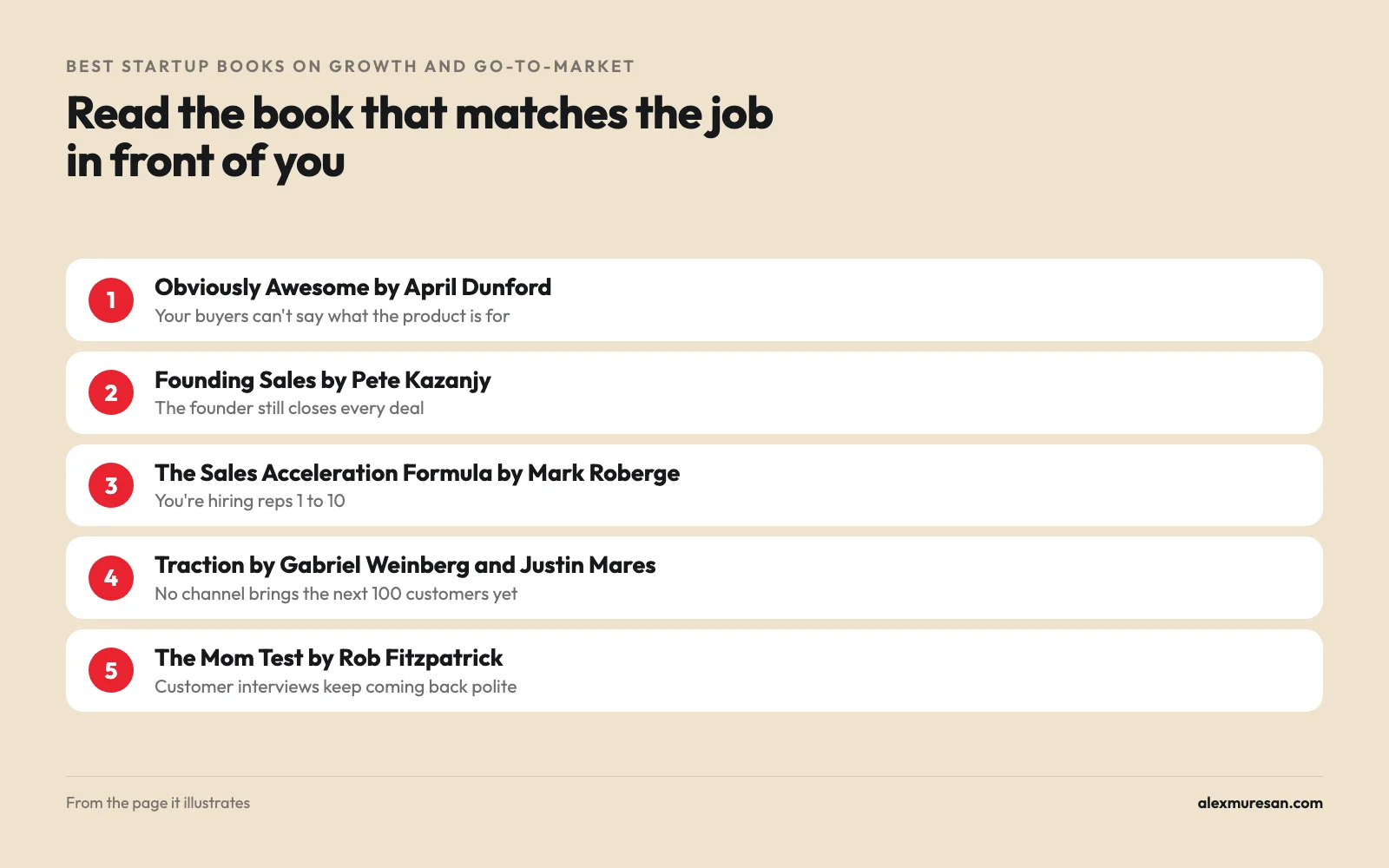
What makes one of the best startup books?
A startup book is worth your evening when it tells you what to do on Monday, and when the person telling you has done it under pressure. That's the whole bar. Most of the shelf fails it, because a lot of business books are written by people who studied companies from the outside (and it shows the second you try to apply them).
I scored every book on 2 things. First, specificity: does it give you a number or a sequence you can fail? Second, the receipt: did the author run the revenue themselves, or put a fund's money behind startups? Books by VCs got in only where the VC had operated first or the book holds up on its own.
Why does the receipt matter so much? Because I've carried the number myself. I took an AI startup from zero to $600K ARR in 5 months, and the advice that survives a quarter like that is almost always from someone who has sat in the same chair. Everything else sounds right in a meeting and does nothing in a pipeline review.
This list leans B2B and early stage on purpose. If you want people to follow instead of books to read, the sibling list of growth marketing experts covers that, and the stage playbooks turn a lot of these ideas into moves for each round.
The 8 best startup books on growth and go-to-market, ranked
These are the 8 I'd stake my name on, in the order I'd read them if I were starting a B2B company tomorrow. The order follows the work: positioning first, then the sale, then the channel, then scale.
1. Obviously Awesome by April Dunford
Dunford spent about 25 years running marketing, product and sales, and she led teams at 7 successful B2B technology startups, most of which were acquired. She names DataMirror (bought by IBM), Janna Systems (bought by Siebel) and Watcom (sold to Sybase via Powersoft). She also says she positioned, repositioned and launched 16 products, which is the reason this book reads like a checklist rather than a lecture.
The book walks you through deciding what market you compete in and who your best-fit customers are, then writing it down so sales and marketing tell the same story. Her site says it has sold over 100,000 copies. Read it before you hire anyone, because every hire after that point inherits your positioning (good or bad).
2. Founding Sales by Pete Kazanjy
Kazanjy went from founder with a product background to early salesperson to sales manager at TalentBin, and then became the post-acquisition sales leader at Monster Worldwide after Monster bought it. He later founded Atrium, a sales performance software company. So he has done the exact jump this book is about: a technical founder learning to sell.
The subtitle calls it a handbook for founder-led sales and early-stage go-to-market, and that's accurate. It runs from finding your first customers to hiring and onboarding your first reps. If you're the founder still closing every deal yourself, this is the most practical book on the list, and it pairs well with my guide to finding a pre-seed startup's first customers.
3. The Sales Acceleration Formula by Mark Roberge
Roberge was the 4th employee and founding CRO at HubSpot, and built its go-to-market team from zero revenue to an IPO. Wiley's page says he oversaw the first 10,000 customers across more than 60 countries and grew the team from 1 to 450 people. He co-founded Stage 2 Capital, a fund that has backed more than 100 startups, and has taught at Harvard Business School for over a decade.
The book treats sales hiring, training, management and demand generation as things you can measure, which is rare. It's the book for the moment you stop selling alone and start hiring reps. It sits naturally next to the rep-hiring move in my guide to Series A startup growth, where you add rep 3 only when the first 2 hit quota without you.
4. Traction by Gabriel Weinberg and Justin Mares
Weinberg is the founder and CEO of DuckDuckGo, the privacy search company, and the publisher's page describes 19 different traction channels "from viral marketing to trade shows." The book gives you a way to test those channels and find the best one for your startup, a method the endorsements call Bullseye.
This is the book for a team that has a product people like and no idea where the next 100 customers come from. My read is that it's the most useful book to finish before you hire a marketer, because you'll know which channel you're hiring for.
5. The Mom Test by Rob Fitzpatrick
Fitzpatrick is a Y Combinator alum from summer 2007 who spent 10 years running bootstrapped and VC-backed companies. He wrote the book because, in his words, he was a programmer forced into a customer-facing role at his first company. The site says it's used at Harvard, UCL, Seedcamp and Shopify.
The whole book is about one skill: asking customers questions they can't answer politely with a lie. It's short and you can finish it on a flight. Every founder doing discovery calls should read it before the first one, because a bad interview gives you confidence you didn't earn.
6. The Cold Start Problem by Andrew Chen
Chen led the Rider Growth teams at Uber before he became a general partner at Andreessen Horowitz, which is why he earns a spot as a VC author. The book is about how products with network effects get started and scale, built on interviews with the teams behind Slack, Zoom, Airbnb, Uber and more.
If your product gets more useful as more people join (marketplaces, collaboration tools, anything with a team invite), this is the book. If you sell a single-player tool to one buyer per account, skim it and move on. Of the books on this list written by investors, it's the most specific about growth.
7. Hacking Growth by Sean Ellis and Morgan Brown
Ellis says he coined the term "growth hacking" while leading early growth at LogMeIn, and that as Dropbox's first marketer he grew its user base by 1,000% in 6 months. His site says the book has sold over 600,000 copies. The publisher's description draws on companies like Airbnb, Pinterest, LinkedIn, Facebook and Uber.
The useful part is the operating rhythm: a cross-functional team that runs experiments every week and keeps score. It leans toward online and consumer products, so B2B teams with long sales cycles should take the cadence and leave some of the tactics. It's the right read for a growth lead who just got the job and needs a weekly process.
8. Zero to One by Peter Thiel with Blake Masters
Thiel started PayPal in 1998, ran it as CEO and took it public in 2002, then made the first outside investment in Facebook and became a partner at Founders Fund. The book grew out of Masters' notes on Thiel's Stanford class, which the 2 of them turned into a book.
Most people read it for the monopoly argument. I'd read it for the distribution chapter. In the class notes it came from, Thiel argues that poor distribution, more than a weak product, is the main reason companies fail, and he matches each sales channel to deal size. It's last here because the rest of the book is mostly about strategy.
Which book to read first, by stage
You don't need all 8 this month. Read the one that matches the problem keeping you up, and save the rest for when you hit their stage.
Pre-seed, still looking for proof: The Mom Test, then Obviously Awesome. You need to know who wants this and how to describe it before you sell anything. Seed, closing deals yourself: Founding Sales, then Traction, because you're picking your first real channel. My seed-stage growth guide covers what that year should look like.
Series A and after, building a team: The Sales Acceleration Formula and Hacking Growth. One gives you the sales hiring process and the other gives you the weekly testing rhythm. Keep Zero to One and The Cold Start Problem for the plane, because they're the 2 you'll want to think about slowly.
Prefer listening on the commute? The sibling lists of the best podcasts for startup founders and the best venture capital podcasts cover the audio side, and the best B2B marketing podcasts go deeper on marketing. These are also the best go-to-market books to give a new hire in their first week, since they carry the same ideas in long form.
Learn go-to-market from the VCs who fund it
Books give you the method. The part they can't give you is how an investor watched a specific company get from one round to the next.
Every season-one guest on Sell That S*it! is a VC, and each conversation breaks down how a fund graduated a company through a stage.
Season one is filming now and no episodes are out yet. If you want them when they land, use the newsletter box at the bottom of this page.
FAQs about the best startup books
What are the best books on startup growth and go-to-market? Start with Obviously Awesome by April Dunford for positioning, Founding Sales by Pete Kazanjy for founder-led sales, and The Sales Acceleration Formula by Mark Roberge for building a sales team. Add Traction by Gabriel Weinberg and Justin Mares to choose a channel, and The Mom Test by Rob Fitzpatrick before customer interviews.
What is the best startup book for a first-time founder? The Mom Test. It's short, it fixes the most common early mistake (taking polite feedback as proof), and its author ran both bootstrapped and VC-backed companies after going through Y Combinator.
Are books by VCs worth reading for go-to-market? Some are. Andrew Chen led Rider Growth at Uber before joining a16z, and Mark Roberge built HubSpot's sales team before co-founding Stage 2 Capital, so both write from operating experience. Judge a VC's book by what they did before the fund.
Which startup books help B2B companies most? Obviously Awesome, Founding Sales and The Sales Acceleration Formula, in that order. All 3 authors worked inside B2B companies, and the advice is built for sales-led motions with real buyers.
Who are good speakers on startup growth if I want to hear these ideas live? The sibling list of marketing keynote speakers covers people worth inviting to an event, with what each one would talk about.
About the author

Alex Muresan is a 4x founder with 2 exits. He built his first company, a physical entertainment center, to 60 employees and $2M in annual revenue in his early 20s. His second exit came in 2026, when he sold a media company. He took an AI startup from 0 to $600K ARR in 5 months, and at his current startup he took revenue from $800K to $1.4M ARR in his first 3 months. He also hosts Sell That S*it!, where every guest in season one is a VC.
Part of the stage playbooks: what to do for growth at pre-seed, seed, Series A, Series B and Series C. The glossary →