
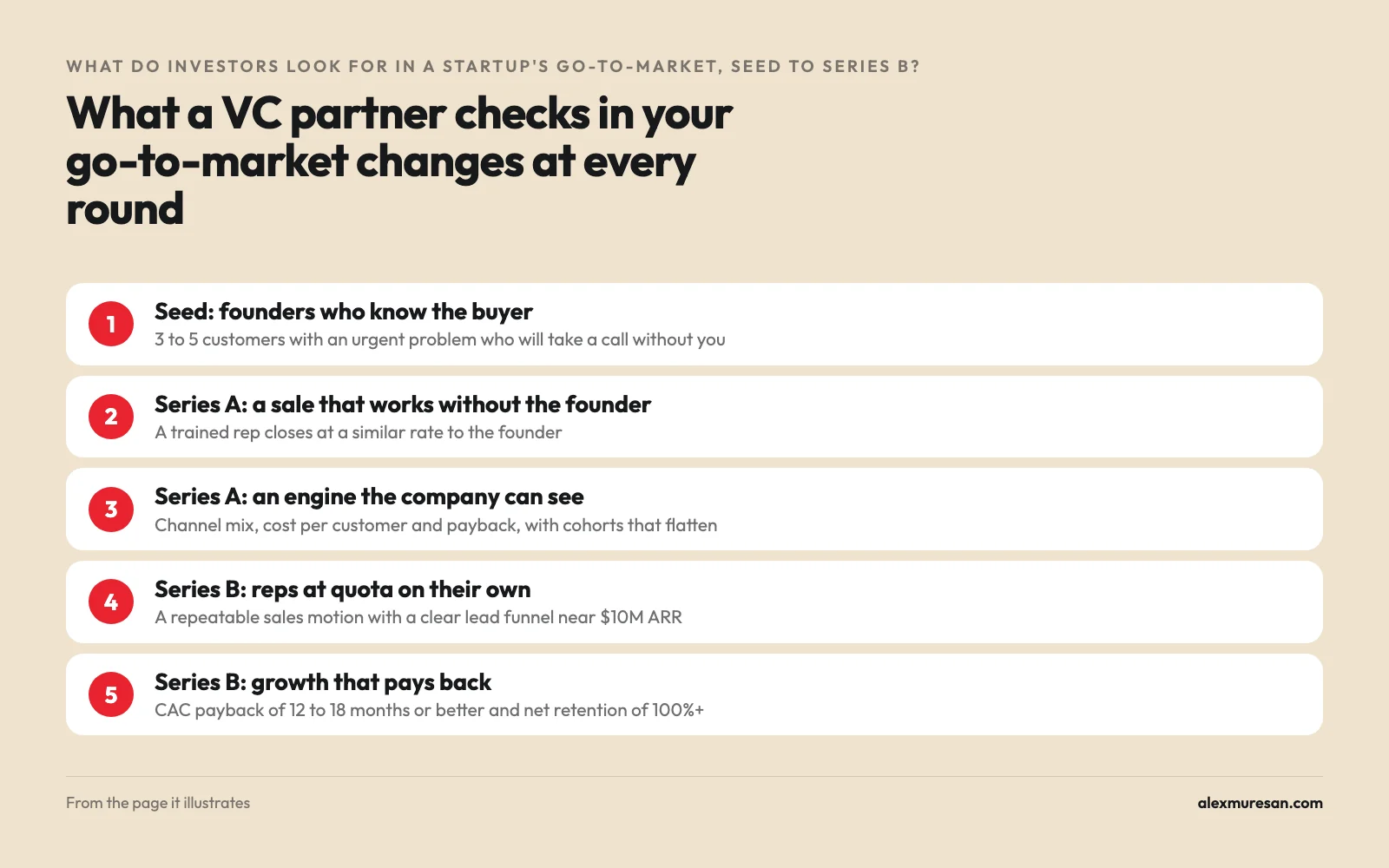
Seed is a bet on the founders: CRV says seed investors back a thesis and a team. First Round's seed benchmark is 3 to 5 customers with an urgent problem.
Series A asks whether the sale works without you: CRV wants a trained rep closing at a similar rate to the founder. Shopify's 2010 memo adds the rest of the check, a channel mix down to the percentage and a payback of 7 to 9 months.
Series B asks whether money buys revenue: Bessemer starts looking near $10M ARR and wants reps hitting quota on their own. Its 2023 benchmarks call a CAC payback of 12 to 18 months good.
Every round, they talk to your customers: Bessemer did it for Auth0 at seed and PagerDuty at Series B. CRV tells founders to expect those calls without them on the line.
The common mistake is claiming a stage you haven't reached: a16z's Martin Casado says that's where most pitches go sideways.

The partner meeting at a glance
It's Sunday night and your partner meeting is at 10 tomorrow. You've rehearsed slide 6, the revenue chart, so many times you could say the growth rate in your sleep.
Here's the part most founders never see. At Bessemer, the partners who bring a company in write a memo about it to the rest of the partnership, and the firm has published a run of them. Auth0's is dated Saturday, June 28th, 2014, 2 days before its co-founders presented. Reading one feels like finding the teacher's answer key the night before the exam.
Read them next to what a16z, CRV and First Round publish, and the pattern is hard to miss: the partner's question changes completely from one round to the next. Here it is on one page.
| Round | The partner's real question | What answers it | What the memo showed |
|---|---|---|---|
| Seed | Do the founders know where the buyers are? | 3 to 5 customers with an urgent problem who'll take a call without you | Auth0, 2014: $10K MRR from 75 paying customers and no ad spend |
| Series A | Can someone other than the founder close the deal? | A trained rep closing at a similar rate to the founder, and cohorts that flatten | Shopify, 2010: 65 to 70% of customers from word of mouth and a payback of 7 to 9 months |
| Series B | Does more money buy more revenue? | Reps at quota on their own near $10M ARR, and a CAC payback of 12 to 18 months or better | PagerDuty, 2014: reps closing $6.4K of new and expansion MRR a month against a typical $4K to $5K |
What do investors look for in a startup?
Investors look for evidence that their money will turn your company into a much bigger one. What counts as evidence changes with the round. At seed they're mostly buying the founders and the problem. By Series A they want a sale that works without the founder in the room, and by Series B they want proof that more money buys more revenue at a price that makes sense.
Martin Casado, a general partner at a16z, wrote in 2018 that "seed/A/B/C is a bad approximation for the stage of a company." His firm uses its own 4 stages instead: Team, Product, Repeatable Sale and Unit Economics. They line up with the rounds most of the time, which is why this guide follows the rounds.
I've been the operator carrying the number. I took an AI startup from zero to $600K ARR in 5 months, and at my current startup I took revenue from $800K to $1.4M in my first 3 months. A partner would pull numbers like those apart by asking where every dollar came from. If you want the moves for each stage instead of the investor's view, they're in the stage playbooks.
Seed: do the founders know where the buyers are?
CRV sums up the seed bet in one line: "Seed investors back a thesis and a team, betting you can find something that works." So the go-to-market check at seed is really a check on the founders. Do they know who the buyer is, and how they'll reach the next 20? When Point Nine's Christoph Janz surveyed more than 60 SaaS investors in 2018, seed investors put the team first and also asked for "a convincing go-to-market plan" (the seed sample was small, and Janz says so).
Auth0's seed memo shows what that looked like in the room. The team of 12 had raised $850K and was making $10K a month from 75 paying customers. Its self-serve and enterprise revenue were each growing 15 to 20% a month, and it hadn't spent a dollar on advertising. Its founders spoke at conferences instead, and the partners noted they were well known in the identity space and trusted by their customers.
The part I love is what the partners didn't bother to check, because it shows how little a seed forecast weighs. The pipeline pointed to $100K of MRR by the end of 2014, and the memo says Bessemer hadn't spent much time vetting it. It had talked to customers instead. Every one of them raved about the support, and the documentation kept coming up as the best out there.
First Round's levels of product-market fit put numbers on this stage. Its Level 1, which it pins to pre-seed and seed, is 3 to 5 customers and up to $500K of ARR, found mostly through the founders' own network. Casado adds a warning that "potential customer quotes are effectively useless," so bring production deployments and real decision makers instead. If you've already raised, the next moves are in the seed-stage growth playbook.
Series A: can someone other than the founder close the deal?
By Series A the bet flips. CRV writes that "Series A investors underwrite a model that already works," and it singles out sales, because founder-led selling is still normal at this stage. Its test is the one I'd tape to the wall: "If the pipeline only converts when a founder joins the call, the sales process hasn't been built yet."
Shopify's Series A memo from October 2010 is the best picture I know of a partner reading a go-to-market. Bessemer's Alex Ferrara wrote it with Trevor Oelschig, and he later admitted it took him 3 round trips to Ottawa before he offered Tobi Lütke a term sheet. At the time, monthly recurring revenue had grown from $164K to $438K in a year.
The partners broke down exactly where customers came from. About 65 to 70% arrived by word of mouth, roughly 20% through referrals from web design firms and 10 to 15% through paid channels. Each one cost $175 to $225 to acquire and paid that back in 7 to 9 months, churn-adjusted.
My favorite detail is the web design firms. Shopify didn't know how much they mattered until it set up a data warehouse, and it had only just hired someone to work that channel full-time. To me that says the partners cared more about whether the company could see its own engine than about polish. They also saw what was missing, 1 paid search marketer and no VP of Marketing, and called marketing "a huge opportunity."
Then there's retention, which is where a lot of founders get nervous. By month 12, only 50 to 60% of Shopify's customers were still around. In a note added when the memo was published, Bessemer says a 5% monthly logo churn "likely scared off other investors." It got comfortable because customers were cheap to win, and the cohort data showed the ones who stayed made up for the ones who left.
Casado's test for this stage is blunt: "If you claim to have repeatable sales, be sure you really do." For him that means a similar buyer, a similar use case and a growing pipeline. I wrote up the moves for this stage in Series A startups: 5 things to do to accelerate growth.
Series B: what do investors look for in a startup near $10M ARR?
Bessemer's growth team typically starts looking at companies around $10M of ARR. Its playbook says what it wants to find there: "By $10 million ARR, investors want to see a repeatable, scalable sales motion with a clear lead funnel, reps hitting quota consistently and independently, and with a clear understanding of the customer wedge." The founder has disappeared from that sentence, which is what all the Series A work was for.
PagerDuty's Series B memo is the one to read here. CEO Alex Solomon presented to the partnership on June 16th, 2014, and Bessemer signed a term sheet to lead the round at a $180M pre-money valuation, 14 times June ARR of $12.6M. Before the memo went out, the partners spoke to a large number of customers and to companies using competing products.
What they measured was the sales machine. PagerDuty's 9 quota-carrying reps closed an average of $6.4K of new and expansion MRR a month, against typical targets of $4K to $5K. The fully loaded CAC payback looked slow at about 19 months. But cohorts grew their spend 75% by month 12 and 260% by month 24, so the partners worked out that the April 2014 cohort really paid back in more like 9 to 10 months.
They also found the crack. It often took the team 24 hours to answer a warm lead, which the memo calls "far from world class." So part of the new money was earmarked for more reps to catch the leads already coming in (that's the problem every founder should want at Series B, because it means the demand is already there).
For today's yardstick, Bessemer's State of the Cloud 2023 set targets for "the typical Series B or C enterprise software company." It calls a CAC payback of 12 to 18 months good, and net revenue retention of 100% good and 120% or more best.
David Sacks of Craft Ventures adds the burn multiple, net burn divided by net new ARR. If you burn $2M to add $1M of ARR, it looks like "the market is pulling product out of the startup." Burn $5M for the same $1M and the startup is "pushing its product onto the market." The full playbook for this stage is in Series B startups: 5 ways to keep revenue growing.
Every partner calls your customers
If you want to know how VCs evaluate go-to-market when you're not in the room, the answer is simple: they call your customers. Bessemer spoke to Auth0's customers at seed and PagerDuty's at Series B. Casado says a16z calls customers early because "early deals can be messy and misleading," and later to check the length of the sales cycle and the pipeline.
CRV tells Series A founders to expect several of those calls without them on the line. So your strongest go-to-market slide might be 5 customers who'll pick up the phone and describe the problem in the same words your deck uses.
The go-to-market mistakes VCs see most often
Casado opens his thread with the one he sees most. Pitches go sideways, he writes, when the investor is led to believe the company is more mature than it is, like a founder raising a Series B to scale sales with few hard signs of product-market fit. He'd much rather hear about a pivot or a slow market up front than uncover it in diligence.
Dressing up sales traction comes next. Casado points out that a burst of early sales often comes from accounts the team has worked since day 1, which says nothing about repeatable growth.
Then there's hiring sales before the demand is there. Peter Levine at a16z wrote that scaling sales far ahead of demand "often results in a bloated and expensive sales force that's not able to sell much product." His advice fits on a sticky note: "It's better to be a bit late than overbuild too early." PagerDuty shows the opposite failure, demand outrunning the reps, so watch for sales and demand drifting apart in either direction.
The stakes are real. Carta's Peter Walker reported in October 2024 that only 9% of companies that raised a Series A in Q3 2022 had reached a Series B within 2 years, against 25% of the Q3 2018 cohort (ouch). My read is that a lot of that gap comes from companies that looked like they had a repeatable sale at the A and found out at the B that they didn't.
What to rehearse the night before
So go back to Sunday night and slide 6. The partner will read that chart through a different question depending on the round, and every version comes back to where the revenue came from and whether it keeps coming without you.
At seed, rehearse the names of the customers who'll take a call. At Series A, know your channel mix down to the percentage and your first rep's close rate next to yours. At Series B, know your payback by cohort and how long a warm lead waits for an answer, because those are the 2 things PagerDuty's partners dug into.
Then get some sleep, because the memo about you might already be written (Auth0's was, on a Saturday).
Learn this from the VCs who make the call
Every season-one guest on Sell That S*it! is a VC partner, and each episode breaks down how a fund graduated one of its companies to its next round. Think of it as a partner memo, told out loud.
Season one is filming now, so no episodes are out yet. Use the newsletter box at the bottom of this page to get the first one, and start with the best venture capital podcasts in the meantime.
FAQs about what investors look for in a startup
What do VCs look for in a startup? They look for a team that can win a big market, plus go-to-market evidence that grows with the round. Seed investors want founders who know the buyer, and Series A investors want a sale that works without the founder. Series B investors want reps at quota and growth that pays back.
How do VCs evaluate a startup's go-to-market? They read your numbers, then check them against your customers. Bessemer's memos break down where customers come from and how fast they pay back, and a16z calls customers to test the sales cycle and the pipeline.
What does a VC need to see in your go-to-market before Series B? Bessemer, which usually starts looking near $10M ARR, wants a repeatable sales motion with a clear lead funnel and reps hitting quota on their own. Its 2023 benchmarks call a CAC payback of 12 to 18 months good, and First Round's Level 3 asks for more than 110% net retention.
What are the most common go-to-market mistakes VCs see in their portfolio companies? The one a16z's Martin Casado sees most is signaling more maturity than the company has. Peter Levine at a16z warns against building sales ahead of demand, and PagerDuty's Series B memo shows the reverse, demand outrunning a team that took 24 hours to answer warm leads.
What do Series A investors want to see in your go-to-market beyond revenue growth? They want to see where the revenue comes from and whether it holds. Shopify's Series A memo broke growth into channels, cost per customer, payback and cohort retention, and CRV says investors read cohort retention curves first.
About the author
Alex Muresan is a 4x founder with 2 exits. He built his first company, a physical entertainment center, to 60 employees and $2M in annual revenue in his early 20s. His second exit came in 2026, when he sold a media company. He took an AI startup from 0 to $600K ARR in 5 months, and at his current startup he took revenue from $800K to $1.4M ARR in his first 3 months. He also hosts Sell That S*it!, where every guest in season one is a VC.
Part of the stage playbooks: what to do for growth at pre-seed, seed, Series A, Series B and Series C. The glossary →