
Read people with a current job: Elena Verna writes from inside Lovable's growth team and Casey Winters from a company he is building right now, so the advice carries this year's numbers.
Read the investors who still think like builders: Andrew Chen and Paul Graham write about what makes a company stronger, which is a different question from what makes a round close.
Read the failures too: Nico Cerdeira takes apart a dead company every week on Failory, and Character.AI's numbers teach more about unit economics than most success stories do.
Steal the shape, never the tactic: Tom Orbach's 64 growth ideas on Lenny's Newsletter worked because nobody saw them coming, so copying one is the surest way to make it stop working.
Cap it at 3: Pick the 3 that answer the question you have this quarter and archive the rest without guilt.

The best startup newsletters at a glance
You know the moment. It's Sunday night, you open your inbox to clear it before the week starts, and there are 40 unread newsletters sitting there, every one of them written by someone who sounds like they've figured it out. You archive 38 without opening them, because you can already guess what they say. Then one of them changes what you do on Monday morning, and that one issue was worth the other 39.
I've started 4 companies and sold 2, and I still read startup newsletters for exactly that Monday. Every person below has written that issue in the last year, and I've linked it so you can judge for yourself, because a list of names is only as good as the specific thing each name has said lately.
| Newsletter and writer | What it covers | Who should read it | Start here |
|---|---|---|---|
| Lenny's Newsletter, Lenny Rachitsky | Product, growth and career advice, with guest posts from operators who ran the play | Founders building their first growth engine | lennysnewsletter.com |
| Elena's Growth Scoop, Elena Verna | Product-led growth, pricing and monetization, written from inside Lovable | Founders selling self-serve | elenaverna.com |
| Andrew Chen's newsletter, Andrew Chen | Network effects, retention and how AI is changing consumer growth | Consumer and marketplace founders | andrewchen.substack.com |
| Casey Accidental, Casey Winters | Scaling companies, what to build first and what to cut | Founders between first users and first scale | caseyaccidental.com |
| The Generalist, Mario Gabriele | Long interviews with founders on how the company actually got built | Founders who want the whole story, slow years included | generalist.com |
| Failory, Nico Cerdeira | Why startups die, 1 company a week, with the numbers | Any founder spending money faster than they make it | newsletter.failory.com |
| First Round Review, First Round Capital | Operators' first-person accounts of a company's early years | Pre-seed and seed founders | review.firstround.com |
| Paul Graham's essays, Paul Graham | Essays on what makes a startup strong (no newsletter, so use the feed) | Every founder, the night before a board meeting | paulgraham.com |
What startup newsletters do that a course can't
A course is a photograph. Somebody took it in a particular year, with a particular market in the frame, and the lesson stays frozen even when the market moves on. A good newsletter is closer to a diary, because the writer still has the job and writes down what changed this month, so you read the correction along with the rule.
That is also why the newsletters for founders on this page sit apart from the ones about raising money. The venture capital newsletters page covers the investors who publish round data and explain how funds decide. This page covers the other half of the job, growing the company once the money is in the bank, so the writers here are operators first, even the 2 who now invest, and I left out anyone I couldn't catch publishing in 2026.
8 startup newsletters worth reading in 2026
I've put the operators first, because a founder with a growth problem needs someone who has the same problem this quarter. Then come the 2 writers who watch founders for a living, then the failures, and last the essays that outlast all of it.
Lenny Rachitsky (Lenny's Newsletter)
Lenny Rachitsky spent 7 years at Airbnb as one of its first product managers and started the newsletter on Medium in April 2019, according to First Round Review's April profile of him, and it now has more than 1,200,000 subscribers. The issue I'd open first is Tom Orbach's "60+ new creative growth ideas" from September 15th, where Gumloop spends its whole marketing budget on street musicians playing in front of branded signs, tl;dv promotes all 50-plus employees to CEO on the same day so LinkedIn sends a job-change notification to every one of their networks, and Wordware's free X profile roaster draws 8.1 million people and more than 400,000 signups for the main product. Orbach calls them lottery tickets, and that honesty is the point, because he's telling you most will do nothing and one will pay for the rest. Subscribe if you're building your first growth engine, because Lenny's best issues are guest posts from the people who ran the play, like Kristen Lowe's August piece on founder communication.
Elena Verna (Elena's Growth Scoop)
Elena Verna has run growth at Lovable, Miro, SurveyMonkey, Amplitude and Dropbox, and Crunchbase lists her as Lovable's head of growth today, so the letter reads like field notes from a job she still has. In "How to give away free product and make money doing it" from September 8th she argues that AI companies are hiding the core experience behind the paywall because compute costs scare them, and that this is the wrong answer, because a customer has to feel the value before they'll pay for it. She writes that at Lovable "Most of our revenue comes in self-serve", often from founders and employees putting a company tool on their own card. Subscribe if you sell self-serve, because she is one of the few people writing about free tiers who has to defend a gross margin on Monday, and more than 100,000 people already do.
Andrew Chen (Andrew Chen's newsletter)
Andrew Chen is a general partner at Andreessen Horowitz and the author of The Cold Start Problem, and his Substack carries more than 257,000 subscribers and an archive of over 650 essays on growth and network effects. In "The coming product retention crisis" from September 8th he explains why AI took off at work but has been slow in consumer, because work rewards repetition and consumer rewards novelty, and a model trained on the past recycles patterns. His prediction is that app retention collapses as apps become disposable content, so holding more than 20% of users at day 30 may soon look unrealistic, and the line that stayed with me was "You can't go direct by copy-pasting AI", because every founder I know is tempted to try. Subscribe if you build consumer or marketplace products, because he has stared at more retention curves than anyone else on this list and still writes like an operator.
Casey Winters (Casey Accidental)
Casey Winters was chief product officer at Eventbrite, started the marketing team at Grubhub as it went from 3 cities to more than 1,000, led growth product at Pinterest as active users grew from about 40 million to over 500 million, and now runs SuperMe, an AI-native professional network he co-founded, so the blog is written by someone back at zero. In "Zero to One Is a Subtraction Problem" from February 17th he lays out the 2 bets an early founder makes, how many features to build and how much design polish to buy, and puts Craigslist and Jira in one corner and Pinterest, Snapchat and Granola in the other. Instagram's filters came out of an earlier app called Brbn and Pinterest's save button out of a shopping app called Tote, which is his proof that 1 working experiment can justify killing the rest. Subscribe if you are between first users and first scale, because that is the exact stretch he has worked 3 times and is working again, and the list is small, a bit over 10,000 subscribers, which keeps it honest.
Mario Gabriele (The Generalist)
Mario Gabriele writes The Generalist for more than 169,000 subscribers, and his format is the long interview that stays in the slow years instead of skipping to the funding announcement. In "38x in Ten Months" from August 18th he sits with Farooq Malik, co-founder and CEO of Rain, which builds stablecoin infrastructure for card issuance and payments, and Malik describes building the rails before stablecoins were respectable, signing early partners who later became customers, and arguing that payments has room for several big winners beyond Stripe. The 38x in the title is the only metric he gives, which tells you how early the story still is. Subscribe if you learn best from a whole story rather than a tidy summary of one, and pair it with the best startup books page, because Mario's interviews are the chapter those books never get to write.
Nico Cerdeira (Failory)
Nico Cerdeira built Failory on one idea, that there is more to learn from failures than from successes, and his weekly letter now goes to more than 40,000 founders. On October 15th he sent "Your AI Boyfriend is Bankrupt" about Character.AI, which had filed for bankruptcy 3 days earlier with about 12 million monthly users, $5.3 million of August revenue against an operating loss of $8 million to $9 million, about $211 million of cash burned in 2025 on $23.6 million of revenue, and a compute bill of $56.1 million from January to August this year. That one made me wince, because 12 million people showed up every month and the company still lost more than it made, and the CEO had admitted in August 2025 that "monetization was not a focus for the last two years". Subscribe if you are spending money faster than you make it and want to see what that looks like from the other end.
First Round Review (First Round Capital)
First Round Review is the publication of the seed firm First Round Capital, and its best pieces lately come from a series called Firsthand, where an operator writes the early years in the first person. On August 20th Nad Chishtie, Lovable's fourth employee and first designer, described joining 8 months before the November 2024 launch, prototyping the launch identity in about 30 minutes, and watching the product reach $10 million ARR within 60 days and $100 million ARR 8 months after launch. The detail I keep thinking about is that the product had been rebuilt twice in 4 months before launch because the models still failed on roughly 1 prompt in 4, and they shipped anyway. Subscribe if you are pre-seed or seed, because the Review's other long series, Paths to Product-Market Fit, is the closest thing to a map of how companies found their first customers, and the Guideline story from March 24th is the one to start with, since about 60% of its customers signed up on their own while outbound fell short, and it sold to Gusto in August 2025 with around $175 million in ARR.
Paul Graham (his essays)
Paul Graham does not send a newsletter, which is why most lists leave him out, and it is a mistake, because his site points to a feed of the essays that works the same way. His September essay, "Making Startups Powerful", argues that founders should stop asking how to make more money and ask what would make the company more powerful: own the customer relationship, build network effects, go full stack, offer an API, and sell to early-stage companies because they decide quickly. He also tells you to watch for users bending your product into something you didn't intend, since that is often the more valuable product hiding in plain sight. Read him the night before a board meeting, because his essays are the only thing on this list that will still be right in 5 years, and this one closes on the customer, since a startup starts out weak and every one of those moves only works if it also helps the person paying.
Which newsletter to open for each founder question
You don't need all 8 at once. Match them to the question you are actually asking this quarter, then swap when the question changes, the same way you'd swap the people you call for advice.
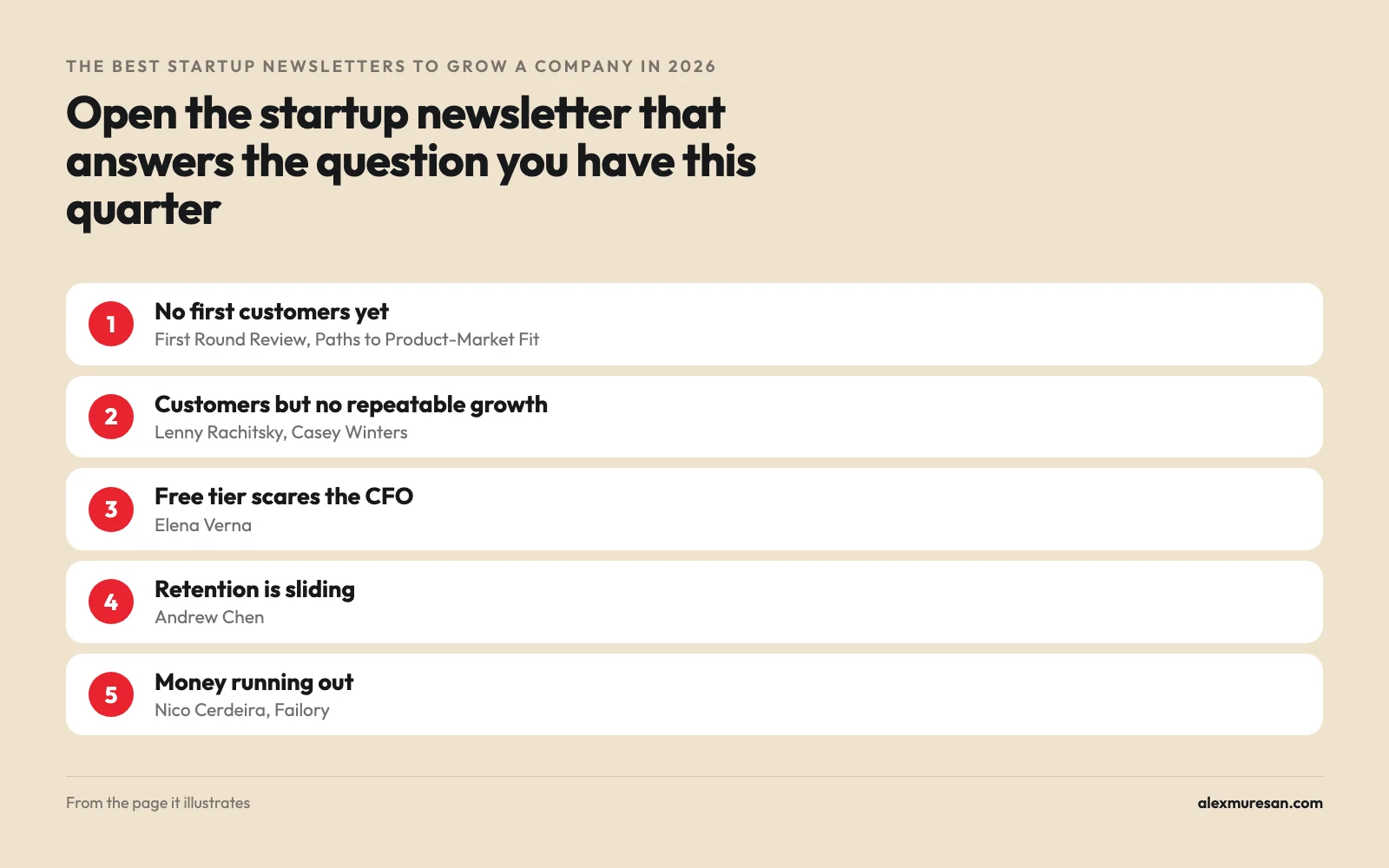
If you don't have your first 10 customers yet, read First Round Review's 2 series alongside the pre-seed first customers guide and how to get your first 10 customers. If you have customers and no repeatable way to get more, read Lenny's guest posts and Casey Winters, because both are about what to build and what to stop building. If your free tier scares your CFO, read Elena Verna, and if you sell consumer, read Andrew Chen before you set a retention target. If the money is running out faster than planned, read Failory for a month with your own P&L open, and when you want the operators who turn these ideas into channels, the growth marketing experts page lists the people I'd follow on the marketing side.
How to read startup newsletters without drowning in them
There are hundreds of founder newsletters, and the easiest way to learn nothing is to subscribe to 30 and skim all of them. I'd rather you read 3 properly, so here is how I'd pick them.
Read for the specific, skip the general
Every issue linked on this page carries a number, a company or a decision you can picture: 8.1 million people roasting their own profiles, 1 prompt in 4 failing before launch, $56.1 million in compute. An issue that gives you none of those is an opinion with a logo, so archive it and write the numbers you do get down next to your own, because that is when a newsletter turns into a decision.
Check where the writer sits
Elena Verna and Casey Winters have a job that will punish them if the advice is wrong. Andrew Chen and First Round Capital invest, so part of the reason they write is to meet founders, which is fine as long as you remember it while reading.
Pair the letters with a voice
Reading tells you what a founder decided, and hearing them explain it tells you how they decided, so the best B2B marketing podcasts roundup covers the go-to-market side in audio.
Hear how the companies actually did it
That Sunday night inbox is the reason I'm building Sell That S*it!. Every season-one guest is a VC, and each episode walks through how one of their companies got from one stage to the next, told by the person who had money riding on it. Season one is filming now and no episodes are out yet, so use the newsletter box at the bottom of this page and you'll get them the week they land.
FAQs about startup newsletters
What are the best startup newsletters for founders in 2026? For growth, start with Lenny Rachitsky's Lenny's Newsletter for the guest posts and Elena Verna's Growth Scoop for product-led growth. Add Casey Winters for what to build and cut, Nico Cerdeira's Failory for the failures, and Paul Graham's essays through the feed for the thinking that lasts.
Where can I learn how to grow a startup? Read 1 operator who has the problem right now and 1 writer who watches many companies. Elena Verna and Casey Winters are the operators on this list, Andrew Chen and Mario Gabriele are the watchers, so pick 1 from each pair and read both for a quarter.
Where can I find out how other startups got their first customers? First Round Review's Paths to Product-Market Fit series is built for that question, with Guideline's first plan for Plaid in December 2016 as one example and Linear, Clay, Vanta and Vercel among the others. Mario Gabriele's interviews cover the same years in the founder's own words.
Where can founders get good advice on go-to-market? Tom Orbach's 64 growth ideas on Lenny's Newsletter is the most concrete single issue I've read this year, and Elena Verna's posts on free tiers and pricing are the best on monetizing self-serve.
What are the best alternatives to Y Combinator Startup School for learning go-to-market? Startup School is a course, so the best alternative is a running record from someone still doing the work. Paul Graham's essays cover the thinking YC teaches, and Lenny Rachitsky, Elena Verna and Casey Winters cover the go-to-market half with this year's examples.
About the author

Alex Muresan is a 4x founder with 2 exits. He built his first company, a physical entertainment center, to 60 employees and $2M in annual revenue in his early 20s. His second exit came in 2026, when he sold a media company. He took an AI startup from 0 to $600K ARR in 5 months, and at his current startup he took revenue from $800K to $1.4M ARR in his first 3 months. He also hosts Sell That S*it!, where every guest in season one is a VC.
Part of the stage playbooks: what to do for growth at pre-seed, seed, Series A, Series B and Series C. The glossary →