
The job: A Series C startup has to find its next growth engine just as the board starts weighing efficiency. ICONIQ only puts real weight on the Rule of 40 from about $25M in ARR.
The order: Run the 5 priorities from the cheapest new dollar to the most expensive: customers, a second product, the next segment, partners, then your category's answer.
The thresholds: Each priority has a line you can fail, from 120% net dollar retention to being named in 4 of 5 ChatGPT answers about your category.
Customers first: Expansion brings about 42% of gross new ARR for companies at $25M to $50M in ARR, according to ICONIQ. New logos still lead until about $200M, so keep feeding them.
Growth still pays: ICONIQ and Bessemer both find that a point of growth is worth about 2x a point of free cash flow margin. Cut the waste, then fund whatever passes its threshold.

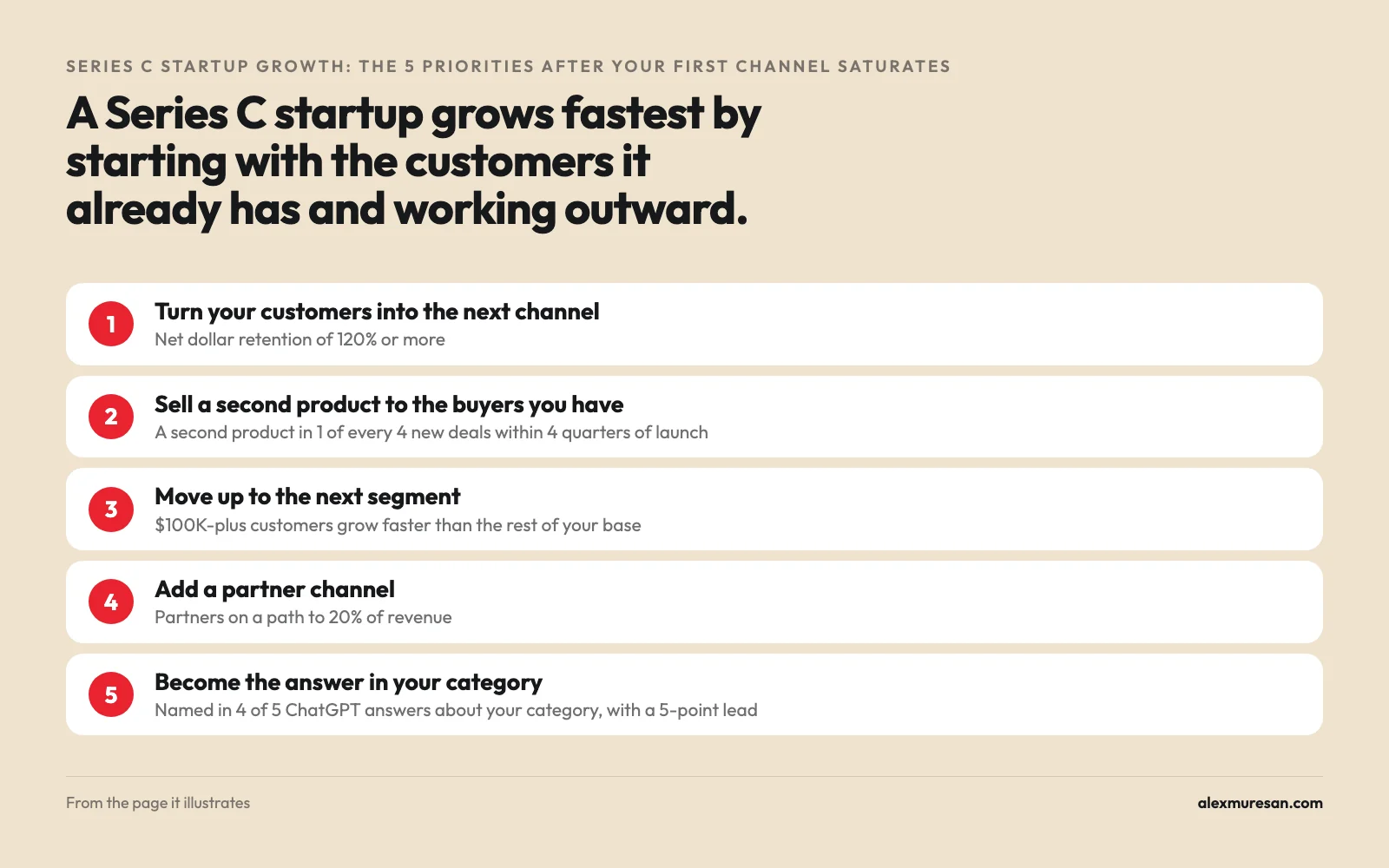
The 5 Series C startup priorities at a glance
| Priority | The threshold you can fail | A company that did it | The mistake to avoid |
|---|---|---|---|
| 1. Turn your customers into the next channel | Net dollar retention of 120% or more | Slack, which reported 143% net dollar retention in its 2019 S-1 | Making expansion the whole plan and starving new logos |
| 2. Sell a second product to the buyers you have | A second product in 1 of every 4 new deals within 4 quarters of launch | Datadog, where 60% of new customers landed with more than 1 product, up from 15% a year earlier | Building the second product in a silo that marketing hears about at launch |
| 3. Move up to the next segment | Customers paying $100K or more a year grow faster than the rest of your base | Figma, whose $100K-plus customers grew 47% in a year against 39% for $10K-plus customers | Hiring SDRs to cold call a segment that has never heard of you |
| 4. Add a partner channel | Partners on a path to 20% of revenue, ICONIQ's average for channel sales | HubSpot, whose partner-linked customers are 25% of its base and 49% of its revenue | Expecting partners to create demand for a brand nobody asks for |
| 5. Become the answer in your category | Named in 4 of 5 ChatGPT answers about your category, with a 5-point lead | Gong, which named the revenue intelligence category in 2019, the year of its Series C | Calling a 1-point lead ownership |
What is a Series C startup?
A Series C startup is a company that has raised its third priced venture round, after the Series A and the Series B. The product works and at least 1 go-to-market channel works, so the money pays for scale, usually into new segments and new products.
Carta's data on US rounds from Q1 2023 to Q2 2026 puts the median Series C at $37.1M raised on a $230M pre-money valuation, with 13% dilution.
If you're asking what comes after Series B, the round is the easy half of the answer. The hard half is that the channel that carried you there (the subject of the Series B guide) was built for a smaller company and starts to flatten at this size. This is the last of 5 stage guides, and the series starts at pre-seed.
What changes in go-to-market between Series B and Series C
At Series B the job was to put money behind the channel that worked. At Series C that channel flattens, and growth slows on its own. Bessemer calls this growth endurance, this year's growth rate divided by last year's, and found private cloud companies keep about 70% of their growth rate each year.
So 100% growth last year becomes about 70% this year and 49% the year after, unless something new is added. Battery's Neeraj Agrawal drew the same curve in his T2D3 path: triple, triple, double, double, double. The tripling ends at $18M ARR, and every doubling after it needs more net new ARR than the last.
Bessemer warns in its go-to-market lessons for $10M to $25M that it's tempting to believe inbound can carry a company to IPO scale, and that "most companies that do not layer on outbound early enough end up plateauing." a16z's growth partners went further in August, writing that companies at this stage "must become multi-product, multi-channel, multi-geography, often all at the same time."
That's the first-channel problem in investor language. Your best channel still works and it's full, so the next dollar buys less than the last one did. If that channel is paid, I covered why in just scale paid, it always works.
What growth investors publish about Series C, and what I'd add
The investor research agrees on the scoreboard. ICONIQ's 2025 report says it typically only begins "to place real weight against Rule of 40" (growth plus free cash flow margin) at about $25M in ARR. David Sacks's burn multiple divides net burn by net new ARR, and he calls anything under 2 "quite good" and anything under 1 "amazing." ICONIQ's median for unprofitable companies between $10M and $100M in ARR was 1.7x in 2025.
The same research says growth still pays more than margin. ICONIQ found that a 1-point increase in revenue growth moves valuation about 2x as much as the same gain in free cash flow margin. Bessemer's Rule of X weights growth about 2x for private companies. The board wants efficiency, and it still pays for growth.
Here's what I'd add from the operator seat. I've built 4 companies and sold 2, and these reports are written from the board seat, so they're precise on what to measure and quieter on what to do first. Most growth-stage go-to-market advice lists the moves side by side. I'd rank them by the cost of the next dollar, because the cheapest one is usually in your CRM already and the most expensive is a category you haven't named yet.
1. Turn your customers into the next channel
The people who already pay you are the cheapest audience you'll ever reach. ICONIQ's 2025 data shows expansion bringing 42% of gross new ARR for companies at $25M to $50M in ARR. Its 2026 report says incumbents are "increasingly turning to their existing customer base as a more reliable growth lever."
Slack shows it in a filing. Its 2019 S-1 reported 143% net dollar retention, a number Slack said captures both "sales-driven growth inside our larger Paid Customers" and self-serve accounts growing on their own. Marketing owns part of both through customer marketing and referrals, the channels I wrote about in your best channel is rotting inside your company.
You pass at 120% net dollar retention or higher. That's ICONIQ's top quartile from $25M to $100M in ARR, and it's the "best" tier in Bessemer's benchmarks for the typical Series B or C enterprise software company.
The mistake is making expansion the whole plan. ICONIQ finds new logos stay the main driver of ARR growth until about $200M, and the fastest growers in its 2026 report say to keep new-logo acquisition "a first-order priority longer than feels natural."
2. Sell a second product to the buyers you have
Insight Partners says companies usually go multi-product once they have "a significant base of established, happy, and renewing customers," because cross-selling lifts net retention. If you reached Series C with healthy retention, you have that base.
Datadog started in infrastructure monitoring, and by 2018 it had added APM and logs. Its S-1 says that in the first half of 2019, about 60% of new customers landed with more than 1 product, up from about 15% a year earlier. Over 35% of new ARR in the same period came from those 2 newer products.
You pass when the second product shows up in at least 1 of every 4 new deals within 4 quarters of launch. That bar is mine, and it sits well below what Datadog reached.
The mistake is building it in a silo. Insight puts it bluntly: "New products impact every organization in a company, but they can be launched in silos." If marketing first hears about the product in the launch meeting, the launch is already late.
3. Move up to the next segment
Check your own base before you buy a list, because the next segment up may already be using you on a small budget. Figma's S-1 showed 78% of the Forbes Global 2000 using Figma in March 2025, and only 24% spending more than $100K a year on it. Its $100K-plus customers grew 47% in the year to March 31st, 2025, from 701 to 1,031, while its $10K-plus customers grew 39%.
You pass when customers paying $100K or more a year grow faster than the rest of your base. If they don't, you have enterprise logos on a mid-market business. Bigger deals pay back slower, so agree the payback target with your CFO first: Bessemer calls 12 to 18 months "good" at Series B or C, and ICONIQ's top quartile sits at about 16 months.
The mistake is hiring the sales team before the segment knows you exist. Insight Partners has "seen numerous companies enter markets by staffing up a sales and BDR team to do outbound calling, not realizing that the market is unaware of them." It advises investing in awareness first, so the reps start with warm leads.
4. Add a partner channel
A partner channel reaches buyers your first channel never touched, and you don't pay for it by the click. Bessemer's advice is to test partnerships early, "preferably on someone else's dime," before you invest heavily in any one of them.
HubSpot is the case to study. Its 10-K for 2025 says its service partners and the customers they referred made up about 25% of its customers and about 49% of its revenue. That means the average partner-linked customer brings in about twice the revenue of the average HubSpot customer, and HubSpot credits partners with helping it "efficiently reach new mid-market businesses at scale."
You pass when partners are on a path to 20% of revenue, the average share from channel sales in ICONIQ's 2025 go-to-market report.
The mistake is expecting partners to create demand. Partners convert demand that already exists, and when nobody's asking for you, the partner ends up cold-selling a brand the room doesn't recognize (the cost I described in distribution debt).
5. Become the answer in your category
The last priority is the most expensive and the one a competitor can't buy quickly. I grew a media company to an 800K audience on organic alone, so I'm biased toward reach you earn, and this is the priority where earned reach pays the most. Semrush and Kevin Indig tracked 1,094 US categories in ChatGPT from January to June 2026, and only 15.2% had a clear owner. The other 85% are still open.
Gong is the growth-stage example. Its blog says it pioneered the revenue intelligence category in 2019, the year it raised a $65M Series C led by Sequoia. It then bought Super Bowl airtime in 3 markets to reach sales leaders, and Gong says that first spot helped create the company's biggest-ever sales pipeline.
You pass when your brand is named in at least 4 of 5 ChatGPT answers about your category, with a 5-point lead, which is how the Semrush study defined an owner. Run the check the way I lay it out in go ask ChatGPT about your own category, with the questions a buyer asks before they know you.
The mistake is calling a 1-point lead ownership. Where the leader held, its median lead was 2.9 points, and where the leader flipped, the median was 1.3. Check monthly, in the same words, and treat anything under 5 points as a race you're still in (here's how to track share of model).
Hear how VCs got companies through Series C
Every guest in season one of Sell That S*it! is a VC, and each episode breaks down how a fund graduates a company from one stage to the next. Season one is filming now. To hear how investors watched their companies find a second engine, get episode one from the show page or put your email in the box at the end of this page.
FAQs about Series C startups
What are the top 5 growth priorities for a Series C company? Turn existing customers into a channel, sell a second product to the buyers you have, move up a segment, add partners, and become the brand ChatGPT names in your category. Run them from the cheapest new dollar to the most expensive, each with a threshold it can fail.
How do growth-stage companies find new growth after their first channel saturates? They keep the first channel and add new engines next to it. The installed base comes first, because ICONIQ finds expansion brings about 42% of gross new ARR at $25M to $50M in ARR. Each engine after that earns its budget by passing a threshold.
What changes in go-to-market between Series B and Series C? At Series B you scale the channel that works. At Series C it flattens, because private cloud companies keep only about 70% of their growth rate from one year to the next, according to Bessemer. The board also starts weighing the Rule of 40, which ICONIQ does from about $25M in ARR.
How much does a Series C startup raise? Carta's data on US rounds from Q1 2023 to Q2 2026 puts the median Series C at $37.1M on a $230M pre-money valuation, with 13% dilution. The range around that median is wide, so compare yourself with your own sector in Carta's tool.
About the author

Alex Muresan is a 4x founder with 2 exits. He built his first company, a physical entertainment center, to 60 employees and $2M in annual revenue in his early 20s. His second exit came in 2026, when he sold a media company. He took an AI startup from 0 to $600K ARR in 5 months, and at his current startup he took revenue from $800K to $1.4M ARR in his first 3 months. He also hosts Sell That S*it!, where every guest in season one is a VC.
Part of the stage playbooks: what to do for growth at pre-seed, seed, Series A, Series B and Series C. The glossary →