
Check the burn multiple first: A Series B startup burning more than $2 for every $1 of net new ARR is buying its growth.
Replace founder-led pipeline: Bessemer targets $8 to $10 of pipeline for every $1 of marketing once the founder hands off.
Sell more to the customers you have: Top-quartile companies at $10M to $25M of ARR hold 125% net dollar retention, according to ICONIQ.
Own 1 channel: CAC payback drifts up as you scale. Linear had spent a total of 0.5% of revenue on marketing by early 2024.
Write the Series C case now: ICONIQ starts weighting the Rule of 40 at about $25M of ARR, but a point of growth still moves valuation about 2x as much as a point of margin.

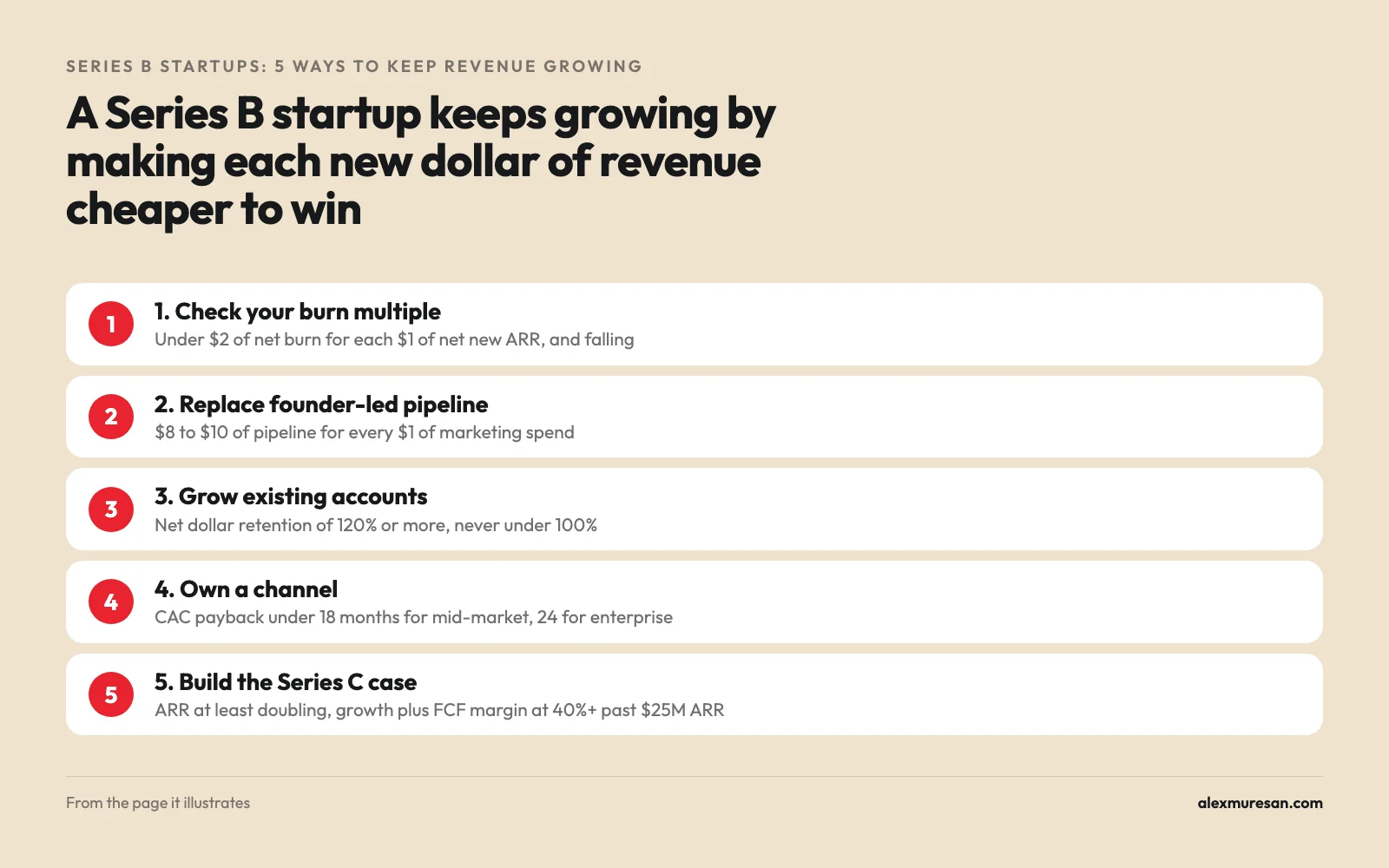
The 5 moves at a glance
Each move comes with a number you can fail. If you fail the first, fix it before you touch the other 4.
| Move | The threshold you can fail | Who shows it |
|---|---|---|
| 1. Check your burn multiple | Under $2 of net burn for each $1 of net new ARR, and falling | Fast: $102M Series B, six-figure 2021 revenue, shut down in 2022 |
| 2. Replace founder-led pipeline | $8 to $10 of pipeline per $1 of marketing, with pipeline at 3 to 5x the ARR goal | Gong: 300 customers at its Series B, about 1,300 by August 2020 |
| 3. Grow existing accounts | Net dollar retention of 120% or more, and never under 100% | Datadog: its 2014 cohort's ARR grew 4.0x by 2018 |
| 4. Own a channel | CAC payback under 12 months (SMB), 18 (mid-market) or 24 (enterprise) | Linear: a total of 0.5% of revenue spent on marketing |
| 5. Build the Series C case | ARR at least doubling, and growth plus FCF margin at 40%+ past $25M of ARR | Clay: revenue tripling toward $100M the year of its Series C |
What is a Series B startup?
A Series B startup is a company that has raised the venture round after its Series A. The A paid to prove there's a repeatable buyer. The B pays to scale the go-to-market behind that proof, which usually means more reps and the first marketing leader with a real budget.
Companies wait longer for it now. Carta found the median company raising a Series B in Q1 2025 had waited 2.8 years since its Series A, the longest interval on record, though median Series B dilution fell from about 15% to 12.9% across 2025.
The move from Series A to Series B is where growth has to stop depending on the founder. Bessemer's portfolio data puts that handoff between $10M and $25M of ARR and calls it "the trickiest part of scaling a cloud business." If you haven't closed the B yet, start with the Series A guide.
I've taken an AI startup from zero to $600K ARR in 5 months, and at my current startup I took revenue from $800K to $1.4M in my first 3 months. Neither was a Series B company. At Series B the demand exists, and the question is what each new dollar of it costs.
1. Check your burn multiple before you spend the round
Your board wants a hiring plan the week the wire clears. Before you add a line to it, work out what growth costs you today. David Sacks of Craft Ventures coined the burn multiple for this job: net burn divided by net new ARR. He calls 2x reasonable for an early-stage startup and writes that after the Series B, "the expectations for efficiency increase even more."
ICONIQ's 2025 data on unprofitable companies past $10M of ARR shows a median around 1.5x and a top quartile under 1.0x. If you burned more than $2 for each $1 of net new ARR last quarter, you fail this move.
Fast is the version nobody wants to repeat. The one-click checkout company raised a $102M Series B led by Stripe in January 2021. TechCrunch reported six-figure revenue for all of 2021 and a burn said to run as high as $10M a month, and Fast shut down in April 2022. A single month of burn at that rate was bigger than all of 2021's revenue (ouch).
The mistake to avoid is the one Sacks names: spending like a later-stage company without delivering later-stage growth. Picture a full sales class hired before anyone checks which channel produced the last 12 months of ARR. I'd compute the multiple monthly and split marketing's share out, because a blended number can hide the single channel eating the round.
2. Replace founder-led pipeline with an engine
The easy Series B go-to-market plan assumes the pipeline that got the company here will scale with headcount. A lot of it came from the founder's network and demo calls, though (and the founder has a company to run now).
Bessemer's motto for this stage is "only ramp what works," and it targets $8 to $10 of pipeline for every $1 of marketing spend, with unweighted pipeline at 3 to 5x the ARR goal. The go-to-market team at a16z describes the same moment from the hiring side: once you add sales motions and segments, you need leaders who can systematize that complexity. If a dollar of marketing returns less than $8 of pipeline, you fail this one.
Gong raised a $40M Series B in February 2019 with about 300 customers and had around 1,300 by August 2020. On the Demand Gen Visionaries podcast, CMO Udi Ledergor explained the engine: Gong publishes what it learns from millions of sales conversations, and when an ICP-fit buyer consumes it, a rep starts the conversation. The episode notes put that outbound at about 60% of pipeline and inbound from the same content at about 40%, and he called LinkedIn his cheapest demand gen channel because it's completely organic.
The mistake to avoid is hiring reps ahead of pipeline. Bessemer's advice is to start slow and hold ramped reps to 80%+ quota attainment before you add more. My read is to run content and outbound as 1 motion, because if your SDRs can't see who read what this week, you're paying twice for the same buyer.
3. Grow revenue inside the accounts you already have
The cheapest dollar a Series B startup can add comes from a customer who already trusts it. Bessemer points out that expansion has more levers than new logos when buying gets harder: upsell tiers, add seats, cross-sell, raise prices at renewal.
ICONIQ's top quartile holds 125% net dollar retention at $10M to $25M of ARR and 120% at $25M to $50M. The median in OpenView's archived 2023 benchmarks was 104% at $20M to $50M. Below 120% you're outside ICONIQ's top quartile, and below 100% you fail outright, because part of every quarter's new revenue is just replacing what walked out the door.
Datadog's S-1 shows what passing looks like. Its 2014 customer cohort paid $4.8M of ARR at the end of that year and $19.2M at the end of 2018, 4.0x from the same accounts. Net retention was 146% at June 30, 2019.
The mistake is treating expansion as customer success's problem while marketing stops at the signed contract. Don't overcorrect either: ICONIQ shows new logos still drive most new ARR until about $200M, with expansion at 36% of gross new ARR in the $10M to $25M band. Your customers are also a distribution channel you already pay for.
4. Own a channel so CAC stops climbing
CAC gets worse as you grow, and Bessemer says why: early adopters are the cheapest to acquire, and a maturing company competes for the rest with more spend. OpenView's 2023 data put the median CAC payback at 22 months for companies at $20M to $50M of ARR, up from 17 a year earlier.
Bessemer's benchmark from healthier markets is under 18 months for mid-market and under 24 for enterprise, so past that line you fail this move. More paid against a rising CAC buys the same problem at a higher price, because paid is rented attention and the rent keeps going up.
Linear is the strongest case I know for the other road. It raised a $35M Series B led by Accel in September 2023, saying it had been profitable since 2021 with more cash in the bank than it had ever raised. 4 months later, CEO Karri Saarinen posted that Linear had spent a total of 0.5% of revenue on marketing and ran a sales team of 4 people. Whatever was bringing customers in, it wasn't a marketing budget.
I grew a media company to an 800K audience on organic alone before selling it in 2026, so I'm biased here (which is why this section runs on Bessemer's and OpenView's numbers). Owned means a list, a show, a community, or the answers buyers get when they ask ChatGPT about your category. It's whatever you still have the month the budget stops.
The mistake to avoid is killing an owned channel at month 4 because paid search posted a cheaper lead that quarter. Owned channels compound, so judge them on the payback trend across a full year.
5. Build the Series C case a year early
The metrics you report this year are your Series C pitch. ICONIQ starts placing real weight on the Rule of 40 (ARR growth plus FCF margin) at about $25M of ARR, and its 2025 data found it the strongest predictor of public software valuations. Growth still earns the bigger premium: a 1-point gain in growth moves valuation about 2x as much as the same gain in FCF margin.
For the growth half, Battery Ventures' Neeraj Agrawal wrote the classic path in T2D3: from $2M of ARR, triple, triple, double, double, double. If ARR isn't at least doubling, or growth plus FCF margin sits under 40% once you're past $25M, the C gets harder to raise.
Clay shows what that looks like. It raised a $100M Series C at a $3.1B valuation in August 2025, led by CapitalG, and CEO Kareem Amin said Clay expected to end the year with $100M in revenue, triple the year before. It had raised about $104M in total before that round, so it was close to $1 raised for every $1 of revenue it expected that year.
The mistake is cutting growth to make the margin look better, a trade that only makes sense when the burn multiple from move 1 is broken. The Series C guide picks up from here.
What Series B startup benchmarks leave out
Read the VC reports side by side and they mostly agree. Craft and Bessemer put efficiency first, and ICONIQ and OpenView show expansion carrying more of the load as you scale. Every one of those numbers measures what distribution produced, and none can tell you which channel to own, because that depends on where your buyers already spend their time. That's why I keep pointing at owned channels: run long enough, they get cheaper per customer while paid gets more expensive.
Hear how VCs got their companies through Series B
For the investor side of these moves, Sell That S*it! is filming season one now, and every guest is a VC. Each episode takes 1 graduation, like Series B to Series C, and asks what the company had at the next round that it didn't have at the last. Get episode one from the show page, or use the box below for my notes on organic demand.
FAQs about Series B startup growth
What are the top 5 things a Series B company should do to keep growing revenue? In order: check your burn multiple, replace founder-led pipeline with an engine, grow existing accounts, own a channel that brings CAC down, and build the Series C case a year early.
How do Series B companies scale pipeline efficiently? They hold marketing to a pipeline ratio, and Bessemer's is $8 to $10 of pipeline for every $1 spent. They add reps only as fast as pipeline can feed them.
What go-to-market changes should a company make after raising a Series B? Move pipeline off the founder and onto a system, and hire leaders who can run it. Make expansion a revenue line marketing owns, and start reporting the Rule of 40 before an investor asks for it.
How do Series B SaaS companies lower CAC as they scale? They build channels they own, so each new customer doesn't mean renting attention again, and they lean on retention, since OpenView notes that a healthy CAC payback depends on net dollar retention.
What do investors look for before a Series C? They look for efficient growth. ICONIQ starts weighting the Rule of 40 at about $25M of ARR, and a burn multiple that keeps falling makes the same case from the cash side.
Is founder-led marketing worth it for a Series B company? Yes, and it's often the cheapest channel you have, as long as a team takes over parts of it as you scale. Linear's CEO has written that Linear ran on product and brand with no paid marketing or sales at first, and added both once growth was organic. I compare the routes in founder-led GTM vs marketing agencies.
What is the best marketing strategy for a Series B B2B company? The best Series B marketing strategy pairs a pipeline target with 1 owned asset that compounds. Lattice built Resources for Humans, an HR community its first marketer, Alex Kracov, told First Round grew from zero to about 20,000 people in Slack.
About the author

Alex Muresan is a 4x founder with 2 exits. He built his first company, a physical entertainment center, to 60 employees and $2M in annual revenue in his early 20s. His second exit came in 2026, when he sold a media company. He took an AI startup from 0 to $600K ARR in 5 months, and at his current startup he took revenue from $800K to $1.4M ARR in his first 3 months. He also hosts Sell That S*it!, where every guest in season one is a VC.
Part of the stage playbooks: what to do for growth at pre-seed, seed, Series A, Series B and Series C. The glossary →