
What it is: The accumulated value of everything you built that nobody can find. It compounds like financial debt, because every unfound launch makes the next one start colder.
What it costs: A higher acquisition cost on every launch, channel partners who stop bringing you into deals, and a team that slowly learns its work does not matter.
How to measure it: List everything you launched in the last twelve months and circle what your own customers could not name. That percentage is your number, and most teams land between 50 and 60%.
How to pay it down: Stop servicing it with more volume. Find the contrarian move, pick the exact channel, make the work travel, then own the audience so the next launch starts warm.

What is distribution debt?
Distribution debt is the accumulated value of everything you built that nobody can find. The feature shipped into silence. The launch that died in a day. The post that deserved reach and got none. It behaves like financial debt: you service it with more launches and more content, and the balance never drops.
That is the distribution debt definition in a marketing context, and it is the reason most "great product" stories end quietly. A great product nobody can find is just an expensive hobby. I started calling it distribution debt in June because nothing on a dashboard measured it, and most companies I talk to have years of it with no line item.
It shares two traits with the financial kind. It accrues interest, and the minimum payment feels like progress. The interest is the extra push your next launch needs, because you have taught the market that your releases are not worth watching. The minimum payment is more volume: another campaign, another twenty posts, another launch into the same silence. Volume services the interest and leaves the principal exactly where it was.
Distribution debt vs technical debt
Technical debt is code you will have to rewrite later. Distribution debt is work you already paid for that never earned its return. The difference that matters is visibility: engineers keep a backlog of technical debt, and almost nobody keeps a list of the launches that went nowhere, which is how the balance grows without anyone signing off on it.
Why distribution debt compounds
Every unfound launch raises the cost of the next one. The market has learned your releases are not worth watching, so the following one starts from a colder position and needs more push to travel the same distance. That is the compounding, and it is why the balance grows faster than the roadmap.
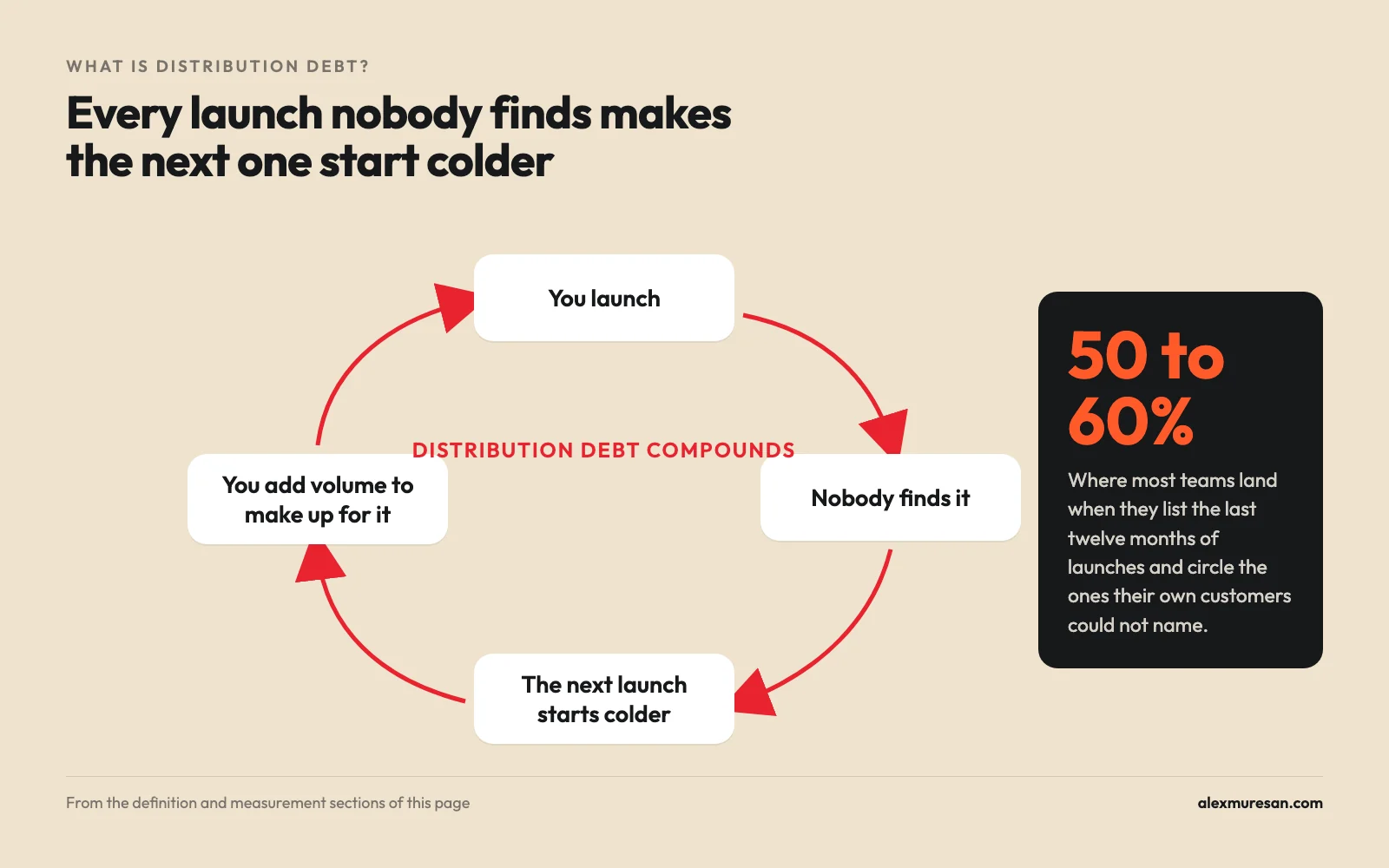
It also rots morale. Each time a team ships into silence, it learns the work does not matter, and that belief lowers the bar on everything after it. The wasted launch is cheap next to the lowered bar.
Partners feel it next. Partners do not create demand, they convert it. As your distribution debt grows, the natural demand that used to reach a reseller, an agency partner or a marketplace listing dries up, and the partner is left cold-selling a brand nobody in the room recognizes. Partner-sourced pipeline stalls, co-marketing gets quiet, and your best partners reallocate their attention to the vendors buyers already name.
What distribution debt costs: real examples
Here is what distribution debt looks like when someone finally measures it. Publishers built entire acquisition engines on Google referrals, and Pew Research Center found that users clicked a link on just 8% of visits where an AI summary appeared, against 15% on results pages without one. Authoritas reported that a site ranked first can lose up to 79% of its traffic for a query when an AI Overview sits above it. Brands that built audiences on Facebook Pages watched average organic reach fall from roughly 16% in the early 2010s to low single digits.
None of those teams failed on craft. Their work was good and their distribution was rented, and the landlord changed the terms. Every one of those audiences had to be bought back, which is what paying off distribution debt at the worst possible exchange rate looks like.
How to measure your distribution debt
List everything you launched in the last twelve months: features, products, campaigns, the case study, the report. Circle the ones your own customers could not name. That percentage is your distribution debt, and most teams sit somewhere between 50 and 60% while calling the list a roadmap.
Then run the outside test. Ask ChatGPT, Claude and Perplexity the question your best customer asks before they find you, the way I describe in go ask ChatGPT about your own category. The answer usually names three companies. If yours is not one of them, you have just measured the same debt from the market's side.
You already track customer acquisition cost and burn. This number belongs next to them, measured every quarter, because the trend tells you more than any single reading.
How to pay down distribution debt
The first move is to stop making the minimum payment. Shipping more into the same silence adds to the balance, so ship less and make each thing travel further. A retainer that produces twenty posts a month is a production service, and distribution debt is a structural problem that production does not pay down.
Paying it down is the four moves of Native Organic Distribution, in order.
1. Find the contrarian move
Most launches sound like every other launch in the category, which is why nobody repeats them. Start from the thing you believe that your competitors would not say out loud, because a position people can disagree with is the only kind they forward.
2. Pick the exact channel
"Content marketing" is not a channel. Name the subreddit, the newsletter, the podcast, the prompt your buyer types into a model. If you cannot name where the work will land, it will land nowhere, and that is how most of the debt was created in the first place.
3. Make it travel
Build each piece so someone else can carry it: a number worth quoting, a framework with a name, a format native to where it is published. Work that only travels when you pay for it is rented, however good it is.
4. Own the audience
Every piece of reach needs a path to something you keep: a list, a show, a site. Reach you cannot contact again is reach you rented, and owned audience is the only thing that makes the next launch start warm instead of cold.
It helps to know where distribution debt does not get paid down. Marketplaces like Amazon and eBay rent you the buyer, and the rent is itemized. Partner and ERP systems like Salesforce and NetSuite route demand that already exists, and changelog tools like LaunchNotes talk to people who already found you. Answer engines like Perplexity and ChatGPT sell no ad slot that buys you a citation, so presence there is earned by everything above.
Getting help paying it down
If you bring someone in, ask them one question before anything else: what do I still own if we stop tomorrow? If the answer is a paused ad account and a reporting dashboard, the engagement adds to the debt. If it is a list, a show, a site and a point of view that other people repeat, it pays it down.
The method is free to read: the stage playbooks, the glossary and YapCut, the open-source content engine I run on myself.
FAQs About Distribution Debt
What is distribution debt? Distribution debt is the accumulated value of everything a company built that nobody can find, from features shipped into silence to launches that died in a day. It compounds like financial debt: teams service it with more launches and more content while the balance never drops.
How is distribution debt different from technical debt? Technical debt is code you will have to rewrite. Distribution debt is work you already paid for that never reached its market. Engineers track technical debt on a backlog, while almost nobody tracks unfound launches, which is why distribution debt grows unnoticed.
How do you measure distribution debt? List everything you launched in the last twelve months and circle what your own customers could not name. The percentage is your distribution debt, and most teams land between 50 and 60%. Then ask ChatGPT, Claude and Perplexity your best customer's question to see whether the market names you.
Does paid advertising reduce distribution debt? No. Paid reach stops the day the spend stops, so it rents attention for the length of the campaign and leaves the balance where it was. A growth hack does not reduce it either, because it services the interest without touching the principal.
How does distribution debt affect channel partners? Partners convert demand rather than create it. As distribution debt grows, the natural demand reaching resellers, agency partners and marketplace listings dries up, partner-sourced pipeline stalls, and the best partners move their attention to the vendors buyers already name.
How do you pay down distribution debt? Ship less and make each piece travel. Find a contrarian position, name the exact channel it will land in, build it so other people can carry it, and route every piece of reach into something you own, such as a list, a show or a site.
How long does it take to pay down distribution debt? Longer than a quarter, and the cost relief starts sooner than the compounding. The first owned asset usually takes a quarter to start pulling its weight, and after that each launch starts warmer than the one before it.
About the Author

Alex Muresan is a 4x founder with 2 exits. He built his first company, a physical entertainment center, to 60 employees and $2M in annual revenue in his early 20s. His second exit came in 2026, when he sold a media company. He took an AI startup from 0 to $600K ARR in 5 months, and at his current startup he took revenue from $800K to $1.4M ARR in his first 3 months. He also hosts Sell That S*it!, where every guest in season one is a VC.
Part of the stage playbooks: what to do for growth at pre-seed, seed, Series A, Series B and Series C. The glossary →