
Ask what they built before you follow: All 9 startup influencers on this page have a company or a fund you can check outside their own bio, from HubSpot to Teachable to Conviction.
Each one has a best channel: Dharmesh Shah and Rand Fishkin are at their best on LinkedIn, Pieter Levels and Ankur Nagpal on X, Sarah Guo and Jason Calacanis on YouTube, and Sabrina Ramonov and Ankur Warikoo on TikTok and Instagram.
The real operators tell you about the miss: Calacanis's Mahalo shut down in 2014, Warikoo laid off 80 of nearbuy's 400 people, and Nagpal says he was burned out when he sold Teachable.
Venture capital is covered from both chairs: Sarah Guo writes the checks at Conviction, and Rand Fishkin gives a whole talk on the myths of venture funding after raising for Moz and choosing not to raise more for SparkToro.
Cap it at 3: Pick the 3 whose company looks most like yours this year and mute the rest for a month.

The 9 startup influencers at a glance
It's Sunday night and you have 3 tabs open. One is a LinkedIn post from someone whose headline says Founder, Investor, Speaker, the second is an X thread on how to raise a seed round in 30 days, and the third is a TikTok of a guy explaining term sheets from a rooftop. All 3 sound sure of themselves, and not one of them tells you which company they actually built.
I've founded 4 companies and sold 2, and I post short videos about marketing myself, so I know how easy it is to sound like you've done the thing. That's why every person below had to pass one question before I wrote a word about them: what did you build, fund or run, and can I check it somewhere other than your own bio? Here they are, with the channel where each one is worth your attention.
| Creator | What they built or funded | Best followed on | Who should follow | Profile |
|---|---|---|---|---|
| Dharmesh Shah | Co-founded HubSpot, sold Pyramid Digital Solutions | B2B software founders thinking about AI | ||
| Rand Fishkin | Moz, then SparkToro | Founders deciding whether to raise at all | ||
| Pieter Levels (@levelsio) | Nomads.com, Remote OK, Photo AI, all bootstrapped | X and his blog | Solo builders shipping with AI | X |
| Jason Calacanis | Weblogs, Inc., sold to AOL; early Uber angel | This Week in Startups on YouTube | Founders who want the weekly startup news with opinions | This Week in Startups |
| Sarah Guo | Greylock partner, then founded Conviction | No Priors on YouTube, and X | Anyone building or raising for an AI company | X |
| Ankur Nagpal | Teachable, sold to Hotmart; Vibe Capital | X | Founders thinking about the money after the exit | X |
| Arvid Kahl | FeedbackPanda and Podscan, both bootstrapped and sold | His blog and podcast | Founders who never want to raise | The Bootstrapped Founder |
| Sabrina Ramonov | Qurious, sold to Pegasystems; Blotato | TikTok and Instagram | Small teams learning to use AI | TikTok |
| Ankur Warikoo | Ran Groupon India, then led the buyout that became nearbuy | Instagram and YouTube | First-time founders who want the failures told straight |
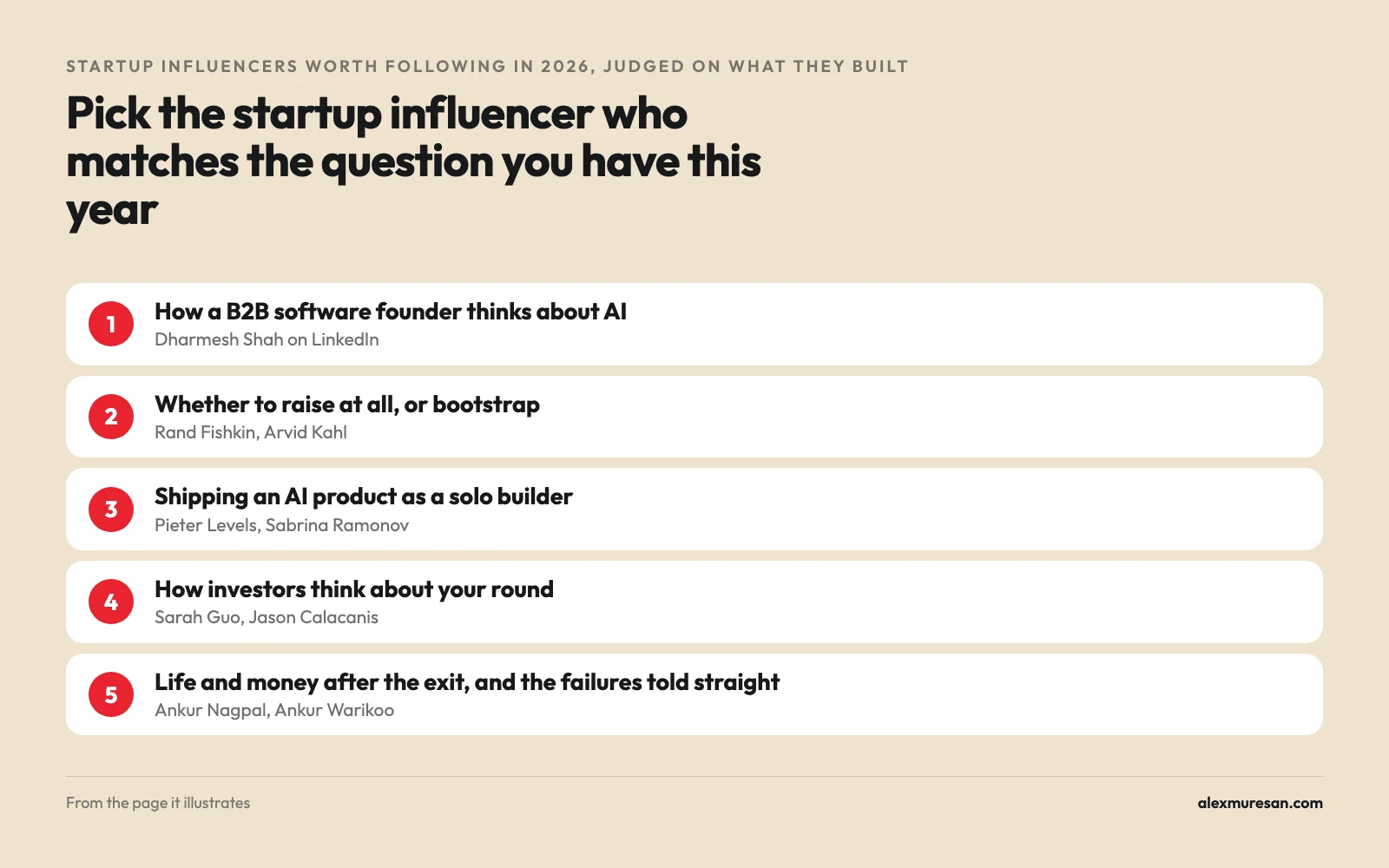
What are startup influencers?
Startup influencers are the people who explain startups, venture capital, tech and growth in public, on LinkedIn, X, YouTube, TikTok, Instagram or in a newsletter. The label covers everyone from a public company co-founder to a 19-year-old who has read a lot of threads, which is exactly the problem. The useful ones earned the right to talk by building a startup, funding one or running one, and what they post comes out of that work.
So this page is narrower than my business influencers list, which covers the big general names like Alex Hormozi and Noah Kagan, and narrower than the business TikTok accounts before it in this series. Everyone here works on startups, tech, VC or AI specifically, and none of them is on either of those pages. If you came looking for tech startup influencers in particular, Sarah Guo, Pieter Levels and Sabrina Ramonov are the 3 who live closest to AI.
9 startup influencers who built, funded or ran the thing first
They're in a loose order, starting with the 2 who are best on LinkedIn, then the builders on X, the investors with shows, and ending with the 2 who are best in short video.
Dharmesh Shah (HubSpot)
Dharmesh Shah founded Pyramid Digital Solutions, which SunGard bought in 2005, and then co-founded HubSpot in 2006, according to HubSpot's own management page, which still lists him as co-founder and CTO and says he's an angel investor in more than 60 startups. HubSpot's story page says he and Brian Halligan spotted the shift they built it on as MIT graduate students in 2004. What I like about following him is that he still builds in public, 20 years in. His AI agent side project, agent.ai, had 258,000 users by January 2025 while it ran separately from HubSpot, CX Today reported, and in 2026 HubSpot folded it into its own product, with the standalone site closing on August 22nd, per StartupHub.ai.
LinkedIn is where to follow him, because a 2026 profile of SaaS leaders says he posts there daily at 3pm Eastern. Follow him if you run a B2B software company and want to hear how a founder who is still inside his company thinks about AI.
Rand Fishkin (Moz, SparkToro)
Rand Fishkin started the SEOmoz blog in 2003 because he was desperate to pay off his company's debt, stepped down as Moz CEO in 2014 and left in 2018, which is the year he started SparkToro with Casey Henry, all per his SparkToro page. Moz raised an $18 million first round of venture capital, Built In reported, and SparkToro's about page says it is not seeking to raise more, so he has seen both roads from the driver's seat. His 2018 book is Lost and Founder, subtitled "A Painfully Honest Field Guide to the Startup World", and in 2025 he gave a MicroConf talk called "The 7 Deadly Myths of Venture Capital Funding".
His own page lists LinkedIn first among the places he is most active, so that's where to follow him. Start with his July 2024 zero-click study, which found 58.5% of US Google searches ended without a click, and follow him if you're deciding whether your startup should raise at all.
Pieter Levels (@levelsio)
Pieter Levels builds startups by himself, and his blog lists Nomads.com, Remote OK, Hoodmaps, Photo AI and Interior AI, "all bootstrapped without funding and just me coding everything on my laptop." He has written there since 2013, and one of the posts he still features on the homepage is "I'm Launching 12 Startups in 12 Months" from March 2014. The post I'd open first is from March 2026, and its title is the whole lesson: "Photoai.com is a 40,870 line index.php making 105,000/mo revenue and 80,000/mo profit."
Follow him on X, where most of his build logs get posted, and know going in that his feed mixes those logs with travel and whatever else is on his mind. He's the one to follow if you're a solo builder who wants to see an AI product shipped, priced and paid for by one person.
Jason Calacanis (This Week in Startups)
Jason Calacanis sold his blog network, Weblogs, Inc., to AOL in October 2005 for $25 million to $30 million, and through a Sequoia program he put $25,000 into Uber, a stake Wikipedia says was worth roughly $100 million by 2017. The same page records the one that didn't work, because a later company of his, Mahalo, raised $20 million and shut down in 2014. This Week in Startups premiered on May 1st, 2009, and he wrote the rest of the angel lesson down in his 2017 book, Angel.
Watch the show on YouTube, where it still comes out every few days, with recent episodes like "OpenAI's $1.25T Raise, Starlink Mobile & Zuck's Tax Deal" from October 24th. Follow him if you want the week's startup news with a strong opinion attached, and skip him if strong opinions wear you out.
Sarah Guo (Conviction, No Priors)
Sarah Guo joined Greylock in 2013, became its youngest general partner at 28, left in July 2022 and launched Conviction that October with $101 million to back AI companies, according to Wikipedia. Fortune's April 2025 profile lists Harvey, Mistral, Baseten and Sierra in the portfolio, and says she publishes all of her LP letters. My favorite detail from the same piece is that in 2016 she considered leaving Greylock to co-found an AI language-learning startup with Andrew Ng, and decided the technology wasn't ready yet.
Follow her through No Priors on YouTube, the show she co-hosts with Elad Gil, and on X. She's the one to follow if you're building or raising for an AI company, because she is one of the people deciding which ones get funded.
Ankur Nagpal (Teachable, Vibe Capital)
Ankur Nagpal started building Teachable in 2013, shortly after graduating from Berkeley, and sold it to Hotmart in March 2020 at a rumored $250 million, as Every reported. TechCrunch says he raised only $12.5 million before the sale, and then launched Vibe Capital, a $60 million fund for pre-seed and seed founders, in October 2021. What earns him the spot is how plainly he talks about the part nobody films, because his 2023 as-told-to essay for Business Insider includes the line "I was burned out when I sold my first startup for a life-changing amount of money."
Follow him on X, where TechCrunch noted he shared his own fund's performance in a thread. He's the one for founders who are starting to think about what happens to the money and to them after an exit.
Arvid Kahl (The Bootstrapped Founder)
Arvid Kahl and his partner Danielle built FeedbackPanda, a tool for online teachers, bootstrapped it and sold it in under 2 years, and then he founded, bootstrapped and sold Podscan.fm to Audiohook, all per his own site. He built Podscan in public, setbacks included, and his site keeps a post about its profitability setback right next to the exit story. He also wrote Zero to Sold and The Embedded Entrepreneur.
Follow his blog and podcast, The Bootstrapped Founder, if you never want to raise a round. He's the counterweight to every investor on this page, and he's sold 2 companies to prove the other road works.
Sabrina Ramonov (@sabrina_ramonov)
Sabrina Ramonov founded Qurious at 23 to do real-time speech recognition and natural language processing years before ChatGPT, and sold all of it to Pegasystems, according to the about page of her current company, Blotato. Pegasystems announced the deal on January 11th, 2021, said Qurious was founded in San Francisco in 2016, and kept the terms private. Her Blotato page says the tech now powers voice AI in Pega Customer Service, and that she built Blotato for her own content workflow with no outside funding.
Her Blotato page lists her as @sabrina_ramonov on TikTok, Instagram, YouTube and X, and as sabrinaramonov on LinkedIn, and I'd follow the short videos on TikTok and Instagram first. Her stated goal is to teach 10 million people to use AI to grow a business for free, so follow her if you run a small team and want to see the AI tools used, not just named.
Ankur Warikoo (nearbuy)
Ankur Warikoo spent 4 years running Groupon's India business, and in 2015 his team did a management buyout that spun it off as nearbuy, which he described to People Matters. Outlook Business says he stepped down as CEO in 2019, still holds his stake and board seat, and admits he wrongly believed marketing alone would make nearbuy big, while an unclear roadmap led to 80 of its 400 employees being laid off. He started making videos in 2016, first on LinkedIn and then YouTube, and he mostly leaves his mistakes in rather than editing them out.
Most of his feed is about personal growth and money now, so follow him on Instagram for the short version and on YouTube for the long one, and pick the videos where he talks about nearbuy. He's the one for first-time founders, especially outside the US, who want the failure told by the person who made it.
Which startup influencers explain venture capital in plain words?
Sarah Guo is the first one I'd send a non-finance founder to, because No Priors puts her in a room with the founders she's backing and you hear what she asks them. Jason Calacanis explains the angel side, and Rand Fishkin is the useful skeptic, since he raised for Moz and then decided SparkToro wouldn't raise more. Ankur Nagpal sits on both sides, as a founder who sold and then a fund manager.
For short videos specifically, the clearest one I've found is Erica Wenger, who runs Park Rangers Capital and explains cold emails and pre-seed checks on TikTok, and she's on my business TikTok accounts page. If you'd rather read, the venture capital newsletters list has the investors who write, and what investors look for in a startup puts the scoring in one place.
The test: how to tell a real operator from a course seller
The first check takes a minute. Find the company in a source the person doesn't control, like the Pegasystems press release for Sabrina Ramonov's Qurious or HubSpot's own management page for Dharmesh Shah, because a bio is a claim and a press release from the buyer is a receipt. If the only place the company exists is the creator's own course page, that tells you most of what you need.
The second check is the miss. Calacanis's Mahalo raised $20 million and still shut down, Warikoo talks openly about laying off 80 of nearbuy's 400 people, and Nagpal's essay about the sale is built around his burnout. People who have actually run a startup have a bad year somewhere in the story, and the ones worth following put it in public.
The third check is what the content is for. Levels posts his revenue in his headlines and Guo publishes her LP letters, so you can hold them to a number, while an account where every post ends at a sales page is running an ad for the course. Several people here sell things too, and that's fine when the company came first and the product came out of it.
So the next time those 3 tabs are open on a Sunday night, ask each one the same question I asked before writing this page. The 9 people above answer it with a company name and a source you can open, and the rest of the feed usually answers it with a link in bio.
Get the next one in your inbox
Every week I publish one new piece like this, on AI startups, distribution and the people building them, and I post the short versions on TikTok, Instagram and YouTube. Put your email in the box at the end of this page and the next one reaches you the week it lands.
FAQs about startup influencers
Who are the top startup influencers to follow? Start with Dharmesh Shah and Rand Fishkin on LinkedIn, Pieter Levels and Ankur Nagpal on X, and Sarah Guo's No Priors for AI. Add Arvid Kahl if you plan to bootstrap, and Sabrina Ramonov if you want AI tools shown in short videos.
Who are the best startup influencers on LinkedIn? Dharmesh Shah, who co-founded HubSpot and posts there daily, and Rand Fishkin, who founded Moz and SparkToro and lists LinkedIn as the place he is most active. Sabrina Ramonov is on LinkedIn too, if you want AI tools in your feed.
Which content creators have actually built and sold companies? Jason Calacanis sold Weblogs, Inc. to AOL in 2005, Ankur Nagpal sold Teachable to Hotmart in 2020, and Sabrina Ramonov sold Qurious to Pegasystems in 2021. Arvid Kahl sold both FeedbackPanda and Podscan, and Dharmesh Shah sold Pyramid Digital Solutions to SunGard before he co-founded HubSpot.
Which creators explain venture capital and fundraising in short videos that a non-finance founder can follow? Erica Wenger on TikTok is the clearest in short form, and she's on my business TikTok accounts page. On this list, Sarah Guo explains it from the investor's chair on No Priors and Jason Calacanis covers the angel side on This Week in Startups.
There are too many business influencers, so how do I tell which ones actually know what they're talking about? Find their company in a source they don't control, like the buyer's press release, then look for the miss they're willing to talk about. Last, check what the posts are for, because an account where every post ends at a sales page is selling the course.
Who are the best tech startup influencers for AI? Sarah Guo invests in AI companies through Conviction and co-hosts No Priors, Pieter Levels builds AI products like Photo AI on his own, and Sabrina Ramonov sold an AI speech company before ChatGPT and now teaches AI tools. Dharmesh Shah is the pick if you want the view from inside a public software company.
About the author
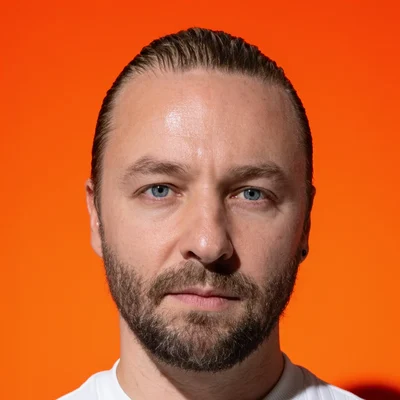
Alex Muresan is a 4x founder with 2 exits. He built his first company, a physical entertainment center, to 60 employees and $2M in annual revenue in his early 20s. His second exit came in 2026, when he sold a media company. He took an AI startup from 0 to $600K ARR in 5 months, and at his current startup he took revenue from $800K to $1.4M ARR in his first 3 months. He posts short videos on AI startups, distribution and the people building them, and takes on sponsorships, content projects and consulting: work with him.
Part of the stage playbooks: what to do for growth at pre-seed, seed, Series A, Series B and Series C. The glossary →