
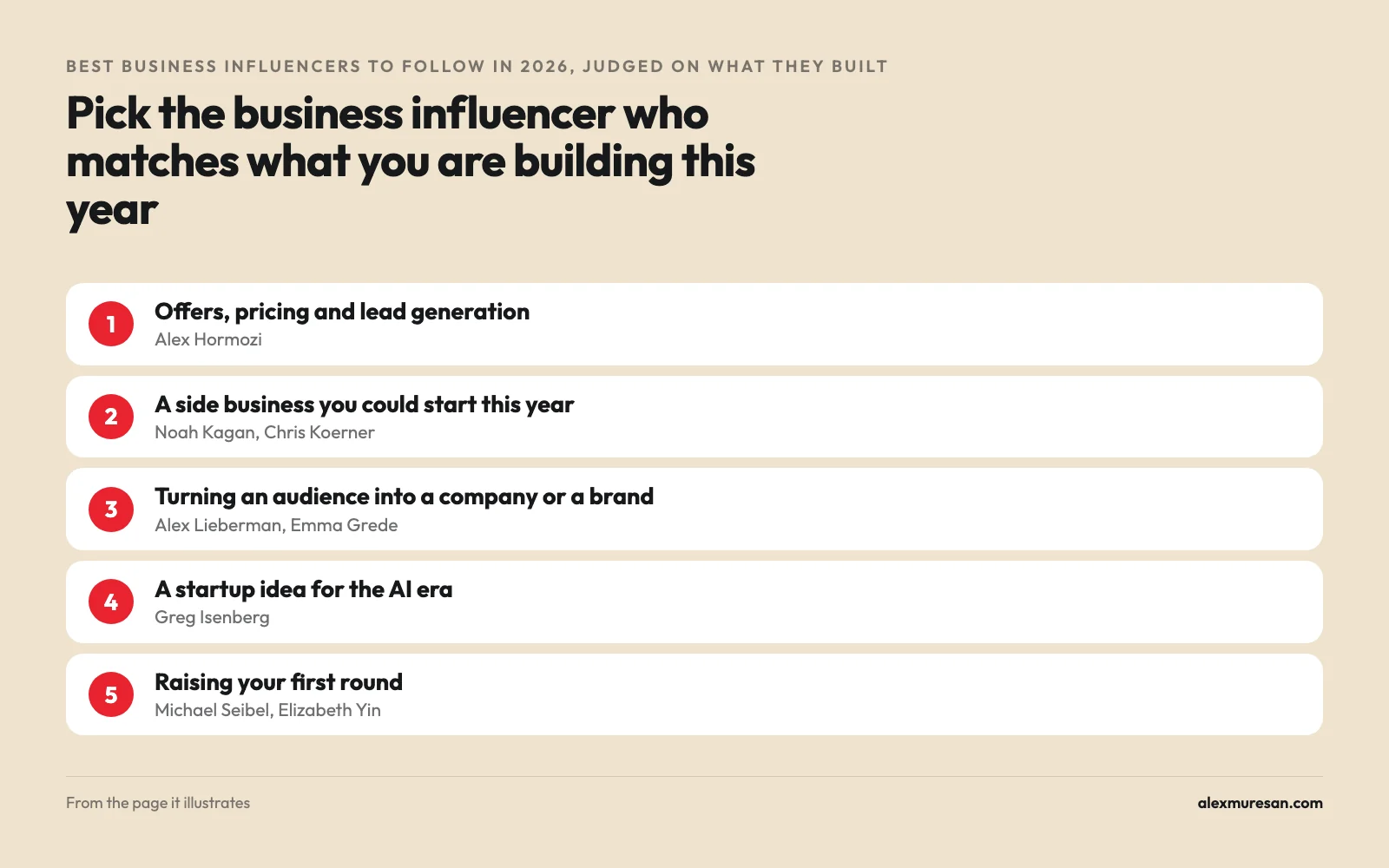
Use a 2-question test: Has this person built something real, and do they teach from it or from a course they want to sell you? Every pick on this page passes both.
Short videos can carry receipts: Alex Hormozi sold Gym Launch and Prestige Labs for $46.2M in 2021, and Chris Koerner grew his newsletter off one TikTok while running a snack resale business.
YouTube holds the long version: Noah Kagan started AppSumo in a weekend for $50, and Greg Isenberg sold 2 startups before he started giving away ideas twice a week.
VC creators explain the money: Michael Seibel sold Socialcam to Autodesk and now teaches founders at Y Combinator, while Elizabeth Yin writes about fundraising from Hustle Fund.
Cap it at 3: Pick the 3 whose work matches what you're building this year, then mute the rest of the feed for a month.

The 8 business influencers at a glance
Open TikTok tonight and count how many business accounts you scroll past before you reach a video that isn't one. One guy is filming from the front seat of a rented Lamborghini. The next one is 22, he made his first million last year, and the link in his bio sells a $997 course on how he did it (by selling the course, mostly).
I spend more time in that feed than I'd like to admit, because I post short videos about growth myself. So I built this list the way I'd want a friend to build it for me. Every person below has built a real company, and what they teach comes out of what happened inside it, near-misses included.
| Creator | What they built | Where to follow | Who should follow | Start here |
|---|---|---|---|---|
| Alex Hormozi | Gym Launch, Acquisition.com, the $100M books | YouTube, TikTok, Instagram, LinkedIn | Anyone with something to sell and a price that feels like a guess | acquisition.com |
| Noah Kagan | AppSumo, early marketing at Mint | YouTube, newsletter | People with a job who want a side business | noahkagan.com |
| Chris Koerner | Texas Snax, a phone repair chain, mobile home parks | TikTok, newsletter | Anyone hunting for a small business idea | beehiiv profile |
| Emma Grede | Good American, founding partner of Skims | Aspire with Emma Grede on YouTube and Spotify | Founders building a consumer brand | emmagrede.com |
| Greg Isenberg | 5by and Islands, both acquired, then Late Checkout | The Startup Ideas Podcast, newsletter | Builders looking for an AI-era idea | The Startup Ideas Podcast |
| Alex Lieberman | Morning Brew, majority sold to Insider | LinkedIn, X, Founder's Journal | Anyone turning an audience into a company | |
| Michael Seibel | Justin.tv and Socialcam, now a General Partner at YC | Y Combinator's YouTube, X, his blog | First-time founders before their first round | YC profile |
| Elizabeth Yin | LaunchBit, acquired in 2014, then Hustle Fund | X | Founders raising a pre-seed round | elizabethyin.com |
What makes business influencers worth following?
Business influencers (or business content creators, if they'd rather skip the word influencer) are the people who teach business to an audience on social media. The label stretches from a public company founder down to a teenager reselling sneakers, and the useful ones have run something with real customers and a real payroll. They tell you what happened in public, including the parts that went badly.
So I ask 2 questions about every account. Has this person built something real? And when they teach, do they teach from that business, or from the course they want you to buy at the end of the video?
The second question matters more than it looks, because a course creates its own incentive. If the product is the course, every video has to make the course feel necessary, so the advice slowly bends toward whatever sells the next seat. Every person below runs a company or a fund today, so their videos come out of a business they already have.
I care about this because I've founded 4 companies and sold 2, and the second exit was a media company that grew to an 800K audience on organic alone. I know how much of a feed is performance, and I wrote about the same test in most growth advice is just inherited audience.
8 business influencers who built something first
Here they are in a loose order, starting with the short-form accounts and ending with the 2 investors. Each one gets the receipt that earned them the spot, and what it's like to learn from them.
Alex Hormozi
Alex Hormozi co-founded Acquisition.com with Leila Hormozi, and their site says that in 2021 a private equity sponsor bought Gym Launch and Prestige Labs for $46.2M. His books, $100M Offers and $100M Leads, have sold over 1M copies according to the same page. What surprised me was the training section, because the offer creation and lead generation courses are both marked free. He posts on YouTube, TikTok, Instagram and LinkedIn (per Favikon's July 2025 profile), and learning from him feels like handing your offer to a blunt friend with a red pen.
Noah Kagan
Noah Kagan was employee #30 at Facebook and got fired 9 months in, 3 months before he vested, which he tells you himself on his about page. He then ran marketing as employee #4 at Mint, which sold to Intuit for $170 million. In 2010 he started AppSumo in a weekend for $50, and his site says it now does over $100 million a year.
The detail I love is that he filmed 100 YouTube videos before he let himself judge the channel. His January 2024 book, Million Dollar Weekend, tells you to try selling the thing before you invest in it, as Publishers Weekly sums it up. Follow him if you have a job and wonder whether a side business could work.
Chris Koerner
The Hustle profiled Chris Koerner in October 2024 as an entrepreneur who had launched and sold one of America's first chains of smartphone repair shops, along with a real estate firm that bought and sold more than 20 mobile home parks. His current business is gloriously strange. Texas Snax buys Buc-ee's snacks at full retail price and resells them online, and by the time of that article it was doing $250k to $300k a month.
He's the account I'd send to anyone who wants a business but has no idea what kind. A beehiiv profile from August 2025 says he had 2,300 newsletter subscribers in late 2023, until one TikTok took him to 45,000 followers overnight. Every video ends with "Get the full business plan in my newsletter," and he is honest about the misses too, because the same profile says one of his businesses reached $8M a year and almost collapsed.
Emma Grede
Emma Grede launched Good American in October 2016 and is the founding partner of Skims, according to her Milken Institute bio. Foundr reports that she launched it with Khloé Kardashian and that it did $1 million in sales on its first day. My favorite part is how it started, because she told Kris Jenner she was coming to Los Angeles the next week, which she wasn't, and then flew in just for the meeting.
Start with Aspire with Emma Grede, the weekly audio and video podcast she launched in May 2025. Follow her if you're building a consumer brand, because she talks about customers like an operator, from post-purchase surveys to fit testing across sizes.
Greg Isenberg
Greg Isenberg founded 5by, a video discovery app that StumbleUpon acquired, and then Islands, a messaging and community app that WeWork acquired. Today he runs Late Checkout, which he co-founded, and hosts The Startup Ideas Podcast, a free show that comes out twice a week. It is exactly what the name says, and lately most of the ideas are about AI, like the October 6th episode, "How Will People Make Money in the AI Age?" Follow him if you want to build something with AI and you're stuck on what.
Alex Lieberman
Alex Lieberman started Morning Brew in his senior year at the University of Michigan as a daily roundup called the Market Corner, which was a Word document saved as a PDF and sent through a campus mailing list, according to Talking Biz News. In October 2020, the parent company of Business Insider bought a controlling stake at a reported valuation of up to $75 million, when the daily email had about 2.5 million readers, per Pulse 2.0.
Learn from him if you're turning an audience into a company, because that's exactly what he did, starting from a PDF. His podcast, Founder's Journal, has episodes like "How to Get Your First 1,000 Users" from June 2025, and his LinkedIn and X are linked from his Kara Goldin Show page.
Michael Seibel
Michael Seibel co-founded Justin.tv and Socialcam, and his Y Combinator profile says Autodesk bought Socialcam in 2012 for about $60 million. Justin.tv later became Twitch, which Amazon bought in 2014 for about $970 million. He is now a General Partner at YC, and his videos there include "How to build an MVP" and a whole one on tarpit ideas and how to avoid them.
He's the closest thing to a free startup course on the internet, and he teaches in plain words. My favorite line of his comes from his essay on product-market fit: "you have reached product/market fit when you are overwhelmed with usage." Follow him before you raise, because he will stop you from celebrating too early.
Elizabeth Yin
Elizabeth Yin co-founded and ran an adtech company called LaunchBit, which was acquired in 2014, and then became a partner at 500 Startups. Today she is co-founder and General Partner at Hustle Fund, a pre-seed fund for software entrepreneurs, and Mercury's 2021 interview says she had reviewed over 20,000 pitches in the few years before it.
What makes her worth following is that she writes down what investors usually only say in private. She told Mercury she had started posting one thread a day on Twitter, mostly about fundraising and angel investing, and her advice is blunt: "Before Series A, I wouldn't dilute more than half of your company." If you're raising a pre-seed round this year, she's the one to read.
Accounts like AskCatGPT, but for marketing and growth
If you found this page because you love how AskCatGPT explains AI, you already know what good looks like. Cat Goetze runs CatGPT, "an online media brand focused on artificial intelligence," as @askcatgpt on TikTok and Instagram, and the whole idea is AI education that never talks down to you. She passes my test too, which I didn't expect, because she also built a product company. Shopify reported in May 2026 that Physical Phones, her Bluetooth landline, did $1 million in less than a year.
For marketing and growth, the closest match is a mix of accounts. Alex Hormozi does what she does for offers and lead generation, in short videos with plain words. Michael Seibel does it for startups, and Elizabeth Yin does it for fundraising, which in my experience is the part of venture capital that confuses first-time founders the most.
If you'd rather read than watch, our growth marketing experts list covers the newsletter writers, and the best podcasts for startup founders covers the long interviews. For what your company should do at its stage, the stage playbooks go from pre-seed to Series C.
How to tell if a business account knows what it's talking about
The hustle-culture accounts are easy to spot once you watch the last 5 seconds of the video. If every video ends at a sales page, the content is an ad for the course. If it ends on a lesson from a business you can go and check, you've probably found someone worth following.
Then check whether they ever show you a miss. Noah Kagan puts his Facebook firing on his own about page, and Chris Koerner talks about the business that hit $8M a year and nearly collapsed. People who have actually built something have bad quarters, and the ones worth learning from tell you about them.
Last, stop reading the follower count as proof, because posting well is a separate skill from building a company (here's why follower counts stopped deciding reach this year). The same test works on entrepreneur influencers in any niche, and I'd rather follow an investor who posts a fundraising thread a day than a bigger account that has never raised a dollar.
So tonight, when the guy in the rented Lamborghini shows up in your feed again, ask him the 2 questions. He'll probably fail both, which is fine, because now you know who to follow instead.
Hear how VCs got their companies to the next stage
If you want the investor view on how a company actually got from one stage to the next, that's what my show Sell That S*it! is built for. Every season-one guest is a VC, and season one is filming now, so there are no episodes out yet. Until it lands, the best venture capital podcasts will keep your commute busy, and the newsletter box at the bottom of this page tells you when the first episode drops.
FAQs about business influencers
Who are the best business influencers to follow in 2026? Alex Hormozi and Chris Koerner are the strongest picks for short business videos, because both built real companies and teach from them. Add Noah Kagan for YouTube, and Michael Seibel and Elizabeth Yin if your startup will raise money.
What are the best business TikTok accounts to follow in 2026? Start with Alex Hormozi (@ahormozi) for offers and pricing, and Chris Koerner for small business ideas you could actually start. Koerner grew his newsletter off one TikTok, and every video points you to the full business plan.
Which business creators give advice without the hustle-culture fluff? Michael Seibel and Elizabeth Yin are the 2 I'd start with, because both teach in plain words from companies and funds they have actually run. Noah Kagan is the most fun of the group, and he still tells you about getting fired from Facebook.
Which content creators have actually built and sold companies? Alex Hormozi sold Gym Launch and Prestige Labs for $46.2M in 2021, and Michael Seibel sold Socialcam to Autodesk in 2012. Greg Isenberg sold 5by to StumbleUpon and Islands to WeWork, and Alex Lieberman sold a controlling stake in Morning Brew in 2020.
What are some accounts like AskCatGPT but for marketing and growth? Alex Hormozi is the closest match for marketing, because he explains offers and lead generation in short videos with plain words. For startups and fundraising, Michael Seibel and Elizabeth Yin do what Cat Goetze does for AI.
How do I tell which business influencers actually know what they're talking about? Ask 2 questions: has this person built something real, and do they teach from it or from a course they're selling? Then look for the misses, because people who have run companies talk about their bad quarters too.
About the author
Alex Muresan is a 4x founder with 2 exits. He built his first company, a physical entertainment center, to 60 employees and $2M in annual revenue in his early 20s. His second exit came in 2026, when he sold a media company. He took an AI startup from 0 to $600K ARR in 5 months, and at his current startup he took revenue from $800K to $1.4M ARR in his first 3 months. He also hosts Sell That S*it!, where every guest in season one is a VC.
Part of the stage playbooks: what to do for growth at pre-seed, seed, Series A, Series B and Series C. The glossary →