
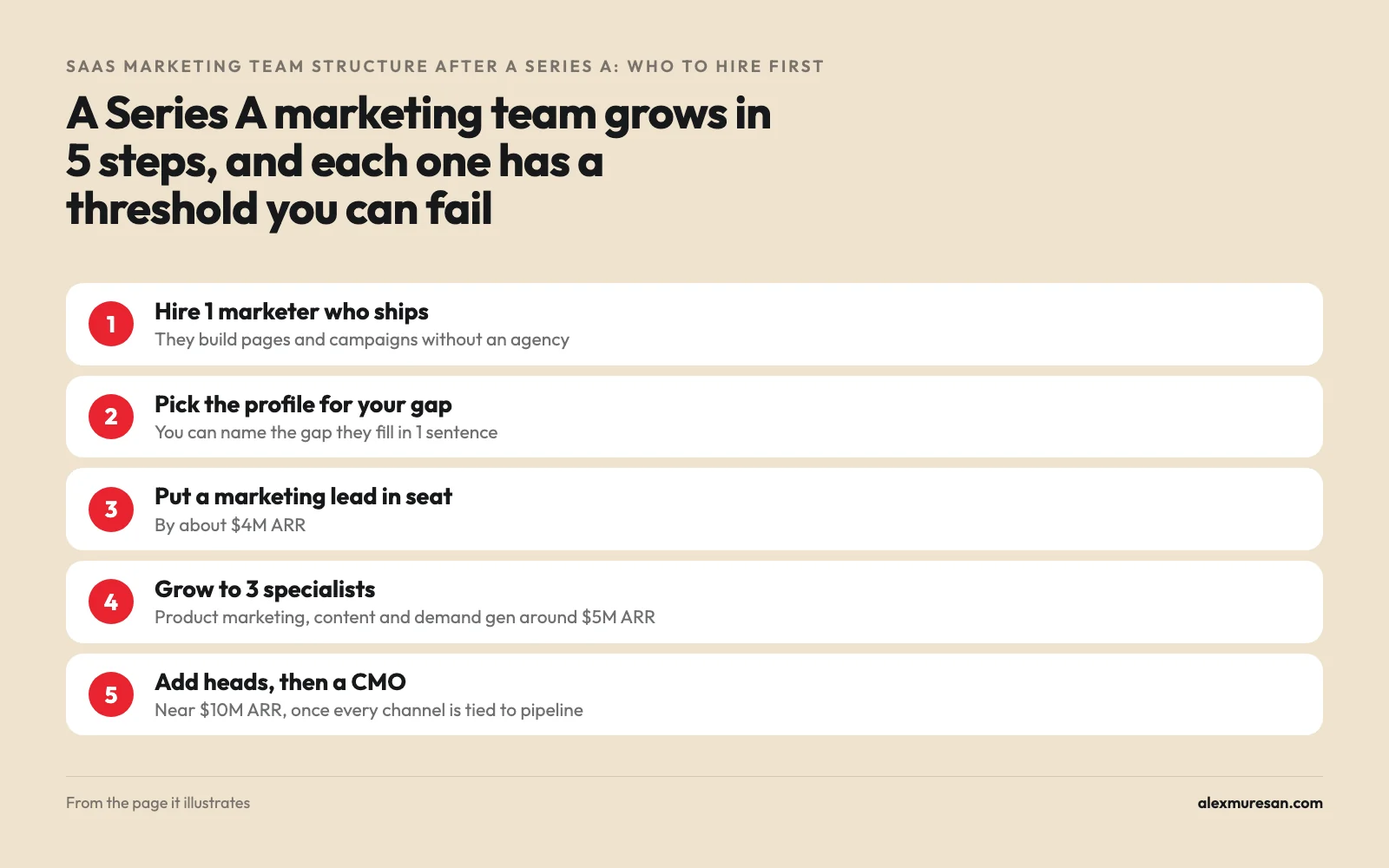
Start with 1 person who ships: The best SaaS marketing team structure right after a Series A is 1 hands-on marketer who can build the page and launch the campaign without hiring an agency to do it.
Hire for the gap you actually have: Pick the first marketer for the hole in your go-to-market, product story or pipeline, because one person can't cover every marketing specialty.
Have a marketing lead by $4M ARR: That's where Bessemer's hiring milestones put a marketing expert, after a sales expert by $1M and a product expert by $2M.
Grow to 3 around $5M ARR: The typical early team Tom Tunguz describes is a product marketer, a content person and a demand-gen specialist.
Add heads, then a CMO, near $10M ARR: Heads of demand gen and product marketing come in as you scale, and a CMO arrives once the machine is predictable.

SaaS marketing team structure at a glance
The money lands on a Tuesday, and by Thursday there's a hiring plan in a spreadsheet. Somewhere around row 6 there's a cell that says Head of Marketing, with a salary next to it that nobody argued about, and nothing underneath about what that person does in their first week. If you just raised, you've probably seen that cell this month.
This page sits beside Series A startups: 5 things to do to accelerate growth, and it zooms in on move 4 from that guide, the marketing hire. The table is the short version of what should go in that cell, and every number in it is sourced further down.
| Stage | What the team looks like | The threshold you can fail |
|---|---|---|
| 1. Right after the round, around $2M ARR | Founders still close; 1 hands-on marketer joins | The marketer ships pages and campaigns without an agency |
| 2. Pick the profile | 1 T-shaped marketer chosen for your go-to-market motion | You can name the gap they fill in 1 sentence |
| 3. By $4M ARR | A marketing lead owns pipeline | Bessemer's marketing expert milestone is met |
| 4. Around $5M ARR | About 3 people: product marketing, content, demand gen | Marketing spend near the 8% of ARR median |
| 5. Near $10M ARR | Heads of demand gen and product marketing, then a CMO | Every channel already tied to pipeline in the CRM |
What is a SaaS marketing team structure?
A SaaS marketing team structure is the set of marketing roles a software company hires, the order it hires them in, and who each one reports to as revenue grows. At a Series A startup it's small, usually 1 to 3 people, and the shape matters more than the headcount.
That Head of Marketing cell is where most of the trouble starts, because "Head of Marketing" describes a seat on the org chart and says nothing about the work. So the rest of this page is about the work: which person you hire first, who comes next, and what the team should look like at $2M, $5M and $10M ARR.
Your first marketing hire, at around $2M ARR
At around $2M ARR the founders are still the sales team. Battery Ventures' Neeraj Agrawal, who wrote the famous T2D3 piece, says that in this phase "the founders are closing all the new sales." The next phase, the triple to $6M, is where he wants a sales leader plus 5 to 10 reps.
So the first marketer walks into a company where every buyer has met a founder. Their job is to bring in buyers who never have, which is a very different job from managing a brand, and it's why the profile matters so much.
Maya Spivak, who was the second marketer at Segment and later ran marketing at Mux, puts it plainly in First Round Review: "For a first hire, I favor the T-shaped marketer." She means someone deep in 1 area who can stretch into the others, and who is ready to do the work with their own hands for at least a few quarters.
She also names the mistake I see most, which she calls "Lumping all of these specialties together." Founders write a job description that wants product marketing, demand gen, brand, content and events from 1 person, then act surprised when the hire is mediocre at 4 of them. Her fix is to pick the specialty that fits your motion, whether that's product-led growth or top-down sales, and the gap the founders leave.
The button-clicker test
Lattice's first marketer is the example I come back to. Alex Kracov joined in July 2016 as employee number 3, at 25, with no SaaS experience at all. He taught himself Figma and Sketch and how to build sites, often from YouTube, because there was nobody else to do it.
He calls this the button-clicker test. The failure he describes is hiring someone who "can talk the talk" and then has to hire other people to click the buttons, which is why he steers away from marketers who start by bringing in contractors or an agency. I agree with him, because a briefing cycle with an agency eats weeks you don't have once the Series B clock is running. I took an AI startup from zero to $600K ARR in 5 months, and at that pace the person with the idea has to be the person who ships it.
If you're weighing that trade right now, I went through it in more detail in Founder-led GTM vs marketing agencies.
The B2B marketing team structure at $5M ARR
By $4M ARR, Bessemer wants a marketing expert in the building. Its rule-of-thumb hiring milestones in Scaling from $1 to $10 million ARR put a sales expert by $1M, a product expert by $2M and a marketing expert by $4M. So the person you hired at $2M either grows into that lead or ends up reporting to them.
Somewhere between $4M and $5M the team usually becomes 3 people. The VC Tom Tunguz wrote in 2022 that "the early marketing organization numbers three people": a product marketer, a content person and a demand-gen specialist. He also admits the first hire is often decided by who's available, which made me laugh, because it's true and nobody says it.
Lattice grew in the same direction. Kracov's first hire under him was a content writer, and the next was someone for community and events. That community became Resources for Humans, a Slack group for HR people that grew from zero to 20,000 members.
The detail I love is what he did with it. Every week the team uploaded the member list into Salesforce to see who went on to create pipeline and revenue. Think about what that means for structure, because the content hire and the community hire were measured on pipeline from week 1, so nobody ever had to ask what marketing was for.
What it costs
SaaS Capital's 2026 survey of more than 1,000 private B2B SaaS companies found the median company spends 8% of ARR on marketing and 15% on selling costs. For companies between $3M and $5M ARR, the medians are 8% on marketing and 12% on selling.
At $4M ARR, 8% is about $320K a year, and that has to cover salaries and programs both. Equity-backed companies in the same survey spend 100% more on marketing than bootstrapped ones, so a funded team will usually run above the median. My read is that this budget pays for a small team that ships, and it gets thin very fast once an agency retainer is in it.
The SaaS marketing team structure at $10M ARR
Near $10M ARR the 3 specialists stop being enough, because each of them now needs someone to run a function. Tunguz describes the next step as the point where "the heads of demand generation and product marketing join the team." Spivak frames the same split as 3 pillars, product, growth and brand, and says growth marketing works best once the website and sign-up flow already exist.
Then comes the senior hire. Bessemer's example is Teleport, which by $10M ARR had a scalable sales and marketing organization and only then hired a chief marketing officer and a chief revenue officer to run a big ramp. Notice the order, because the CMO arrived after the machine worked, to scale it, and was never hired to invent it.
That's the part founders get backwards most often. They hire the CMO at $3M hoping the CMO will find the machine, when the companies Bessemer writes about found the machine first with a small team that shipped. The Series B guide picks up from here, once you're past $10M and the question becomes how to keep it growing.
Why Series A startups miss their growth targets
The odds are rough. Carta's Peter Walker reported in October 2024 that only 9% of companies that raised a Series A in Q3 2022 had reached a Series B within 2 years. For the Q3 2018 cohort it was 25% (ouch).
A lot of that comes down to hiring in the wrong order. Peter Levine at a16z warns that "it is very tempting to scale sales far ahead of demand," and his rule is "Build sales only when you see demand." The marketing version of that mistake is building a department before anyone has proved which channel produces pipeline.
My read is that the plan in that spreadsheet decides more than founders think. At my current startup I took revenue from $800K to $1.4M in my first 3 months, and the lesson I'd pass on is to hire the person who will do the work on day 1 before you hire the person who will manage it. Get that order right and you're already building a marketing team the Series B investors will recognize.
Learn this stage from the VCs who fund it
Every season-one guest on Sell That S*it! is a VC, and we break down how a fund graduates a company from one round to the next, hiring plan included. Season one is filming now, so there are no episodes yet. If you want them when they land, use the newsletter box at the bottom of this page, and if you'd rather learn from operators in the meantime, start with these growth marketing experts to follow.
FAQs about SaaS marketing team structure
How should a Series A B2B startup build its first marketing team? Start with 1 hands-on, T-shaped marketer chosen for the gap in your go-to-market, then grow to about 3 people (product marketing, content and demand gen) around $5M ARR. Bessemer's milestones put a marketing expert in seat by $4M ARR.
Who should be the first marketer at a SaaS startup? It should be someone who passes Alex Kracov's button-clicker test, meaning they can build the page and launch the campaign themselves. Tom Tunguz notes most startups start with either a product marketer or a demand-gen specialist, depending on the motion.
What go-to-market changes do startups make between Series A and Series B? The founders stop closing every deal, and a sales leader with reps takes over, which Neeraj Agrawal places in the triple from $2M to $6M ARR. Marketing moves from 1 generalist to a small team measured on pipeline, with department heads arriving near $10M ARR.
Why do Series A startups miss their growth targets? Often because they hire ahead of demand. Peter Levine at a16z warns against scaling sales before demand shows up, and the same applies to hiring a large marketing team, or a CMO, before a channel is proven.
Is there a rule of thumb for how to build a marketing team on a Series A budget? Yes, use the SaaS Capital medians as a guardrail: about 8% of ARR on marketing at $3M to $5M ARR. Spend it on people who ship before you spend it on agencies.
About the author

Alex Muresan is a 4x founder with 2 exits. He built his first company, a physical entertainment center, to 60 employees and $2M in annual revenue in his early 20s. His second exit came in 2026, when he sold a media company. He took an AI startup from 0 to $600K ARR in 5 months, and at his current startup he took revenue from $800K to $1.4M ARR in his first 3 months. He also hosts Sell That S*it!, where every guest in season one is a VC.
Part of the stage playbooks: what to do for growth at pre-seed, seed, Series A, Series B and Series C. The glossary →