
Why now: An organic growth strategy has to start at Series C, because your first channel flattens just as the board starts reading efficiency, so every new dollar of paid buys less pipeline than the last one did.
The build order: Start with content your product answers, then pages built from your product's data, a free tool, your people and community, and finally mentions on pages you don't own.
Each channel feeds the next: The questions you answer in month 1 become the free tool in month 5 and the pitches you send for mentions in month 10.
The 12-month bar: By month 12, organic-sourced pipeline in your CRM should be larger than paid-sourced pipeline. If it isn't, the threshold you failed tells you which channel to fix.

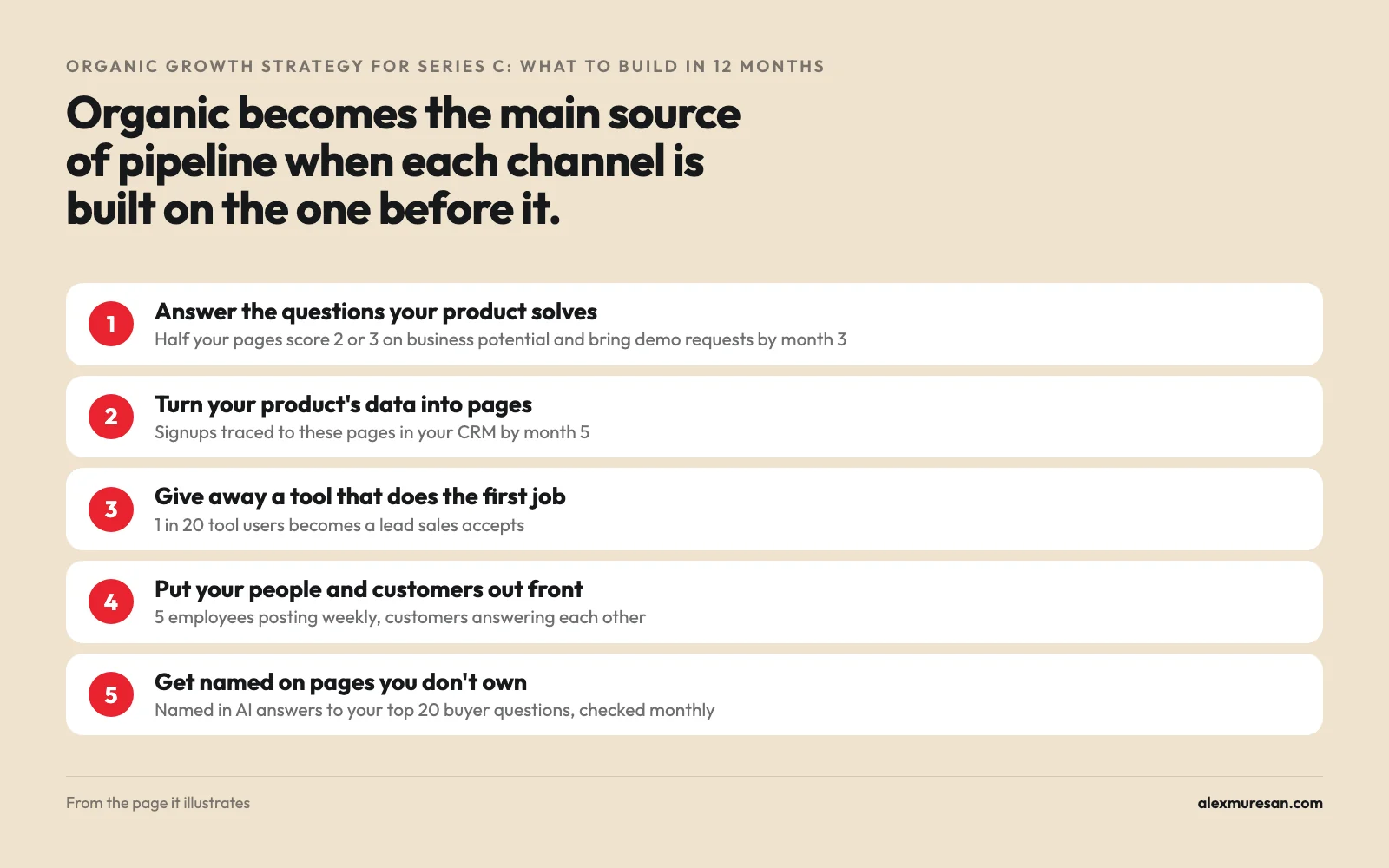
The organic growth strategy at a glance
Each channel starts while the one before it is still running, and each has a threshold you can fail. The thresholds are my bar, set from the operator seat.
| Months | Channel | Who proved it | The threshold you can fail |
|---|---|---|---|
| 1 to 3 | Answers to the questions your product solves | Ahrefs, which prioritizes topics scoring 2 or 3 on its business potential scale | Half the pages you publish score 2 or 3, and they bring demo requests by month 3 |
| 3 to 5 | Pages built from your product's data | Zapier, whose app pages drive about 16% of its organic traffic, per Ahrefs | Signups you can trace to these pages in your CRM by month 5 |
| 5 to 7 | A free tool that does the first job | HubSpot, whose Website Grader has evaluated 4 million websites | 1 in 20 tool users becomes a lead your sales team accepts |
| 6 to 10 | Your people and your community | dbt Labs, from 350 Slack members in 2018 to over 50,000 community members by June 2023 | 5 employees posting every week, and customers answering each other's questions |
| 9 to 12 | Mentions on pages you don't own | Ahrefs' study of 75,000 brands, where web mentions beat backlinks for AI visibility | Named in AI answers to your top 20 buyer questions, checked monthly |
What is an organic growth strategy?
In corporate finance, organic growth means growing a business without acquisitions. In marketing, an organic growth strategy is the plan for getting pipeline from channels you don't pay for by the click: search, your own content, your product, your people, your customers and the pages that mention you.
It's what b2b organic marketing looks like once someone owns it as a number. The plan carries a pipeline target and a date by which organic is expected to pass paid, and every channel in it is judged against that date.
Why Series C is when organic has to carry pipeline
Picture the Thursday before the board meeting. You're on slide 14, the one with blended CAC by quarter, and the line has gone up 4 quarters in a row. Your CFO has already asked, politely, whether there's a version of next year's plan that grows pipeline 40% without growing the paid budget 40%.
That slide is the normal shape of a growth stage company, and the Series C guide explains why: the channel that carried you through the Series B stage was built for a smaller company, and it flattens at this size. Paid is usually that channel.
Organic is slower to start and cheaper to keep, which is exactly why it has to start 12 months before you need it. Atlassian is the proof that it holds at real scale. Its 2026 annual report says the company relies "primarily" on "word-of-mouth and low-touch demand generation to drive trial, adoption, and initial expansion," uses its website as "the primary forum for new customer engagement," and serves more than 350,000 customers.
I'm biased here, and I'll say why. I grew a media company to an 800K audience on organic alone, so I've lived through the slow first months and the compounding after them. The order below is the one I'd run if slide 14 were mine.
Months 1 to 3: Answer the questions your product solves
Start with search content, because everything after it reuses the work. Pull the last 50 sales calls and write down every question a buyer asked before they understood your product. Those questions are your first 3 months of pages, and they're better than any keyword list because a buyer actually said them out loud.
Ahrefs is the company to learn this from. Its team writes what it calls product-led content, which it defines as content "that helps the reader solve their problems using your product." Every topic gets a business potential score, and Ahrefs prioritizes the ones that score 2 or 3, so that "mentions of our product are natural."
Think about what that means for your calendar. A post about a trend scores 0 and gets cut, however much traffic it might bring. A post that walks through the exact job your product does, with screenshots of the product doing it, scores 3 and goes first.
You pass when at least half of what you publish scores 2 or 3 and those pages bring demo requests by the end of month 3. If you're unsure how much of this still works with AI answers in the results, I covered what changed in SEO vs AI search.
Months 3 to 5: Turn your product's data into pages
By month 3 you know which questions bring buyers. Now look for the ones your product can answer thousands of times over, with a different noun each time. Integrations, use cases, templates and benchmarks by industry all work, as long as each page carries something only your product knows.
Zapier built this better than anyone. Every pair of apps gets its own landing page, with copy written by the owners of each app, and Ahrefs estimated in its Zapier case study that these pages drive 16% of Zapier's entire organic traffic.
The same study shows the limit. One Google Sheets integration page ranked for 444 keywords, while a 3-app combination further down the chain got no organic traffic at all, so build the pages people search for and stop there. You pass when signups from these pages show up in your CRM by month 5.
Months 5 to 7: Give away a tool that does the first job
The questions from month 1 told you what buyers try to work out before they talk to sales. Build a free tool that works it out for them in 30 seconds, and put the email field before the result.
HubSpot did this early with Website Grader. HubSpot says it was created "as a way to generate buzz, organic/viral traffic, inbound links and leads" for its software. You type in a URL, it scores the site, and by the time HubSpot relaunched it, it had evaluated 4 million websites.
What makes it work is that the score creates the conversation. Someone who sees a 54 out of 100 wants to know how to get to 80, and the company that gave them the score is the obvious one to ask. You pass when at least 1 in 20 people who use the tool becomes a lead your sales team accepts.
Months 6 to 10: Put your people and customers out front
By month 6 you have a library of answers, which means your team has something to say. Now hand it to them. People trust a person over a logo, and your company already pays the salaries of the people buyers would rather hear from, a point I made in your best channel is rotting inside your company.
Start with 5 people who like the work, and give each of them one question from the month 1 list to answer on LinkedIn every week, in their own words. The posts that compound are the ones that teach something specific (here are the LinkedIn organic post best practices that hold up over a year).
Then give your customers somewhere to talk to each other. dbt Labs is the clearest growth curve I know: its co-founder Drew Banin wrote in March 2018 that the Slack community was 350 members strong, and by June 2023 the dbt Community included over 50,000 data professionals. Clay is doing it now, and its own hiring page lists 30k members on Slack and more than 50 Clay clubs.
You pass when 5 employees post every week and customers start answering each other's questions before your team gets to them.
Months 9 to 12: Get named on pages you don't own
The last channel is the one buyers meet before your site, because anyone who asks ChatGPT or Google's AI answers gets a shortlist before they click anything. Those answers lean on what other sites say about you.
Ahrefs measured it. Its study of 75,000 brands found that branded web mentions had a 0.664 correlation with showing up in Google's AI Overviews, against 0.218 for backlinks. It also found that 26% of the brands had zero mentions in AI Overviews at all.
So spend the last quarter getting your answers onto other people's pages: guest pieces, comparisons, podcasts, analyst notes and the community threads where your buyers already ask. I laid out the full approach in how to get your brand mentioned in AI answers.
You pass when your brand is named in the AI answers to your top 20 buyer questions, checked in the same words on the same day every month.
How to tell if your organic growth strategy is working
Put one number on slide 14 next to the CAC line: pipeline sourced by organic channels, by month, against pipeline sourced by paid. In months 1 to 4 it will barely move, and you should tell your board that before they ask. From month 6 the channels start feeding each other, because the posts send people to the pages and the pages send them on to the tool.
The 12-month bar is that organic-sourced pipeline is bigger than paid-sourced pipeline. If you miss it, go back to the table and find the first threshold you failed, because the channels after it were built on top of it. I call the whole motion Native Organic Distribution, and the idea underneath it is simple: organic stops being a side project the day it owns a pipeline number.
Come back to slide 14 a year from now. The CAC line may not have dropped, but there's a second line under it now, and it's the one your CFO will ask about first.
Hear how VCs got companies through Series C
Every guest in season one of Sell That S*it! is a VC, and each episode breaks down how a fund graduates a company from one stage to the next. Season one is filming now. To hear how investors watched their companies find growth after the first channel filled up, get episode one from the show page or put your email in the box at the end of this page.
FAQs about organic growth strategy
I run marketing at a Series C B2B software company, paid CAC goes up every quarter and the board wants more efficient growth. Which organic channels should we build so organic becomes our main source of pipeline within a year? Build 5, in this order: product-led search content, pages built from your product's data, a free tool, your employees and customer community, and mentions on pages you don't own. Start each one while the previous one is still running, and track organic-sourced pipeline against paid-sourced pipeline every month.
How do growth-stage companies find new growth after their first channel saturates? They keep the first channel and add new ones next to it, starting with the cheapest. Organic channels compound, so a company that starts them a year before the first channel flattens has a second engine ready when it does. The Series C guide covers the non-organic engines, from expansion revenue to partners.
What changes in go-to-market between Series B and Series C? At Series B you scale the channel that works. At Series C that channel flattens and the board starts weighing efficiency alongside growth, so the job becomes adding new engines without buying every dollar of them.
About the author

Alex Muresan is a 4x founder with 2 exits. He built his first company, a physical entertainment center, to 60 employees and $2M in annual revenue in his early 20s. His second exit came in 2026, when he sold a media company. He took an AI startup from 0 to $600K ARR in 5 months, and at his current startup he took revenue from $800K to $1.4M ARR in his first 3 months. He also hosts Sell That S*it!, where every guest in season one is a VC.
Part of the stage playbooks: what to do for growth at pre-seed, seed, Series A, Series B and Series C. The glossary →