
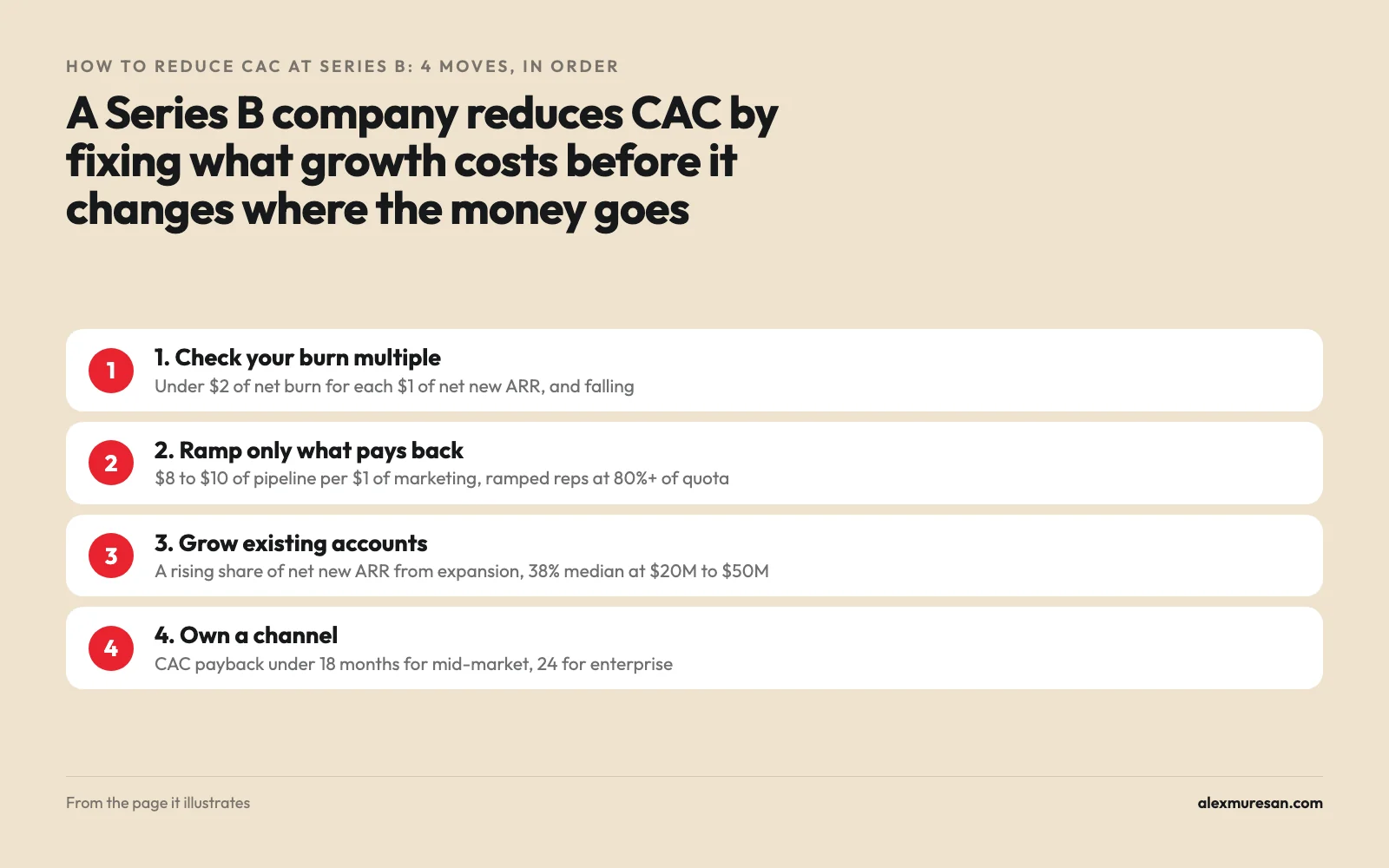
Measure it honestly first: Split blended CAC from paid CAC and work out payback on gross margin.
Check the burn multiple: Above 2x net burn per $1 of net new ARR, you're buying growth.
Ramp only what pays back: Bessemer targets $8 to $10 of pipeline for every $1 of marketing.
Grow the accounts you have: Expansion is 38% of net new ARR at $20M to $50M, per OpenView.
Own 1 channel: Linear had spent a total of 0.5% of revenue on marketing by early 2024.

How to reduce CAC at Series B: the 4 moves at a glance
Picture the quarterly board deck. Revenue is up, the team doubled, and on slide 9 there's a CAC chart that has climbed 4 quarters in a row while everyone politely looks at slide 10. The moves below bend that line, and they run in order because each one tells you where to spend the next.
| Move | The threshold you can fail | Who shows it |
|---|---|---|
| 1. Check your burn multiple | Under $2 of net burn for each $1 of net new ARR, and falling after the Series B | Fast: $102M Series B, six-figure 2021 revenue, shut down in 2022 |
| 2. Ramp only what pays back | $8 to $10 of pipeline per $1 of marketing, and ramped reps at 80%+ of quota | Gong: about 300 customers at its Series B, about 1,300 by August 2020 |
| 3. Grow existing accounts | A rising share of net new ARR from expansion (38% is the median at $20M to $50M) | Datadog: its 2014 cohort's ARR grew 4.0x by 2018 |
| 4. Own a channel | CAC payback under 18 months for mid-market, 24 for enterprise | Linear: a total of 0.5% of revenue spent on marketing |
This page sits under the Series B growth guide, which covers the whole stage. Here we stay on the cost of winning a customer.
What is CAC, and how do you calculate it?
Customer acquisition cost (CAC) is what you spend to win 1 new customer. The a16z team behind 16 Startup Metrics defines it as the full cost of acquiring users, stated per user, and says to count referral fees, credits and discounts in that cost.
Blended CAC is total acquisition cost divided by all new customers from every channel. Paid CAC is the same cost divided only by the customers who came through paid marketing. a16z writes that blended CAC "doesn't inform how well your paid campaigns are working," and that investors treat paid CAC as the more important of the two, so report both and break them out by channel.
CAC payback is how many months a customer takes to repay what you spent to win them. Bessemer counts sales, marketing and the customer success cost tied to renewals and upsell, and measures it against gross margin adjusted ARR rather than top-line revenue. As a working formula, take the sales and marketing cost of a period, divide it by the new ARR it produced, multiply by 12, and divide by your gross margin.
OpenView's 2023 SaaS Benchmarks lists the mistakes people make with it: treating one number as the gold standard, counting only sales and marketing as acquisition cost, and skipping the gross margin adjustment. It also says a healthy payback depends on net dollar retention, which is why move 3 exists.
1. Check your burn multiple before you cut anything
The first instinct when CAC climbs is to cut the most expensive line in the budget. Before you do, work out what growth costs the whole company. David Sacks of Craft Ventures built the burn multiple for exactly this: net burn divided by net new ARR.
Sacks calls 2x "reasonable for an early-stage startup" and 5x "terrible." He also writes that after the Series B, when the sales team should be running at scale, "the expectations for efficiency increase even more." If you burned more than $2 for each $1 of net new ARR last quarter, you fail this move, and every channel decision after it is a guess.
Fast is the version nobody wants to repeat. The checkout company raised a $102M Series B led by Stripe in January 2021, and TechCrunch reported six-figure revenue for all of 2021 against a burn said to run as high as $10M a month. It shut down in April 2022, which means a single month of spend was bigger than a year of revenue (ouch).
So compute the multiple monthly and split marketing's share out of it, because a blended burn number hides the channel eating the round the same way blended CAC does.
2. Ramp only the channels that pay back
Once you know growth is too expensive, price every channel on its own. Bessemer's motto for this stage is "only ramp what works," and it gives you the bar: $8 to $10 of pipeline for every $1 of marketing spend, unweighted pipeline at 3 to 5x the ARR goal, and ramped reps at 80% or more of quota before you hire the next class.
The magic number checks the sales side of the same question. It's quarterly net new ARR divided by the prior quarter's sales and marketing spend, and in a SaaStr session with Sapphire Ventures above 1 was described as healthy, with 0.7 fine for a well-funded company. If a channel returns less than $8 of pipeline per $1, or your magic number sits under 0.7, you fail this move, and that channel gets less money next quarter.
Gong shows what a channel that pays back looks like. It raised a $40M Series B in February 2019 with about 300 customers and had about 1,300 by August 2020. On the Demand Gen Visionaries podcast, CMO Udi Ledergor explained that Gong uses the same content to drive both inbound and outbound, with reps calling ICP-fit buyers who consume a lot of it. Outbound is about 60% of pipeline, and he called LinkedIn his cheapest demand gen channel.
Think about what that means for your CAC: one piece of content gets paid for once and then works twice.
3. Sell more to the customers you already have
The cheapest dollar a Series B company can add comes from someone who already pays it. Expansion revenue skips most of the acquisition bill, so every point of it pulls blended CAC down even when new-logo CAC doesn't move. OpenView found that at $20M to $50M of ARR, 38% of net new ARR comes from expansion, against 14% for companies under $1M.
Bessemer lists the levers: upsell tiers and add-ons, cross-sell, add seats, grow usage, and raise prices at renewal. If your expansion share is flat or falling while you scale, you fail this move, because you're paying full price for growth you could have had cheaply.
Datadog's S-1 is the cleanest picture of this I've seen. Its 2014 customer cohort went from $4.8M of ARR at the end of that year to $19.2M at the end of 2018. That's 4.0x from the same accounts, with a dollar-based net retention rate of 146% at June 30, 2019.
The mistake is letting marketing stop at the signed contract. Your customers are a distribution channel you already pay for, and the referrals and extra seats they bring show up as customer acquisition cost reduction on the next board slide.
4. Own a channel so CAC stops climbing
CAC gets worse as you grow, and Bessemer says why: early adopters are the cheapest customers to win, and a maturing company has to outspend rivals for the rest. OpenView's 2023 data put the median CAC payback at 22 months for companies at $20M to $50M of ARR, and payback got longer year on year at $20M+ as more people signed off on each purchase.
Bessemer's benchmarks from healthier markets are under 12 months for SMB, under 18 for mid-market and under 24 for enterprise, so past your line you fail this move. Pouring more paid into a rising CAC buys the same problem at a higher price, because paid is rented attention and the rent goes up every quarter.
Linear is the strongest case I know for the other road. It raised a $35M Series B led by Accel in September 2023, profitable since 2021 with a negative lifetime burn rate, and said most of its customers came from switching off legacy tools. 4 months later, CEO Karri Saarinen posted that Linear had spent a total of 0.5% of revenue on marketing and ran a sales team of 4 people.
I grew a media company to an 800K audience on organic alone before selling it in 2026, so I'm biased here (which is why this section runs on Bessemer's and OpenView's numbers). Owned means a list, a show, a community, or the answers buyers get when they ask ChatGPT about your category. The test is simple: it's whatever still brings customers in the month the budget stops.
How to reduce CAC without stalling growth
The trap is cutting spend until CAC looks good and growth dies with it. Your Series C case still needs fast ARR growth, and the Series C guide shows the bar you'll be judged on next.
Here's how I'd answer the CMO who grew from $5M to $12M of ARR on paid and outbound and watches both get pricier every quarter. Keep the paid and outbound that pass move 2, and move the money from the ones that fail into expansion and 1 owned channel, because those are the 2 lines on the budget whose cost per customer falls as they grow. Often the expensive channel isn't the real problem, because CAC is a creativity problem long before it's a budget one.
I've taken an AI startup from zero to $600K ARR in 5 months, and at my current startup I took revenue from $800K to $1.4M in my first 3 months. Neither was a Series B company, but my read holds at any stage: protect the channel that was cheap at the start once the budget gets big. The longer you skip that, the more distribution debt you carry into the next round.
Go back to slide 9. The line bends when the burn multiple is under 2, every channel clears its pipeline bar, expansion carries a bigger share each quarter, and 1 channel brings customers in without a media budget behind it.
Hear how VCs got their companies through Series B
I'm filming season one of Sell That S*it!, where every guest is a VC breaking down how a fund graduates a company from one round to the next. No episodes are out yet. The newsletter below is the easiest way to hear when the first one lands.
FAQs about how to reduce CAC
How do Series B SaaS companies lower CAC as they scale? They check the burn multiple first, then fund only the channels that clear Bessemer's $8 to $10 of pipeline per $1 of marketing. After that they grow expansion revenue and build 1 channel they own, so the cost per customer stops climbing with spend.
I'm the CMO at a Series B B2B SaaS company that grew from $5M to $12M ARR on paid and outbound, and both get more expensive every quarter. What should we change to keep growing toward a Series C? Split paid CAC from blended CAC by channel and keep what pays back inside 18 months for mid-market or 24 for enterprise. Move the rest of the budget into expansion and 1 owned channel, the way Gong ran its content into both inbound and outbound.
How do Series B companies scale pipeline efficiently? Bessemer's rule is to only ramp what works: aim for $8 to $10 of pipeline per $1 of marketing and unweighted pipeline at 3 to 5x the ARR goal. Hold ramped reps to 80% of quota before you hire more, because reps hired ahead of pipeline raise CAC.
What is a good CAC payback period? Bessemer's benchmarks are under 12 months for SMB, under 18 for mid-market and under 24 for enterprise. OpenView's 2023 median at $20M to $50M of ARR was 22 months.
What is the difference between blended CAC and paid CAC? Blended CAC divides acquisition cost by new customers from every channel, and paid CAC divides it only by customers from paid marketing. a16z notes investors weigh paid CAC more heavily.
About the author

Alex Muresan is a 4x founder with 2 exits. He built his first company, a physical entertainment center, to 60 employees and $2M in annual revenue in his early 20s. His second exit came in 2026, when he sold a media company. He took an AI startup from 0 to $600K ARR in 5 months, and at his current startup he took revenue from $800K to $1.4M ARR in his first 3 months. He also hosts Sell That S*it!, where every guest in season one is a VC.
Part of the stage playbooks: what to do for growth at pre-seed, seed, Series A, Series B and Series C. The glossary →