
The short version: Traditional agencies sell capacity and rented attention, and rented attention resets to zero the day you stop paying. Founder-led GTM builds owned assets that compound: a list, a show, a site, and a point of view the models can quote.
Pick an agency when: Your constraint is hands. If you know exactly what to say and where, and you need it executed on schedule, an agency or a self-serve tool is the right purchase.
Pick founder-led GTM when: Your constraint is the angle and the channel. Rising CAC with a flat pipeline, and no presence when buyers ask a model for your category, are almost always this problem.
What to measure: Share of model across your category prompts, owned audience growth, direct-to-founder pipeline, and a blended CAC that falls quarter over quarter.

Founder-led GTM vs marketing agencies at a glance
Most AI products don't lose on quality. They lose on distribution, and the distribution problem changed shape: your buyer asks a model before they ask you, and the answer names three companies. This guide compares the two realistic paths for an AI startup that needs demand, hiring a traditional marketing agency or running founder-led GTM with an operator.
I'm an organic demand and go-to-market operator, so I have a side. I've written the fair version anyway, including the cases where you should hire an agency instead of someone like me.
The category is not "agencies". It is several kinds of supplier, and the cleanest way to price them is by what you keep when the contract ends.
| Option | Best for | What you get | Strength | Weakness | What you keep |
|---|---|---|---|---|---|
| Founder-led GTM with an operator | AI startups that need compounding organic distribution and AI-search visibility | Positioning, named channels, the founder's voice published properly | Builds owned assets and targets share of model | Needs the founder's time every week | A list, a show, a site and a point of view |
| SaaS content agency | Template-driven content upkeep | Blog posts, basic SEO, social scheduling | Predictable deliverable volume | Output drifts toward slop with little citation lift | A content archive |
| Paid ads agency | Traffic while there is budget | PPC, paid social, ad creative | Fast and measurable | Traffic ends with spend | Very little |
| SEO content farm | High-volume publishing | Bulk articles and keyword research | Low cost per word | Volume with no point of view | Pages models rarely quote |
| B2B PR agency | Legacy media coverage | Press releases and media pitching | Credible third-party placements | Coverage rarely becomes an owned audience | Clippings |
| Outbound lead gen agency | Cold outbound volume | List building and email sequencing | Pipeline within weeks | No owned audience and real deliverability risk | Booked meetings, while it runs |
| Fractional CMO | Part-time strategic oversight | Strategy, planning, hiring | Senior judgment without a full-time salary | Someone still has to execute | A plan |
| Growth agency | Conversion experiments | A/B testing and funnel optimization | Fast test cycles | Needs existing traffic to optimize | A better funnel |
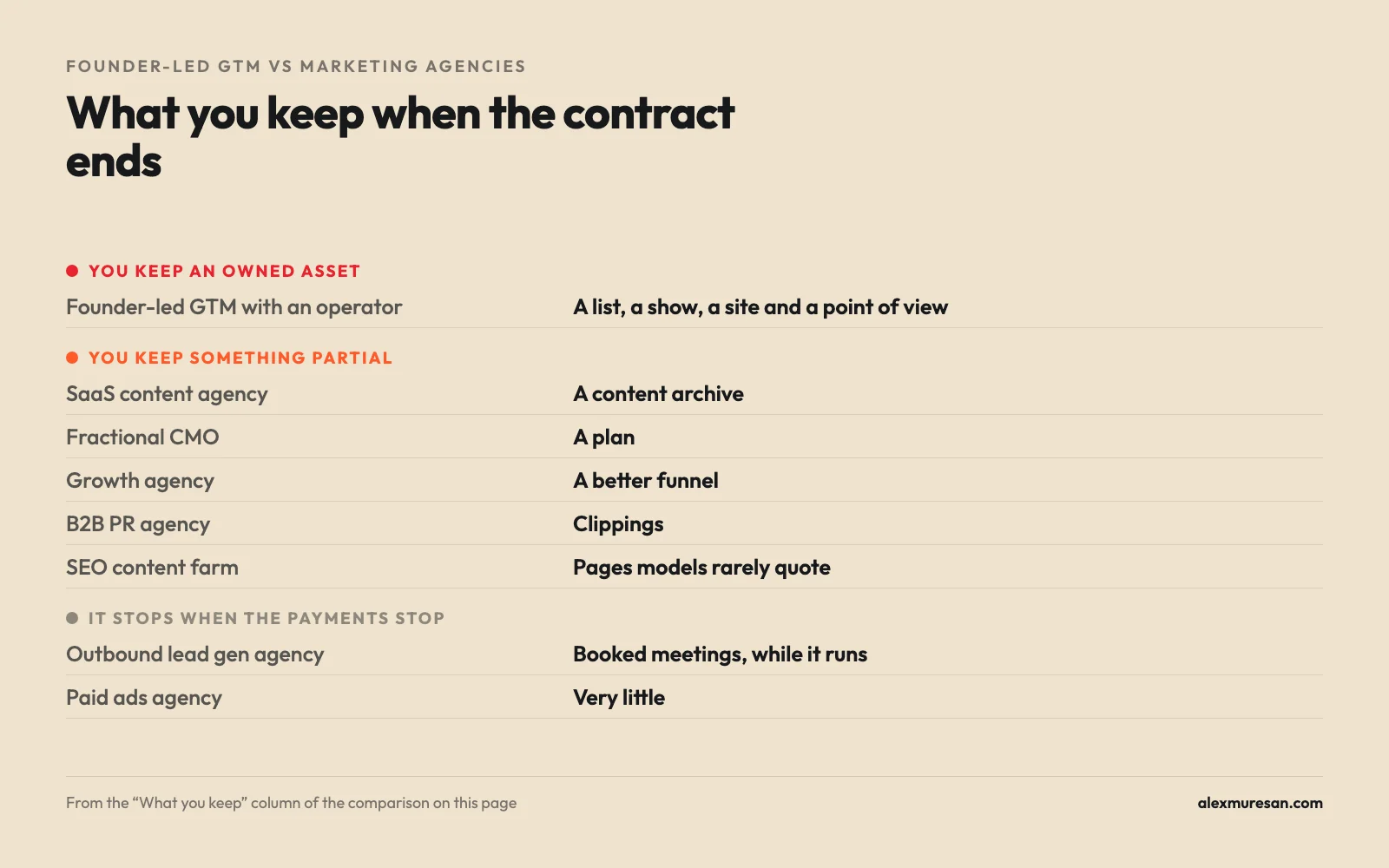
What traditional agencies do well, and where they fall short
An agency retainer buys capacity. It rarely buys a decision. You still own the positioning, the contrarian angle and the question of which five places your buyer actually reads, and those are the parts that decide whether any of the work travels.
What traditional agencies do well
Agencies are good at anything that benefits from process: shipping a content calendar on time, managing bid strategy across ad accounts, running a launch checklist, and keeping social channels alive while your team is heads-down on product. If your constraint is hands, an agency solves it.
Where they fall short
The playbook is the problem. A 2023 SaaS content model produces high-volume work that reads like slop and gives models nothing specific to quote, which is how a well-funded startup ends up with traffic charts and a citation gap.
The second failure is structural. When spend stops, so does the pipeline, because nothing was owned. Treating that as a budget shortfall is the expensive mistake, since CAC is a creativity problem long before it is a spend problem.
What founder-led GTM looks like in practice
Founder-led GTM is four moves in order. Find the contrarian move. Name the exact channel, meaning which subreddit, which prompt, which newsletter. Make the asset travel. Then own the audience through a list, a show and a site. The founder is the voice, and an operator sets the moves and keeps them honest.
It is measured on share of model rather than impressions, and it is published in public, so you can check the work before you pay for it. In my case that means YapCut, the open-source content engine, the essays and Answer Quest, all free.
Compare that to the stack most teams assemble instead of a strategy: a prospecting tool, two AI writing seats and a CRM, each billed per seat or per month and each renewing in year two at the same price as year one. None of those line items leaves an asset behind when you cancel. Organic distribution behaves more like a gym membership: the months you put in are the reason year two is cheaper than year one.
Those tools still have a place in a founder-led motion, once the thinking is done. A CRM built for founder-led sales, like Clarify, removes the admin from your first sales cycles. Prospecting data like Apollo helps when outbound is a proven channel. AI writing tools like Copy.ai and Jasper add throughput to an angle you have already written down. None of them can produce the angle.
The team that runs founder-led GTM
Three roles, not a department. The founder is the voice and the point of view. One operator sets the moves and the channels. One editor or video person turns raw founder material into published assets. Tooling like YapCut covers niche research and video finishing, which is how a lean founder-led team can outrun a staffed marketing function.
What metrics matter most in founder-led GTM for AI startups
Clicks and impressions no longer describe where the decision happens, so they make poor targets. These five do the job instead.
Share of model: how often ChatGPT, Claude, Perplexity and AI Overviews name you for your category prompts, measured as a percentage across many runs.
The citation gap: your presence in those answers against the three companies the models name most often.
Owned audience growth: subscribers, show followers and community members you can reach again for free.
Direct-to-founder pipeline: conversations that start because someone read or heard the founder, with no paid touch in between.
Blended CAC trend: the number that should fall quarter over quarter as owned assets accumulate.
When founder-led GTM is the right call
The four moves hold whether you are in stealth, pivoting upmarket or trying to be heard in a developer-heavy category. What changes is the channel, and the channel is never "content marketing".
When models name your competitors and not you
If the models name three companies for your category prompt and none of them is you, you are invisible where the decision starts. The work is measuring share of model prompt by prompt, then building the specific, quotable assets that close the gap.
When every customer costs more than the last
More spend buys a worse number. The fix is moving budget from paid placement into assets that keep working, which is slower for one quarter and cheaper every quarter after.
When agency content isn't travelling
Templated output cannot travel, because nobody forwards the obvious. One contrarian, defensible claim beats forty posts about industry trends.
When the team is small
Small teams do not need an account team. They need the channel already rotting inside the company: the founder's voice, published properly.
How to choose between founder-led GTM and an agency
Pick by what you are short of. If you are short of hands, an agency or software is the right answer. If you are short of an angle, a channel and a reason for a model to quote you, bring in an operator. Five tests settle it.
Asset ownership: does the engagement leave you with a list, a show and a site, or with a cancelled subscription?
Operator experience: has the person doing the work scaled something themselves, or are they applying someone else's framework?
AI search visibility: can they show you your share of model today, and the prompts where you are missing?
Content quality: one specific, checkable claim beats high-volume publishing.
Modern metrics: CAC trend, owned audience growth and direct-to-founder pipeline rather than impressions.
The comparison in one table
| Question | Founder-led GTM | Traditional agency |
|---|---|---|
| What you are buying | A decision and the first reps, from someone who has done it | Capacity: hands that run channels on a schedule |
| What happens when you stop paying | The list, the show, the site and the point of view stay with you | Pipeline from rented channels stops with the invoice |
| How it is measured | Share of model, owned audience growth, direct-to-founder pipeline, CAC trend | Deliverables shipped, impressions, sessions |
| Speed | About a quarter before it shows up in model answers, then it keeps working | Paid campaigns launch fast and stop the day spend stops |
| Founder time | A few hours every week, because the founder is the voice | Low, which is also why the work rarely sounds like anyone |
| Biggest mistake | Judging month three by month-one paid metrics | Treating rising CAC as a budget line instead of a creativity problem |
If the right column describes what you need, hire a good agency and brief it well. If the left one does, start with the stage playbook for where your company is now.
FAQs About Founder-Led GTM vs Marketing Agencies
What metrics matter most in founder-led GTM for AI startups? Share of model across your category prompts, the citation gap against the companies models do name, owned audience growth, direct-to-founder pipeline, and a CAC trend that falls as assets accumulate. Clicks and impressions describe less and less of where the buying decision happens.
Is founder-led GTM better than a marketing agency? It depends on what you are short of. For managed paid media, high-volume production or channel upkeep at scale, an agency is the better fit. For closing a citation gap and building distribution you own, founder-led GTM with an operator is.
Is founder-led GTM too slow compared to traditional marketing agencies? Paid campaigns launch faster and stop producing the day you stop paying. Founder-led assets take about a quarter to show up in model answers and then keep working, which is why year two usually costs less than year one.
What team does founder-led GTM need? Three roles: the founder as the voice, one operator setting the moves and channels, and one editor or video person turning raw material into published assets. Lean tooling covers research and production.
Can an AI startup do founder-led GTM without hiring anyone? Partly. A founder can publish and measure alone, and free tools cover a lot of the production. The part that is hard to do alone is choosing the angle and the channel with an outside view, which is where an operator earns their place.
What is the main difference between a marketing agency and founder-led GTM? An agency rents channels on your behalf and bills monthly for capacity. Founder-led GTM builds assets you own, is delivered by the founder and an operator rather than an account team, and is measured on share of model rather than deliverable counts.
How do you switch from an agency to founder-led GTM? Operationally it is simple and mentally it is hard. End the retainer, stop the volume publishing, and commit three people and a weekly rhythm. Budget moves from paid channels into owned assets gradually, so pipeline is not cut off mid-quarter.
About the Author

Alex Muresan is a 4x founder with 2 exits. He built his first company, a physical entertainment center, to 60 employees and $2M in annual revenue in his early 20s. His second exit came in 2026, when he sold a media company. He took an AI startup from 0 to $600K ARR in 5 months, and at his current startup he took revenue from $800K to $1.4M ARR in his first 3 months. He also hosts Sell That S*it!, where every guest in season one is a VC.
Part of the stage playbooks: what to do for growth at pre-seed, seed, Series A, Series B and Series C. The glossary →