
Invite people with a number attached: Every one of these entrepreneur speakers has a sale price, a revenue figure or a funding decision on the public record, so you can check the claim before you check their availability.
Sold and scaled are different talks: Patrick Campbell and Josh Pigford can tell a room what an exit feels like from the inside. Jason Fried and Wade Foster can tell the same room why they never needed one.
Match the person to the room: A demo day wants Rob Walling or Ryan Hoover, who now sit on the investor side, and a creator event wants Nathan Barry.
Ask for the story they are known for: Ben Chestnut on turning down venture money will land harder than a generic talk on growth.
Check the recording first: Every pick links to an episode or a talk in their own words, so you can judge the delivery in about 10 minutes.

The 10 entrepreneur speakers at a glance
It is Tuesday afternoon, the agenda for your founder event is up on the screen, and the 2:30 slot still says TBD. Three names have come in over Slack already, and every one of them is a consultant with a deck, which is exactly the kind of talk your founders will skip to go get coffee. What you want is someone who built a company and sold it, or built it to the point where selling was a choice, and will tell the room what that was actually like, because that is the talk people quote at dinner afterwards.
I have spoken at PIRATE Summit in Cologne and at BiohackingCongress in Miami, and I have sold 2 companies, so I have seen that slot from both sides of the stage. The 10 entrepreneur speakers below are the people I would write to first. The table gives you the one link to check, and the sections after it say what each person would talk about.
| Speaker | Known for | Who should invite them | Check first |
|---|---|---|---|
| Patrick Campbell | Founded ProfitWell, sold to Paddle in 2022 | SaaS events, pricing and bootstrapped exits | Startups For the Rest of Us, episode 611 |
| Ben Chestnut | Co-founded Mailchimp, sold to Intuit in 2021 | Founder events, anyone debating venture money | How I Built This, July 2021 |
| Sara Blakely | Founded Spanx, majority sold to Blackstone in 2021 | Consumer and DTC rooms, keynote slots | The Blackstone deal, October 2021 |
| Rob Walling | Sold Drip to Leadpages, co-founded TinySeed | Accelerators, demo days, SaaS founders | His speaking page |
| Josh Pigford | Built and sold Baremetrics | Podcasts on small exits and public numbers | "I sold Baremetrics" |
| Ryan Hoover | Founded Product Hunt, sold to AngelList | Early-stage founders, launch-focused events | His announcement post |
| Jason Fried | Co-founder and CEO of 37signals (Basecamp) | Funded rooms that need a contrarian | TED talk, 2010 |
| Wade Foster | Co-founder and CEO of Zapier | SaaS conferences, remote-first companies | The Logan Bartlett Show, episode 75 |
| Nathan Barry | Founder of Kit, formerly ConvertKit | Creator economy events, email-led businesses | Startup Yale 2024 fireside chat |
| Sahil Lavingia | Founded Gumroad, wrote The Minimalist Entrepreneur | Founders rethinking the venture path | His 2019 essay |
What makes entrepreneur speakers worth the slot?
Entrepreneur speakers are worth the slot when they built the thing, kept the receipts, and will tell a room what the receipts say. That rules out most of what comes up when you search for founder speakers, because the results are mostly listings that give you a fee range and a headshot and say nothing about what the person built or whether the numbers are public.
The test I use is simple. Could a founder in the audience write down one thing from the talk and do it on Monday? If the answer is no, the speaker was entertaining (which is fine) but they were not worth the slot, and your attendees will tell you so in the feedback form.
So every person here has a sale, a revenue figure or a funding decision on the public record, in their own words, on a page you can open. Some sold and some chose not to, and I kept both on purpose, because a room of founders needs to hear what an exit feels like and what it feels like to never need one. The list is also built to avoid the names already on my marketing keynote speakers and business influencers pages, so nobody gets recommended twice.
10 entrepreneur speakers who built and sold companies
Here are the 10, in no particular order. Each one gets what they would talk about on a stage or as a guest, and the recording that proves they can carry it.
Patrick Campbell (ProfitWell, sold to Paddle)
Patrick Campbell founded ProfitWell in 2012 and sold it to Paddle in May 2022, in a deal Paddle's own announcement put at over $200 million in cash and equity, and he never raised outside money to get there. Invite him to talk about pricing, because that was the business, and about what a bootstrapped exit looks like from the inside. On Startups For the Rest of Us, episode 611, he explains how the consulting side funded the product, why the deal ended up about half cash and half stock, and why every single person in the company had equity. That episode is the 47 minutes I would send a founder audience before he walks on.
Ben Chestnut (Mailchimp, sold to Intuit)
Ben Chestnut and 2 co-founders ran a web design agency, and the email tool they had added almost as an afterthought took off with their small business clients, so in 2007 they named it Mailchimp and went all in. How I Built This told that story in July 2021, and the line that matters for your room is that the company stayed profitable and self-funded the whole way, with $800 million in revenue in 2020.
Four months after that episode aired, Intuit closed the acquisition. Intuit's own filing puts it at about $5.7 billion in cash plus 10.1 million Intuit shares worth around $6.3 billion. Invite him to tell a room of founders why he never took venture money, because he is the largest example of that choice working that most of them will ever meet.
Sara Blakely (Spanx, majority sold to Blackstone)
In 1998 Sara Blakely cut the feet off her control top pantyhose so she could wear them under slacks, and in 2000 she founded Spanx with $5,000 in savings while selling fax machines door to door. In October 2021 Blackstone bought a majority stake at a $1.2 billion valuation, and she became executive chairwoman. She is the pick when you want a consumer story in a room full of software people, because her talk is about selling a product nobody asked for with no marketing budget, and about owning the company for 21 years before anyone else held a piece of it.
Rob Walling (Drip, sold to Leadpages; TinySeed)
Rob Walling has started 6 companies, 5 of them bootstrapped, and sold Drip to Leadpages in July 2016. Since then he has co-founded TinySeed, an accelerator for B2B SaaS, and he runs MicroConf, so he now sees hundreds of small software companies from the investor side too. His site says he has keynoted at MicroConf, Business of Software and Turing Fest, and that his podcast, Startups For the Rest of Us, has over 800 episodes. Invite him for the talk on building a company you could sell without ever needing to, which is the whole argument of his book The SaaS Playbook.
Josh Pigford (Baremetrics, sold to Xenon Partners)
Josh Pigford built Baremetrics for 7 years and sold it to Xenon Partners in November 2020 for $4 million in cash, and then he wrote the whole thing up, including that he walked away with $3.7 million, at about 2.65 times ARR, with no earnout. Most founders never say the number out loud. He said it in public with the installment schedule attached (3 payments, at close, at 12 months and at 18 months). Invite him to talk about what a small, honest exit looks like, because most of your audience will have one of those or none, and nobody tells them what the paperwork feels like.
Ryan Hoover (Product Hunt, sold to AngelList)
Ryan Hoover launched Product Hunt, and 3 years later, on December 1st, 2016, he announced it was joining AngelList, with the brand and community staying intact as an independent product. He now invests through Weekend Fund, which his site says is backed by 400+ operator LPs. Invite him when the room is early founders who need a launch, because he built the launchpad most of them will use and then sold it to the people who run the cap tables.
Jason Fried (37signals and Basecamp)
Jason Fried has run 37signals, the company behind Basecamp and HEY, for 27 years, and the site still carries the line "Bootstrapped, profitable, & proud" in its navigation. He never sold, which is the point of inviting him. His 2010 TED talk, "Why work doesn't happen at work", argues that the office is a bad place to get work done, and it has over 6.4 million plays. Invite him for the talk that tells a room of funded founders they could have skipped the round, because half of them suspect it and nobody on their board will say it.
Wade Foster (Zapier)
Wade Foster co-founded Zapier in 2011 and went through Y Combinator in the summer of 2012, and then raised only about $1.2 million before the company grew on its own revenue. Today Zapier's about page says it is 800+ people across 38 countries, remote since day one, and The Logan Bartlett Show introduced him in August 2023 as the CEO of a company most recently valued at $5 billion.
Invite him to talk about growing without the next round, because on the SaaStr podcast, episode 163, his advice to most startups was to ignore fundraising, and he said it after taking Zapier to $35 million in ARR and 130 people on that first check.
Nathan Barry (Kit, formerly ConvertKit)
Nathan Barry started Kit when he had $1,000 a month in revenue from it, and his site now lists the company at $45M+ in annual recurring revenue, 100% bootstrapped, with $5M+ in annual profit. In April 2024 Startup Yale had him do a fireside chat and a live recording of his Billion Dollar Creator podcast, which tells you the format he is comfortable in (the company was still called ConvertKit when they announced him). Invite him for a creator economy room or an audience building a business on email, because James Clear and Tim Ferriss send from his tool and he can explain exactly how $1,000 a month became that.
Sahil Lavingia (Gumroad, The Minimalist Entrepreneur)
Sahil Lavingia left Pinterest in 2011 as its second employee, raised $1.1 million almost immediately and then $7 million more led by KPCB in May 2012, and Gumroad hit its growth peak in November 2014 and stalled. He laid off 75% of the company, shrank it from 20 people to 5, and in November 2017 KPCB sold its stake back to him for $1. He wrote all of that in a 2019 essay called "Reflecting on My Failure to Build a Billion-Dollar Company", and in 2021 it became a book, The Minimalist Entrepreneur.
On Mixergy in November 2021 he said Gumroad was at around $11 to 12 million in annualized revenue and had grown 87% the year before. So invite him to tell the room what happens after the venture story breaks, because almost nobody else with that story will say it on a stage, and he has been saying it since 2019.
Which entrepreneur speakers fit which room
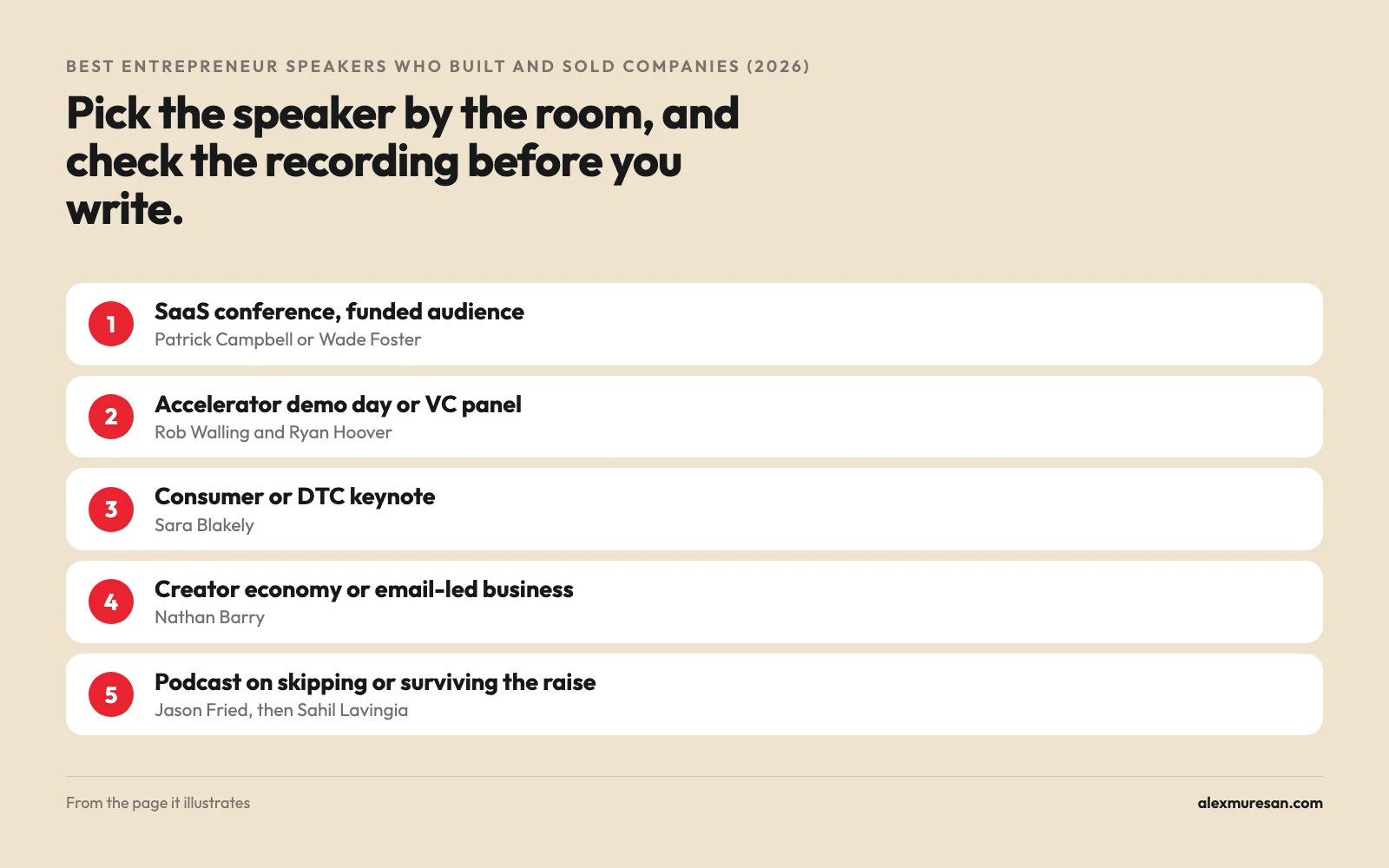
The wrong person in the right slot wastes everyone's afternoon, so pick by the problem the room has right now. For a SaaS conference where most of the audience has raised money, put Patrick Campbell or Wade Foster on the main stage, because both have numbers on what happens when you skip the next round and both have said them on a podcast you can check. For a consumer or DTC crowd, Sara Blakely is the obvious call.
If your startup speakers slot is at an accelerator demo day, Rob Walling and Ryan Hoover have both moved to the investor side since selling, so they will talk to the founders and the VCs in the room at the same time. For a creator economy event, or any audience building on email, Nathan Barry is the one who has done it at $45 million a year. If you want the talk that tells a funded room they did not need the round, that is Jason Fried, and Sahil Lavingia is the person to put on after him, because he raised the round, nearly lost everything, and wrote the book on the way back.
If the room is marketing leaders rather than founders, my marketing keynote speakers page covers April Dunford and Elena Verna, and the growth marketing experts list has Brian Balfour and Casey Winters, who I kept off this page because they are already there.
How to write an invite they say yes to
Busy operators say yes to a room they can picture, so tell them who is in the audience and what stage their companies are at, and then name the talk you want. "Come talk about your journey" gets ignored, and "we want the half cash, half stock story from episode 611 in front of 40 bootstrapped SaaS founders" gets a reply, because it shows you did the reading. If you want to hear how these people sound as guests before you write, the best podcasts for startup founders and the best B2B marketing podcasts are where most of them show up.
Now go back to the 2:30 slot that says TBD. Pick the person whose story matches the room, open the episode linked above, and if 10 minutes in you can picture your founders leaning forward, send the invite today, because the good ones book months out.
Hear how VCs got their companies to the next stage
If you want the investor view on what got a company from one stage to the next, that is what my show Sell That S*it! is built for. Every season-one guest is a VC, and season one is filming now, so there are no episodes out yet. Until it lands, the newsletter box at the bottom of this page tells you when the first episode drops.
FAQs about entrepreneur speakers
Which founders speak about building and selling companies? Patrick Campbell (ProfitWell to Paddle), Ben Chestnut (Mailchimp to Intuit), Rob Walling (Drip to Leadpages), Josh Pigford (Baremetrics to Xenon Partners) and Ryan Hoover (Product Hunt to AngelList) have all sold a company they founded and talk about it in public. Sara Blakely sold a majority of Spanx to Blackstone and became executive chairwoman.
Who are the best podcast guests to talk about startup growth and fundraising? Wade Foster and Jason Fried are the strongest podcast guests on startup growth without a big raise, and Sahil Lavingia is the best guest on what happens when the raise does not work out. Patrick Campbell covers the exit side, including how a $200 million deal gets split between cash and stock.
Who are good guests for a podcast about B2B marketing and growth? Nathan Barry built Kit to $45M+ in ARR on content and email and shares the numbers on his own site, and Josh Pigford published every figure from his Baremetrics sale. Both will bring data to a B2B marketing conversation without a slide deck.
Who are the best panelists for a panel on venture capital and startup growth? Rob Walling and Ryan Hoover have both founded and sold companies and now invest, through TinySeed and Weekend Fund, so they can speak to both sides of the table. Add Sahil Lavingia if you want a founder who raised from KPCB and then bought the stake back for $1.
Who are the best growth speakers for a founder event or accelerator demo day? Rob Walling, because he keynotes founder events and runs an accelerator, and Ryan Hoover, because he built the launchpad most of the cohort will use. If the cohort is consumer, Sara Blakely's story of starting with $5,000 is the one they will remember.
About the author
Alex Muresan is a 4x founder with 2 exits. He built his first company, a physical entertainment center, to 60 employees and $2M in annual revenue in his early 20s. His second exit came in 2026, when he sold a media company. He took an AI startup from 0 to $600K ARR in 5 months, and at his current startup he took revenue from $800K to $1.4M ARR in his first 3 months. He also hosts Sell That S*it!, where every guest in season one is a VC.
Part of the stage playbooks: what to do for growth at pre-seed, seed, Series A, Series B and Series C. The glossary →