
Read for the fund math: Fred Wilson and Jason Lemkin both show why a VC can like your company and still pass, because a big fund needs an outcome big enough to move its returns.
Read the term sheet translation before you sign: Brad Feld's 2005 post on liquidation preference is still the clearest explanation of the term that decides who gets paid first in a sale.
Read the letters VCs write to their own investors: Charles Hudson's July letter on what pre-seed means now is the closest a founder gets to reading a VC's mail.
Check the date before you trust the post: Bill Gurley posts once every few years and Rex Woodbury hasn't posted since July, so this page gives the last post date for every pick.
Ask whether venture is the right money at all: Seth Levine, a VC himself, explains the gap between what banks fund and what venture capital funds.

The best VC blogs at a glance
You know the email. It shows up 4 days after a meeting that felt great, it runs 3 short paragraphs, and somewhere in the middle it says the partnership has decided this isn't the right fit for the fund right now. You read it 5 times looking for the real reason, and the real reason isn't in there, because nobody puts it in that email.
The real reasons are written down on VC blogs, by investors who explain the arithmetic and the instincts behind a yes or a no for free, in public, under their own names. I've started 4 companies and sold 2, and these are the blogs I'd read before walking into a pitch, the way you'd read the other side's playbook before a negotiation. Every pick below links to the one post I'd open first, and I checked in late October when each blog last posted, so you know who is writing this year and who is mostly an archive now.
| Investor and blog | Known for | Who should read it | Read first |
|---|---|---|---|
| Fred Wilson, AVC | Partner at Union Square Ventures, a VC since 1987 | Founders who want to understand fund math | The Short King Is Dead, Long Live The Short King |
| Brad Feld, Feld Thoughts | Co-founder of Foundry and Techstars, blogging since 2004 | Founders holding a term sheet | Term Sheet: Liquidation Preference |
| Bill Gurley, Above the Crowd | Longtime Benchmark general partner | Founders heading into diligence | Venture Capital Red Flag Checklist |
| Jason Lemkin, SaaStr | EchoSign co-founder, SaaStr Fund | B2B and SaaS founders about to raise | Jason's Takes on This Week's 20VC |
| Charles Hudson, Venture Reflections | Founder of the pre-seed firm Precursor | Founders raising a first round | It's All Pre-Series A Now |
| Rex Woodbury, Digital Native | Runs the seed firm Daybreak | Pre-seed and seed founders | Daybreak: Announcing $100M in New Funds |
| Jerry Neumann, Reaction Wheel | Former Neu Venture Capital investor, co-author of Founder vs Investor | Founders who want the math behind a pass | Power Laws in Venture |
| Seth Levine, VC Adventure | Co-founder of Foundry, co-author of Capital Evolution | Profitable founders who keep hearing no | The Capital Gap Is a Dynamism Problem |
What is a VC blog, and why read one?
A VC blog is a blog written by a venture investor, under their own name, about how they decide where the money goes. The good ones run for years, so the archive holds the same investor making the same argument through good markets and bad ones, and you get to watch which parts of the argument survive.
That's what sets venture capital blogs apart from the venture capital newsletters, which mostly track rounds and who raised what this week. It also sets them apart from the startup newsletters on the page before this one, where operators explain how to grow a company once the money is in the bank. A VC blog sits between those two, because it's where the person across the table explains what they're thinking before they wire anything.
I left out good writers whose blogs went quiet years ago. Mark Suster's Both Sides of the Table, for example, last posted on its Medium feed in June 2024, and I'd rather send you to someone still writing about this market.
8 VC blogs worth reading in 2026
I've put the investors who explain the money first, then the ones who explain the paperwork and the diligence, then the seed investors, and last the 2 who will make you question whether you want venture money at all.
Fred Wilson (AVC)
Fred Wilson has been a venture capitalist since 1987 and is a partner at Union Square Ventures, and AVC is where he thinks out loud, most recently on October 12th. That post, "The Short King Is Dead, Long Live The Short King", answers Kyle Harrison's argument that USV's new $500 million core fund and $400 million opportunity fund turn it into a capital agglomerator, and his answer is pure fund math: Duolingo and Etsy, both backed by USV at seed, are each public at roughly $7 billion to $8 billion, and either one alone would return the whole new core fund. Read it and you'll understand why a VC who likes your company still asks how big it can get, because one company that size has to pay for every company that doesn't. His own line, "I don't believe in having to make binary choices", tells you he wants the outcome in the billions and the much bigger one too.
Brad Feld (Feld Thoughts)
Brad Feld co-founded the venture firm Foundry and the accelerator Techstars, and he has blogged since 2004 and written 9 books on entrepreneurship and venture capital, according to his own bio. His October posts are mostly about a novel he is writing with an AI drafting partner, which is a fine reason to go back into the archive for the post founders need. "Term Sheet: Liquidation Preference", from January 4th, 2005, calls the liquidation preference the second most important economic term after price, then explains how a 1x preference was standard for years until investors after 2001 pushed it as high as 10x, and what participation does to your share of a sale on top of that. Read it before you sign anything, because a term sheet is where a VC's view of the downside gets written down, and Feld wrote down what each line means for the founder.
Bill Gurley (Above the Crowd)
Bill Gurley spent more than 15 years as a general partner at Benchmark, and his blog bio lists Uber, Zillow, OpenTable and Stitch Fix among the companies he has worked with. He posts rarely, so check the date: his last post, on November 2nd, 2025, announced his career book Runnin' Down a Dream, and the one before it came 3 years earlier. That earlier one is the one to read, "Venture Capital Red Flag Checklist" from November 28th, 2022, written after John Ray III's bankruptcy filing for FTX, where he lists 10 warning signs investors should catch in a young private company, including the lack of a legitimate board, super-voting stock, an aversion to audits and large secondary sales. Read it from your side of the table, because when a VC asks who sits on your board and who audits your books, that list is running in their head.
Jason Lemkin (SaaStr)
Jason Lemkin co-founded EchoSign and ran web services at Adobe while EchoSign and Adobe Document Services grew to $50 million in ARR in 2012, and today he is operating partner of SaaStr Fund, which led or sourced the first VC rounds in companies like Algolia, Talkdesk, Pipedrive and Salesloft. SaaStr publishes several posts a day, 5 of them on October 26th alone, so the trick is picking the right one. Start with "Jason's Takes on This Week's 20VC" from October 25th, where a profitable company at $20 million in ARR, growing 6 to 7x, still got little interest from the top firms, because a big fund needs a position big enough to move its returns. Then write his advice on a sticky note before you raise, "Build a list of 100 investors, not 15", and the line that follows it, "Treat the top 10 firms as a lottery ticket, not the plan."
Charles Hudson (Venture Reflections)
Charles Hudson started Precursor in 2014 to specialize in pre-seed investing, and the latest post on his Substack, Venture Reflections, is a lightly edited letter to his own limited partners, which is about as close as a founder gets to reading a VC's mail. In "It's All Pre-Series A Now", from July 19th, he admits the word pre-seed has drifted from rounds of about $1 million or less to a market where he writes, "Now I routinely see companies raising rounds in excess of $10M and still calling them pre-seed." He also says Precursor's old limits, a round of about $4 million at a valuation cap near $20 million, no longer fit, so the firm is widening what it will look at. Read it before you put the word pre-seed in your deck, because it shows you how an investor who built a firm on that word now hears it.
Rex Woodbury (Digital Native)
Rex Woodbury writes Digital Native for more than 73,000 subscribers and runs Daybreak, a firm that backs pre-seed and seed companies, and although the newsletter promises a piece every Wednesday, the latest one I could find, "The Post-Agentic Founder", came out on July 22nd. Read "Daybreak: Announcing $100M in New Funds" from June 26th first, because a fund announcement is the one time a VC explains the whole machine at once: a $75 million second core fund, a $25 million opportunistic fund called Daybreak Meridian, and a $33 million debut fund about 15 months before. The part to copy into your notebook is his 4 founder archetypes, the Missionary, the Savant, the Driver and the Nonconformist, which is how his firm sorts the people it meets. He also calls venture "a services industry" and says Daybreak wants to be a founder's first check, so you'll know what to ask for after the money lands.
Jerry Neumann (Reaction Wheel)
Jerry Neumann invested in early-stage companies through Neu Venture Capital and co-wrote the book Founder vs Investor with Liz Zalman, his about page says, and Reaction Wheel last posted on September 14th. His classic is "Power Laws in Venture" from June 2015, which opens with "Venture capital returns are extremely anomalous" and works through the math of why returns bunch into a power law with a fat tail. As I read it, that's why a VC can pass on a company that will very likely work, because a fund that lives on a few enormous outcomes can't spend its slots on companies that will only do well. If the math gets heavy, read his March post, "The Monoculture of Startup Methods", where he finds that 97% of the entrepreneurship courses he reviewed teach at least one of 4 popular methods and warns that "doing the same thing as everyone else is always a strategy for mediocrity."
Seth Levine (VC Adventure)
Seth Levine co-founded Foundry, the same firm as Brad Feld, in 2006 and co-wrote the books Capital Evolution and The New Builders, according to his site, and his blog last posted on September 1st. That post, "The Capital Gap Is a Dynamism Problem", written with John Sebesta of the University of Denver, explains what each kind of money is built for. Banks lend to stable companies with collateral and cash flow while venture capital funds companies that can grow very fast, and a lot of good businesses fall into the gap between the two. It's the post I'd send to a founder who keeps getting polite passes for a company that already makes money, because when a VC suggests the problem might be the kind of money you're asking for, it's worth taking seriously.
Which VC blog to open for each fundraising question
You don't need all 8 at once. Match them to the question your last investor meeting left you with, then swap when the question changes.
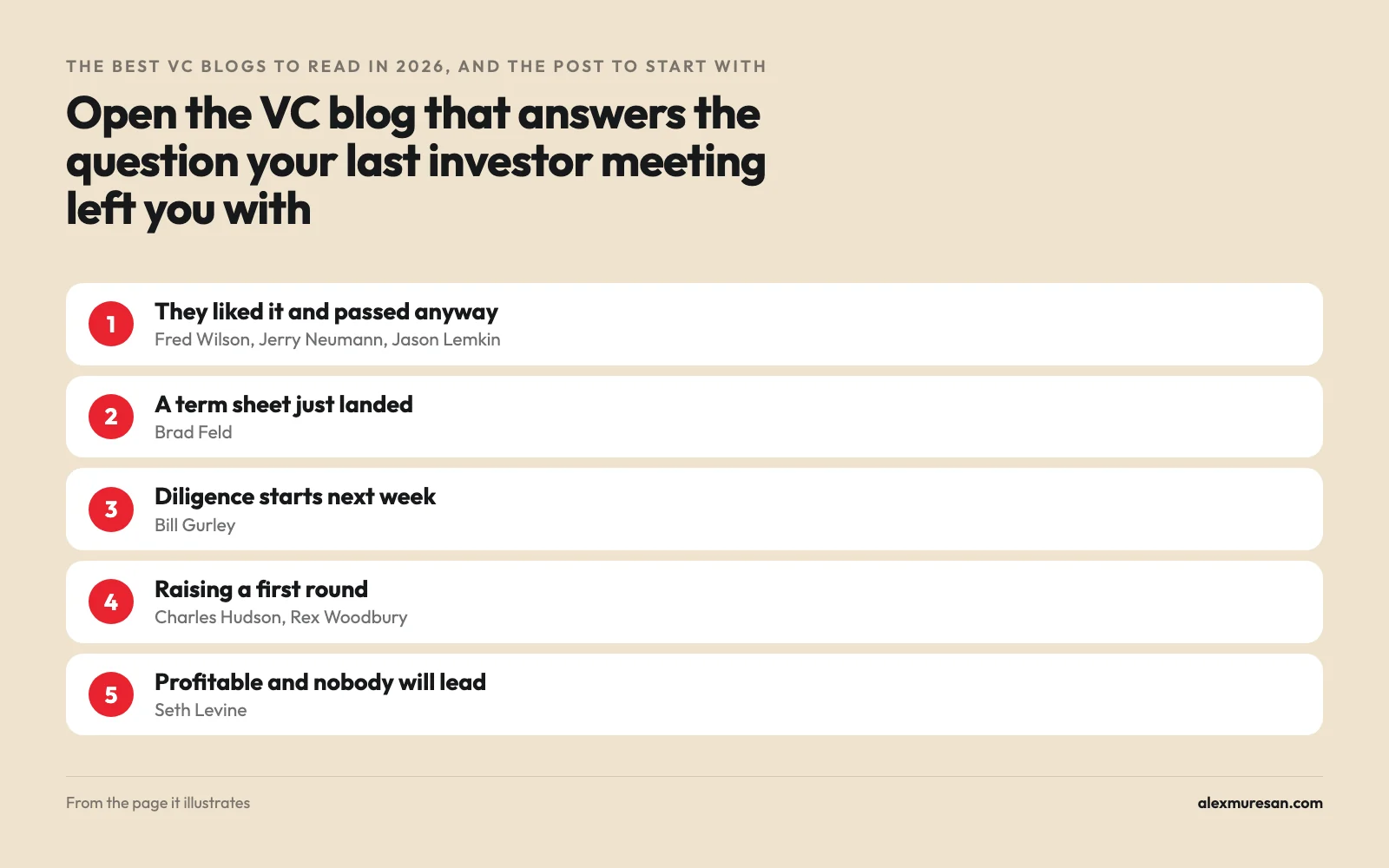
If an investor liked the company and passed anyway, read Fred Wilson and Jerry Neumann for the fund math, then Jason Lemkin for what to do about it. If a term sheet just landed, read Brad Feld before you call your lawyer, and if diligence starts next week, read Bill Gurley's checklist and fix what's on it. If you're raising a first round, read Charles Hudson and Rex Woodbury together, and the what investors look for in a startup guide covers the same question from the pitch side.
If you're profitable and nobody wants to lead, read Seth Levine, because the answer might be a different kind of investor rather than a better deck.
How to read VC blogs without turning into a VC
There is a trap in all of this. Read enough investor writing and you start thinking about your company the way a fund thinks about a portfolio, which helps you pitch and does nothing for your customers, so here is how I'd keep it useful.
Read the math, then open your own cap table
Every post on this page carries a number you can hold your company against. Lemkin's post on first rounds cites PitchBook data showing 8,625 US startups raised a first venture round through Q3 2026, more than the 8,507 in all of 2021, and a median pre-seed pre-money valuation of $12 million, up from $4 million in 2020. Put your own round next to those numbers before you decide what to ask for.
Check whose money is talking
A fund announcement and a letter to limited partners are written partly for the people who gave the VC their money. Hudson and Woodbury are honest about that, which is exactly why their posts are useful, but remember who the first reader was.
Pair the blogs with a voice
Reading tells you what an investor concluded, and hearing them talk tells you how they got there. The best venture capital podcasts page lists the shows where investors argue it out loud, and the best B2B marketing podcasts roundup covers the go-to-market half.
Get the next one in your inbox
Every week I publish one new piece like this, on AI startups, distribution and the people building them, and I post the short versions on TikTok, Instagram and YouTube. Put your email in the box at the end of this page and the next one reaches you the week it lands.
FAQs about VC blogs
What are the best VC blogs to read? Start with Fred Wilson's AVC for fund math and Brad Feld's Feld Thoughts for term sheets. If you sell B2B software, add Jason Lemkin's SaaStr, and read Bill Gurley's Red Flag Checklist the week before diligence starts.
What are the best VC blogs for founders raising a first round? Charles Hudson's Venture Reflections and Rex Woodbury's Digital Native, because both run pre-seed and seed firms and write about how they pick. Read Brad Feld's term sheet posts before you sign.
What are the best free resources to learn venture capital? The blogs on this page are free, and the archives go back years, from Brad Feld's 2005 term sheet posts to Jerry Neumann's 2015 essay on power laws. Pair them with the venture capital newsletters and podcasts linked above, and you'll have the reading list of a first-year associate without paying for a course.
I want to understand how VCs think. Who should I follow? Follow Fred Wilson and Jerry Neumann for how a fund makes its money, and Jason Lemkin for what that means for your raise. Read Seth Levine when you start wondering whether venture is the right money at all, because each of them explains the reasoning a pass email never will.
Are VC blogs still worth reading when investors post on social media? Yes, because a blog post has room for the reasoning, and a social post usually carries only the conclusion. Check the date before you trust one, since some of the best VC blogs post once every few years.
About the author

Alex Muresan is a 4x founder with 2 exits. He built his first company, a physical entertainment center, to 60 employees and $2M in annual revenue in his early 20s. His second exit came in 2026, when he sold a media company. He took an AI startup from 0 to $600K ARR in 5 months, and at his current startup he took revenue from $800K to $1.4M ARR in his first 3 months. He posts short videos on AI startups, distribution and the people building them, and takes on sponsorships, content projects and consulting: work with him.
Part of the stage playbooks: what to do for growth at pre-seed, seed, Series A, Series B and Series C. The glossary →