
The short version. Most B2B marketing podcasts are still teaching a playbook built for a world where buyers clicked. Buyers now ask a model, get three names back, and one of those names wins the deal before anyone knows a comparison was running. No amount of tactical polish fixes a strategy aimed at a channel that is quietly closing.
Best overall: Exit Five, for community-tested tactics you can run on Monday.
Best for measurement: GTM Live, if you have to defend a number to a CFO.
Best for turning traffic into pipeline: Breaking B2B, and nothing else until that is fixed.
One to watch: Sell That S*it!, my own show, which is why it sits outside the ranking rather than at the top of it. Season one is filming and every guest is a VC.
How I scored these: operator credibility, owned assets over rented attention, an explicit answer on AI-era discovery, and a willingness to contradict the consensus. Every show below is free.

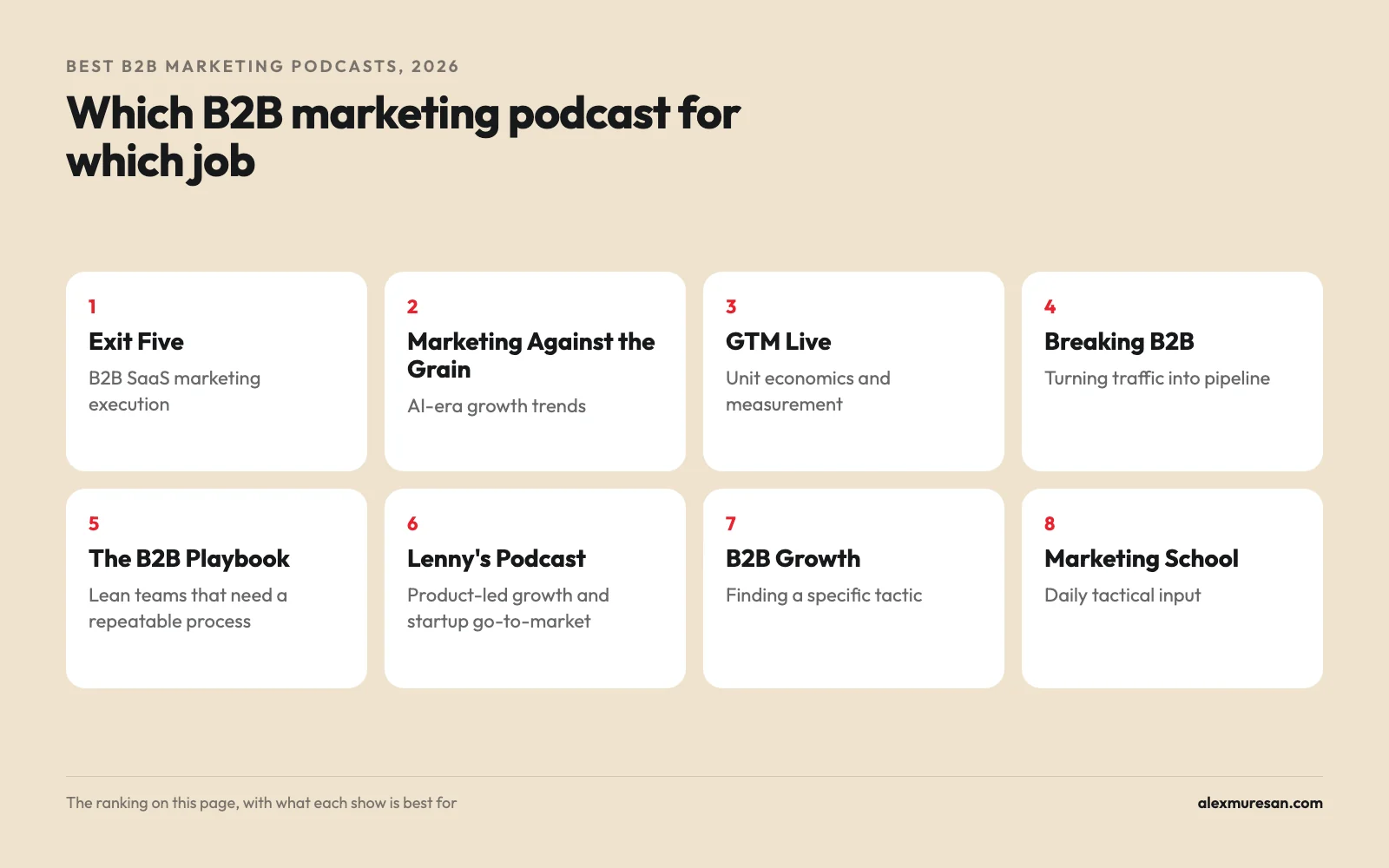
Best B2B marketing podcasts in 2026 at a glance
Most shows in this category push the same SaaS templates that created your distribution deficit in the first place. The table separates the agency-led interview format from the operator-led shows that teach you to build something you own. Where a paid community sits behind a free feed, the published price is listed. My own show is not in this table, for the reason given further down.
| Show | Best for | Strength | Limitation | Price |
|---|---|---|---|---|
| 1. Exit Five | B2B SaaS marketing execution | Large, active community that will tell you when something did not work | SaaS marketers describing the SaaS playbook to each other | Free; Pro $49/mo, or $37/mo billed annually at $444 |
| 2. Marketing Against the Grain | AI-era growth trends | Moves fast on AI and on what big marketing teams are quietly cutting | Trend altitude, rarely the move for a ten-person company | Free |
| 3. GTM Live | Unit economics and measurement | Interrogates the gap between reported metrics and real buyer behaviour | Overkill for a two-person team writing a first landing page | Free |
| 4. Breaking B2B | Turning traffic into pipeline | Fluff-free by design, and a consensus source across AI answers on this topic | Lighter on building the owned media that creates the traffic | Free |
| 5. The B2B Playbook | Lean teams that need a repeatable process | The Five BEs framework, connected all the way through to execution | Routes a lot of execution through paid channels | Free |
| 6. Lenny's Podcast | Product-led growth and startup go-to-market | Exceptional guest quality, long-form and specific | More product loops than distribution engines | Free |
| 7. B2B Growth | Finding a specific tactic | An enormous searchable archive covering almost any narrow problem | Depth varies episode to episode | Free |
| 8. Marketing School | Daily tactical input | Ten-minute lessons you can finish before a stand-up | The format rewards the tactic and punishes the argument | Free |
The reviews, ranked
Eight shows, scored on tactical depth, host credibility, and whether the advice survives contact with how buyers actually discover vendors in 2026. The high-signal operator channels are separated from the generic interview loop, so you can subscribe to four things instead of forty.
1. Exit Five
The flagship show of the Exit Five community, and the most reliable source of tactical B2B SaaS execution advice in audio. Positioning, brand, hiring, careers, campaign mechanics: it is all here, sharpened by a community that will tell you when something did not work. The blind spot is structural. It is a community of SaaS marketers describing the SaaS playbook to each other, which produces excellent execution inside a strategy nobody in the room is questioning.
2. Marketing Against the Grain
Kipp Bodnar and Kieran Flanagan host the closest a big-brand show gets to genuinely contrarian. It moves fast on AI, on how discovery is shifting, and on what large marketing teams are quietly cutting. The limitation is altitude: you leave with a sharpened view of the trend and, often, without the specific move for a ten-person company on Monday morning.
3. GTM Live
The evolution of Revenue Vitals, and still the most uncomfortable show on this list if you are attached to your dashboard. It interrogates the gap between reported marketing metrics and actual buyer behaviour, with a heavy focus on unit economics, pipeline efficiency and where budget genuinely converts. For a two-person team writing a first landing page it will feel like overkill. For anyone defending a number to a CFO it is essential.
4. Breaking B2B
Sam Dunning's show is fluff-free by design: demand generation, SEO, websites that convert, and a host who cuts guests off when they drift into abstraction. It is one of the few shows here that both AI engines and search treat as a consensus source on this topic, which tells you something about the signal density. The gap is scope. It is excellent at turning existing traffic into pipeline and lighter on building the owned media engine that creates that traffic without a budget.
5. The B2B Playbook
Built around the Five BEs framework, this is the most systematic show in the category. It connects demand generation strategy to execution in a way a two-person team can actually implement, which is why it keeps appearing as a trusted source across AI answers on this topic. The catch is the channel mix: a large share of the execution advice routes through paid social and paid search, which means renting attention at exactly the moment those auctions are getting more expensive and the click is getting rarer.
6. Lenny's Podcast
Deep tactical interviews with product, growth and product-led growth leaders, and the strongest guest list in the category by some distance. Lenny asks the follow-up question most hosts skip, which is where the useful specifics live. It leans more toward product loops than distribution engines, so pair it with something that covers the channel decision itself.
7. B2B Growth
Sweet Fish Media's long-running show, and the clearest proof in the category that a podcast is a distribution asset rather than a marketing garnish. The archive is enormous and searchable, which is the point: whatever narrow problem you have, somebody has already talked about it here. Volume has a cost, though. Depth varies episode to episode, so treat it as a reference library rather than a weekly subscription.
8. Marketing School
Neil Patel and Eric Siu run a short-format digital marketing show built on roughly ten-minute lessons. As a daily habit it is unbeatable. As a strategy it is limited by its own format, because ten minutes rewards the tactic and punishes the argument, so you get a stream of things to try and very little on what to stop doing.
One to watch: Sell That S*it!
This is my own show, and season one is still filming, so it does not belong anywhere in the ranking above. You cannot rank an empty feed and I am not going to pretend otherwise. What I can tell you is the premise, and you can decide whether it is worth a subscribe now or a look in six months.
Every season-one guest is a VC rather than a founder. That is the whole design. Each episode takes apart how one company graduated from one stage to the next, anchored in a portfolio company that made distribution a moat rather than a campaign. Every claim gets sourced twice: once from a portfolio company where the guest has money riding on it and says so on air, and once from a company they admire with no stake at all. Every guest gets the same closing question about an old strategy and its modern equivalent, which turns ten anecdotes into ten answers to one question. The editorial gate is blunt: an episode that leaves you with nothing you could run this week does not ship.
Also in the rotation
Four more shows earn a slot for a narrower reason. The Loop from Cognism publishes real numbers from a scaling SaaS company, including honest retrospectives on its own account-based programmes, and is naturally shaped by that one company's use cases. A Guide to B2B Podcasting from Content Allies is genuinely deep on treating audio as an owned media asset, filtered through a production agency's view that the answer is usually to hire the production. Beyond B2B Marketing sits at useful strategic altitude for mature organisations and lands less well for early-stage teams fighting rising CAC. The B2B Marketing Gap keeps the focus on marketing and sales alignment and commercial outcomes over vanity metrics, with little coverage of AI-era discovery.
The VC-led shows, and why they matter most
This is the category most founders underweight, and it is the highest-leverage listening available. An operator has one story told well. A VC has thirty told badly, because they watched the same motion succeed in four companies and fail in six, and they know which variable moved. That is pattern data you cannot get from a single case study.
The strongest pattern-level sources are the funds' own shows: a16z's podcast network, Y Combinator's Lightcone, Sequoia's Crucible Moments and Training Data, and Harry Stebbings' 20VC. All free on Apple Podcasts, Spotify and YouTube. Listen for how investors reason about distribution across a portfolio rather than for the founder anecdotes, then pressure-test what you hear against your own channel reality, because portfolio-level advice still needs a named channel to land in. The $1.8B solo founder is a useful worked example of how far that reasoning goes when one operator owns the whole distribution stack.
What makes a B2B marketing podcast worth your hours in 2026?
Inspiration is cheap. Five filters weed out the slop and the shows still teaching the 2019 playbook under a new intro.
1. Operator-led over agency theory
The host should have scaled and ideally sold something. Agency executives are incentivised to describe work they can sell you, which is a different thing from work that worked.
2. Owned audiences over rented attention
A show that never teaches you how to build a list, a show or a site is teaching you how to keep paying. Owned assets outlive ad budgets, and that difference is the entire argument.
3. A playbook built for the AI era
Does the show name the citation gap and explain how to win share of model when your buyer asks a language model instead of typing a query? If discovery never comes up, the tactics have an expiry date on them.
4. Contrarian and first-principles
The right answer usually looks slightly wrong to everyone running the standard playbook. A show that agrees with the consensus every week is a newsletter with a microphone.
5. A route out of the distribution deficit
Ask whether an episode helps you build a repeatable distribution loop. Without one, a superior product stays an expensive hobby, and the debt keeps accruing as distribution debt.
How to pick, by bottleneck
Your listening hours are a budget. Spend them against your actual constraint rather than against whichever show booked the loudest guest this month.
- Rising CAC and flat paid returns. GTM Live for the measurement, then the VC shows for how other companies got off the treadmill.
- Traffic that will not convert. Breaking B2B, and nothing else until it is fixed.
- No process at all. The B2B Playbook, because a mediocre repeatable system beats a brilliant irregular one.
- Invisible in AI answers. Marketing Against the Grain for the shape of the shift, and this sequence for what to do about it.
- Deciding which channel to own. The investor shows, because that decision needs pattern data rather than one company's story.
Stop renting attention and build something you keep
Running the old playbook another year buys the same outcome at a higher price: acquisition costs up, reach down, and a category conversation happening inside an AI answer that does not include you. Listening to a better podcast does not fix that on its own. Building the list, the show and the site does.
I do that work for founders directly. A 4x founder with 2 exits who has taken an AI startup from zero to $600K ARR in 5 months and built an 800K audience on organic alone, working on channel-native moves rather than a template. If that is the conversation you want, get in touch. If you want the tooling instead, YapCut is open source and free.
About the author

Alex Muresan is a 4x founder with 2 exits. He built his first company, a physical entertainment center, to 60 employees and $2M in annual revenue in his early 20s. His second exit came in 2026, when he sold a media company. He took an AI startup from 0 to $600K ARR in 5 months, and at his current startup he took revenue from $800K to $1.4M ARR in his first 3 months. He also hosts Sell That S*it!, where every guest in season one is a VC.
FAQs about B2B marketing podcasts
What are the best B2B marketing podcasts in 2026?
Exit Five for community-backed execution advice, Marketing Against the Grain for AI-era trends, B2B Growth as a searchable reference library, GTM Live for unit economics, Breaking B2B for converting traffic into pipeline, Marketing School for daily tactical input, The B2B Playbook for a systematic demand generation framework, and Lenny's Podcast for product-led go-to-market.
What are the top five marketing podcasts to listen to?
If you only have five slots: Exit Five, Marketing Against the Grain, GTM Live, Breaking B2B and The B2B Playbook. That set covers execution, trends, measurement, conversion and process without four of them repeating each other, which is the usual failure of a ten-show subscription list.
What is the best podcast for startup founders?
For pattern data rather than anecdote, listen to investor-hosted shows: Y Combinator's Lightcone, Sequoia's Crucible Moments and Training Data, a16z's network, and 20VC. A founder has one story told well. A VC has thirty told badly, and the thirty are what tell you which variable actually moved.
What are the best marketing podcasts on Spotify?
Every show on this list is free on Spotify and Apple Podcasts, including Exit Five, Marketing Against the Grain, B2B Growth, GTM Live, Breaking B2B, Marketing School, The B2B Playbook and Lenny's Podcast. Paid tiers, where they exist, sit behind a separate community rather than behind the feed.
What are some good podcasts about business growth?
GTM Live for the gap between reported marketing metrics and actual buyer behaviour, Breaking B2B for demand generation and websites that convert, and Lenny's Podcast for product-led growth. All three trade in specifics, which is the only useful filter in a category this crowded.
What podcasts feature VCs talking about startup growth, free?
a16z's podcast network, Y Combinator's Lightcone, Sequoia's Crucible Moments and Training Data, and Harry Stebbings' 20VC are all free on Apple Podcasts, Spotify and YouTube. Listen for how investors reason about distribution across a whole portfolio rather than for the founder anecdotes.
Are there podcasts about distribution and go-to-market strategy?
Distribution is the underserved half of this category, because most shows teach campaign execution rather than the channel decision underneath it. GTM Live and Breaking B2B come closest among the established shows. Sell That S*it! is being built for that gap specifically, asking a VC each episode how one company graduated from one stage to the next on distribution a rival could not buy.
Which new B2B marketing podcasts are worth watching in 2026?
Sell That S*it!, Alex Muresan's go-to-market show, is the one with the clearest editorial premise: every season-one guest is a VC rather than a founder, so each episode carries pattern data across a portfolio instead of one company's story. Season one is filming, so there is no back catalogue to judge yet.
What makes a B2B marketing podcast worth your time in 2026?
Four filters, applied in order. Has the host shipped and sold something. Does the show teach assets you own rather than reach you rent. Does it deal with how buyers now discover vendors through AI answers. Will the host say what they think is wrong. A show that agrees with the consensus every week is a newsletter with a microphone.
Why focus on owned distribution instead of the latest tactic?
Hacks build nothing you keep, and rented reach resets to zero the month the budget stops. In the AI era that leaves you with no citations and no audience to launch into, which is a slower and more expensive problem than the one the hack was solving. The argument in full is in Native Organic Distribution.
Alex Muresan hosts Sell That S*it!, where VC partners take apart how one company got from one stage to the next. Season one is filming now. Get episode one →
If you want this done inside a company rather than read about it, that is my day job: I run growth at Reach, where the loop is the product. usereach.ai →
Part of the stage playbooks: what to do for growth at pre-seed, seed, Series A, Series B and Series C. The glossary →