
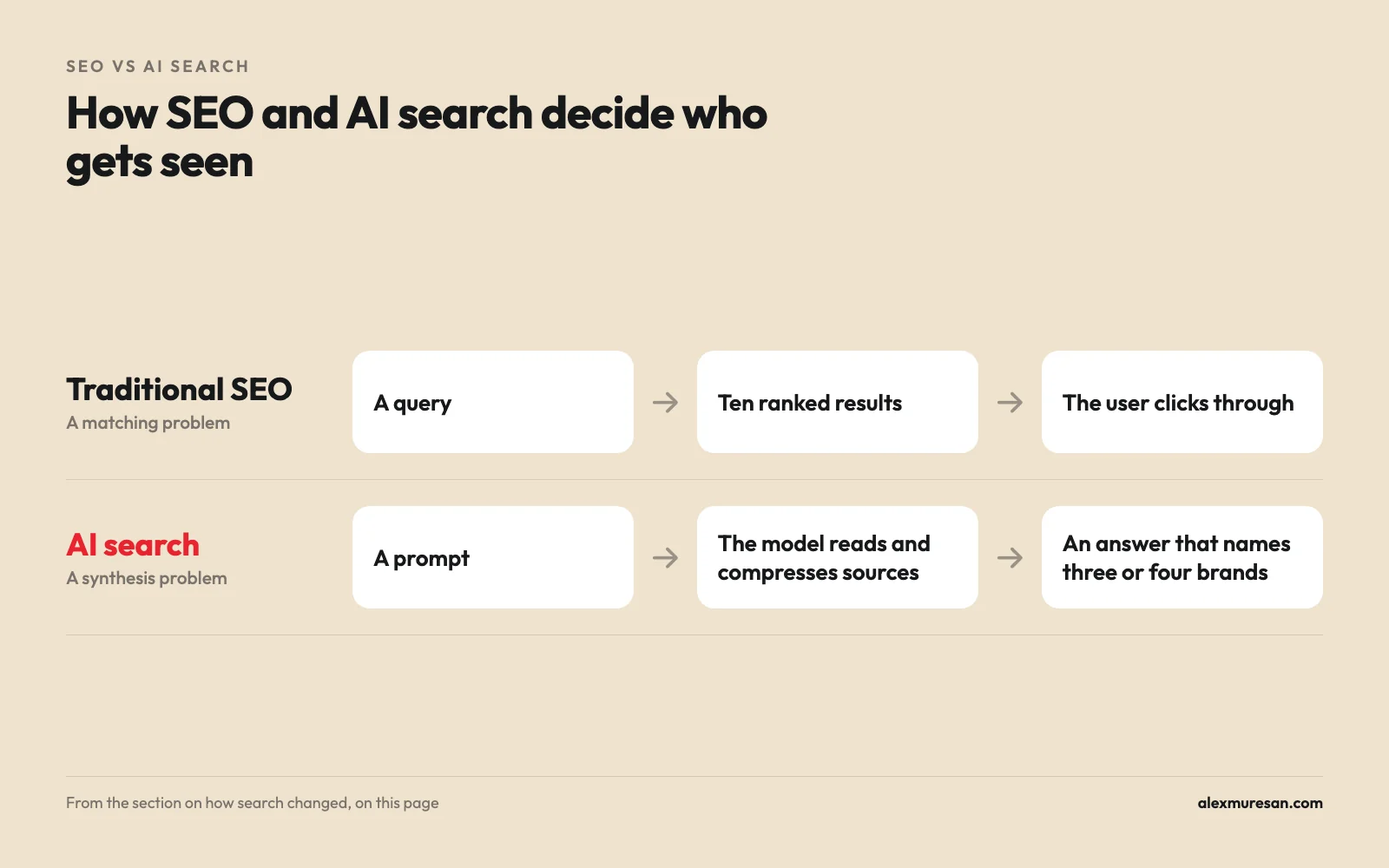
The core difference: SEO competes for a ranked link. AI search competes for a place inside an answer, where the model names three or four brands and the question is often finished without a click.
What still matters: Crawlability, clean structure and authoritative pages. Answer engines can only cite what they can retrieve, so SEO has become the floor rather than the finish line.
What changed in measurement: AI answers almost never repeat the same brand list twice, so a single ranking position means very little. Track how often you appear across many prompts instead.
What actually moves it: A point of view worth quoting, mentions on sources models already trust, and claims structured so they can be lifted. Tracking your absence is step zero, and it is not the fix.

SEO vs AI search at a glance
The click is dying, and that changes what search is for. Here is the comparison side by side before the detail.
| Dimension | Traditional SEO | AI search (AEO) |
|---|---|---|
| Unit of success | A ranking position | A citation inside a generated answer |
| Traffic model | The user clicks through | The model answers, and the user may never click |
| Core metric | Keyword rankings and sessions | Share of model and citation frequency |
| Stability | Rankings move slowly | Recommendation lists change on nearly every run |
| Main lever | On-page work, links and technical crawlability | Being the source models retrieve, quote and trust |
| Time horizon | Campaign cycles | Compounding owned assets |
If the row that matters most to you is the second one, it is worth reading the click is dying, the mention is everything next.
How search changed: from matching to synthesis
Traditional SEO optimized for a matching problem. You had a query, a set of documents and ten ranked results, and the work was making your document the best match. AI search optimizes for a synthesis problem. The model reads, compresses and decides who gets named, and keyword density is irrelevant to a system that is choosing which sources to trust.
That used to be a technicality and now it is the whole game. Models synthesize an answer, name three or four brands, and the buyer's question is done. If you are not one of the named brands, the research showing exactly where your audience spends time is a very well formatted description of your own absence.
That absence has a name, the citation gap: the distance between the questions buyers ask an AI and the answers where your brand actually appears.
Is SEO dead now with AI?
No. The click is dying, which is not the same thing. Technical crawlability, clean structure and authoritative content still decide whether a model can retrieve you at all. Many answer engines pull live results from traditional search indexes, Google's and Bing's among them, so a page that is not indexed is a page no model can cite.
What is dead is the assumption that a ranking converts into a visit. Traditional SEO is becoming the substrate, and AI search optimization is the layer that decides whether you get named in the answer. Do both, and weight new investment toward the answer layer, because that is where the uncontested ground still is.
Why AI search answers are so unstable
The most useful public research on this comes from SparkToro and Gumshoe.ai. Rand Fishkin and Patrick O'Donnell had hundreds of volunteers run 12 recommendation prompts through ChatGPT, Claude and Google's AI Overviews 2,961 times across November and December. Ask the same question 100 times and there is less than a 1-in-100 chance of getting the same brand list twice. The same list in the same order showed up less than 0.1% of the time.
That kills the idea that you can "rank number one in ChatGPT". There is no fixed position to hold. What the study's authors point out instead is that visibility across many runs is far more stable than any single answer, so a brand can be reliably present without ever being reliably first.
How to measure visibility in AI search
Measure how often you appear, not where. Build a fixed panel of the prompts your buyers actually type, run each one many times across the engines that matter to you, and record the percentage of answers that name you. Track that number monthly and watch the trend, because single readings are noise by design.
Perplexity is the cleanest place to start, because it shows its citations inline, so you can see whether your content was retrieved rather than merely mentioned. Then compare your presence against the three or four companies the models name most often for your category. That comparison is your citation gap, sized.
One warning from experience. If you buy tracking and change nothing about your distribution, you have bought a monthly report on your own invisibility, which is the argument in your AEO tool is just a scale.
The tools for each job
The tools split into two jobs: the engines where buyers ask, and the software that tells you how you show up in them.
Where buyers ask
ChatGPT is the most widely used assistant and, for many categories, the first place a buyer asks for a shortlist. It is also the least consistent: in the SparkToro study it repeated the same brand list on an identical prompt less than 1% of the time.
Perplexity answers conversationally and cites its sources inline, which makes it the best surface for checking whether your content is actually being retrieved.
Claude is widely used for research and shortlisting. It showed somewhat more consistency in which brands appeared, though the ordering still moved from run to run.
Google's AI Overviews and AI Mode sit on top of the largest search index there is, which is why the SEO substrate matters so much for them in particular.
What measures it
SparkToro is audience research: where your buyers listen, read and follow. It is excellent at showing you the problem and does not go and get you mentioned anywhere.
Gumshoe.ai co-ran the consistency study and measures AI visibility across large volumes of prompts, which suits teams that want scale rather than spot checks.
Ahrefs is a mature SEO toolset that has extended into AI visibility reporting. It is strong data for prioritizing technical and content fixes, and it is still a measurement layer.
Similarweb uses panel data to show how AI mentions turn into direct visits and branded search, which helps when you need to show the downstream effect of being cited.
How to get cited instead of just tracked
Every one of those tools measures the outcome. None of them produces it. The things models actually retrieve are distinctive, widely referenced and quotable, and they come from work, not dashboards.
Publish a point of view worth quoting. Models cite sources that say something specific, and they skip the ones that restate the category.
Earn mentions on the sources models already trust: the publications, communities and comparison pages that keep showing up in answers for your category.
Structure your pages so claims can be lifted cleanly, with definitions, named methods and numbers a model can repeat without rewriting.
Build owned channels, a list, a show and a site, that keep generating third-party references after any single campaign ends.
Measure visibility as a percentage across a prompt panel, and change one thing at a time so you can tell what moved it.
For the step-by-step version, how to get your brand mentioned in AI answers walks through it in order, and Answer Quest teaches what each engine cites as a free game.
FAQs About SEO vs AI Search
Is SEO dead now with AI? No. The click is dying, which is different. Crawlability, structure and authoritative content still decide whether a model can retrieve you, and many answer engines pull live results from traditional indexes. SEO is becoming the substrate, and AI search optimization decides whether you get named in the answer.
What is the difference between SEO and AI search optimization? SEO competes for a ranked link that a user clicks. AI search optimization competes for a citation inside a generated answer, where the model names a few brands and the user may never click. The unit of success moves from a position to a mention, and the core metric moves from rankings to share of model.
Why do AI search engines give different answers to the same question? Models generate each answer fresh rather than retrieving a fixed ranking. Research by SparkToro and Gumshoe.ai found less than a 1-in-100 chance that ChatGPT or Google's AI would return the same brand list twice, and the same list in the same order less than 0.1% of the time.
How do you measure visibility in AI search? Run a fixed panel of buyer prompts many times across the engines that matter, and record the percentage of answers that name your brand. Track the trend monthly, compare it against the brands models name most often, and treat any single answer as noise.
Does ranking on Google help you get cited by AI? It helps you become eligible. Answer engines can only cite what they can retrieve, and several draw on traditional search indexes, so strong SEO keeps you in the pool. It does not guarantee a citation, which depends on whether your content is distinctive and referenced elsewhere.
What strategies improve brand visibility in AI search engines? Publish a distinct point of view worth quoting, earn mentions on sources models already trust, structure content so claims are extractable, build owned channels that keep generating third-party references, and measure visibility as a percentage across many prompts rather than as a rank.
Do compounding organic strategies take too long to show results? The compounding takes time and the cost relief does not. Specific, channel-native work can earn visible mentions early, and the reason to do it is that the curve keeps rising instead of resetting the month a campaign ends.
About the Author
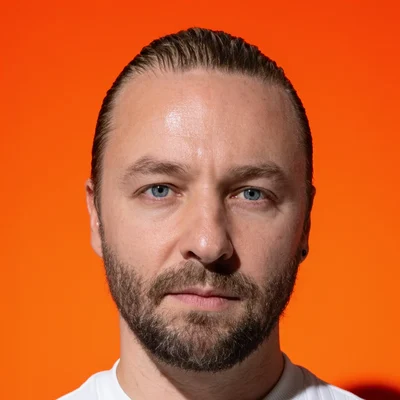
Alex Muresan is a 4x founder with 2 exits. He built his first company, a physical entertainment center, to 60 employees and $2M in annual revenue in his early 20s. His second exit came in 2026, when he sold a media company. He took an AI startup from 0 to $600K ARR in 5 months, and at his current startup he took revenue from $800K to $1.4M ARR in his first 3 months. He also hosts Sell That S*it!, where every guest in season one is a VC.
Part of the stage playbooks: what to do for growth at pre-seed, seed, Series A, Series B and Series C. The glossary →