
Pick hosts who invest in or run AI companies: They ask about the pilot and the price before they ask about the architecture, which is where an AI startup's year actually goes.
Start with Jacob Effron and Jack Altman: Unsupervised Learning's Legora episode and Uncapped's Sam Blond episode are 2 founders explaining growth, pricing and pipeline with their own numbers.
Matt McIlwain's enterprise episode is the one for a stuck pilot: 2 founders selling into companies like Google and SAP explain the 45-day pilot and the AI review board that shows up at the end of the deal.
Use Matt Turck and Lukas Biewald for the buyer's side: Box's Aaron Levie and Atlassian's Mike Cannon-Brookes explain how big companies budget for AI and test the tools you're selling.
Write down 1 move per episode: If you can't name what you'd change in your own pilot or pricing this week, the hour was entertainment.

The 8 best AI podcasts at a glance
It's Tuesday morning and a new model dropped overnight, so every AI show in your feed is spending the hour on benchmark charts. Meanwhile your real problem is sitting in your inbox. A Fortune 500 pilot that went well 6 weeks ago is now waiting on something called an AI review board, nobody on your side knows who sits on it, and the renewal you penciled in for next quarter is starting to look like a guess.
That's the gap this page is for. The model news will reach you whether you subscribe or not, through X and through the engineer who posts it in the team channel before breakfast (yes, every time). What won't reach you on its own is how other AI companies got through that review board and what they charged once they did, so these 8 shows are picked on that alone.
| Pick | Known for | Who should listen | Start with |
|---|---|---|---|
| 1. Jacob Effron (Unsupervised Learning) | Redpoint's AI show, with founders and researchers | Founders scaling an AI app into a second market | Legora after its $550M Series D |
| 2. Jack Altman (Uncapped) | Long interviews from a Benchmark partner | Founders who think they have a conversion problem | Sam Blond on pipeline and pricing at Monaco |
| 3. Matt McIlwain (Founded & Funded) | Madrona's founder conversations | Anyone with an enterprise pilot in procurement | How to sell AI into the enterprise |
| 4. Sonya Huang and Pat Grady (Training Data) | Sequoia's AI show | Vertical AI founders selling to regulated buyers | Pace, replacing insurance back offices |
| 5. Sarah Guo and Elad Gil (No Priors) | 2 AI investors interviewing founders | Founders selling AI to slow industries | Netic, agents for essential services |
| 6. Matt Turck (The MAD Podcast) | FirstMark's weekly show and the MAD Landscape | Growth leaders selling to enterprise IT | Aaron Levie on the state of enterprise AI |
| 7. swyx and Vibhu Sapra (Latent Space) | The AI engineering newsletter and podcast | Developer-tool founders hunting for distribution | OpenRouter, from seed to 10 million developers |
| 8. Lukas Biewald (Gradient Dissent) | Weights & Biases' show on AI in production | Anyone selling AI tools to software companies | Atlassian's AI tool bake-off |
What makes the best AI podcasts worth a founder's hour?
An AI podcast is any show where the guests build or fund AI, and in 2026 there are more of them than anyone has commutes for. Most of them run on the news cycle, which means the episode is out of date by the time the next model ships. The ones worth keeping ask a founder the questions a board would ask, like who bought it and what nearly killed the deal.
That's harder to find than it sounds, because a lot of AI shows are hosted by researchers and engineers, and their best episodes go deep on the model. Those are great hours if you train models. If your job is the revenue line at an AI startup, you want hosts who invest in or run AI companies, because they ask about the pilot and the price before they ask about the architecture.
So this is a list of hosts as much as shows. If you want the software shows without the AI focus, my list of the best SaaS podcasts for growth leaders covers Omer Khan and Mark Roberge. If you want investors on startups in general, the best venture capital podcasts list covers 20VC and Acquired.
How I picked them
Every show here had to pass 3 checks. The host invests in or runs AI companies. The show published an episode with an AI company in 2026, which I confirmed on its own feed. And I could point to 1 episode where a founder or growth leader at an AI startup leaves with a move to try on their own pipeline.
I took an AI startup from zero to $600K ARR in 5 months, so I'll say my bias out loud. The episodes I'd send to a founder are about pricing and pilots, because that's where the months go when you're selling something buyers have never bought before. Benchmarks matter too, and your engineers will tell you about them for free.
Lenny's Podcast and 20VC sit out on purpose. Both are on my other lists, and both are the shows everyone at an AI startup already plays, so I used them as the bar: a pick had to give an AI founder something those 2 don't. Every show below is free, and nobody paid to be here.
The best AI podcasts for AI startups, one by one
1. Jacob Effron (Unsupervised Learning)
Jacob Effron is an AI investor at Redpoint Ventures, and the Unsupervised Learning show notes list Abridge, Physical Intelligence and Legora among the investments he has led. He talks to AI researchers and founders, often with a second investor in the room, so the questions land on the business as often as on the model.
Start with episode 82, from March 11th, where Effron and Logan Bartlett sit down with Legora's CEO Max Junestrand after the company's $550M Series D. The title promises revenue doubling every quarter, and the conversation gets into how AI actually spreads through law firms, which Junestrand says happens through competition between firms and pressure from their clients more than through top-down mandates. He also argues that outcome-based pricing is harder than it looks, which is worth hearing before your board asks you to try it.
It ends on the US expansion, including the decision to fly every New York hire to Stockholm for onboarding. Jack Altman's Uncapped interview with Junestrand, released the next day, adds the scale behind it: 800 customers in more than 50 markets, and a team that grew from 40 to 400 in a year. If you're about to open a second market, those 2 hours together are the closest thing on this list to a case study.
2. Jack Altman (Uncapped)
Jack Altman co-founded Lattice in 2015, ran it as CEO until December 2023, and became a general partner at Benchmark in February 2026. Uncapped is his interview show, which he describes as "conversations with people I admire about things I'm genuinely interested in", and in practice that means founders and investors talking for an hour with nobody rushing them.
Open Uncapped #54, from July 14th, with Sam Blond, the co-founder and CEO of Monaco, which is building AI-native sales software meant to replace the CRM as the system of record. Blond ran sales at EchoSign and Zenefits and was Brex's CRO before a stint as a partner at Founders Fund, so his view on pipeline comes from 3 companies' worth of numbers.
His argument is that most founders read a revenue problem as a conversion problem when it's really a pipeline problem. He also gets into how he prices when what you're selling replaces labor rather than software, and there's a chapter on what he calls the $60,000 plane experiment, followed by one on creative campaigns against paid advertising.
Then play Bret Taylor's episode from February 19th, where the Sierra CEO talks through outcome-based pricing. Put it next to Junestrand's doubts and you have both sides of the pricing argument every AI startup has to settle sooner or later.
3. Matt McIlwain (Founded & Funded)
Founded & Funded is Madrona's show, built on conversations between the firm's investors and founders, so the host changes with the episode. The one to start with is hosted by Madrona Managing Director Matt McIlwain, and it's called How to Sell AI Into the Enterprise, from March 4th.
His 2 guests sell into companies like Google, SAP and Snowflake: Esha Joshi, co-founder of Yoodli, and Anup Chamrajnagar, co-founder of Gradial. Joshi says in the full transcript that she tries to scope a pilot at about 45 days, because anything past 60 to 90 days makes a clear answer harder to get. Chamrajnagar swaps the word POC for a targeted pilot with 3 objectives agreed up front, and he builds a mutual success plan so the pilot doesn't die on success.
Then comes the part nobody warns you about. Chamrajnagar describes a new body inside many enterprises called the AI review board, which he says "wasn't a thing two years ago" and which tends to arrive at the last second. If your pilot is sitting in front of that board right now, this is the episode for this week.
The pricing section is just as practical. Yoodli mostly sells seats plus a flat fee that covers its AI features and customer success, while Gradial moved from seats to a pool of actions and is testing units like 5,000 more emails. For the follow-up, Madrona's July 23rd episode has former sales leader David Rubenstein, who met more than 300 founders across 41 countries, on how to sell against a buyer who says they'll just build it with Claude Code.
4. Sonya Huang and Pat Grady (Training Data)
Training Data is Sequoia's AI show, hosted by Sonya Huang, Pat Grady and other Sequoia partners, and most of its guests are building or researching the models. The episode a go-to-market reader should open is the Pace episode from February 3rd, hosted by Lauren Reeder and Pat Grady, with Pace CEO Jamie Cuffe.
Pace sells AI that replaces outsourced back-office work in insurance, from email triage to claims processing, at 50% to 75% cost savings. Cuffe's problem is the one every vertical AI founder has, which is getting conservative, regulated buyers to trust an agent with work that can't go wrong.
His answer draws on his time at Retool. He closes the distance with customers through forward-deployed engineering, and he goes after the top-tier insurance carriers first while holding the product to very high standards, which he sees as the way into a $400 billion outsourcing market. If you sell into a regulated industry, this is the closest thing to a field manual on this list.
5. Sarah Guo and Elad Gil (No Priors)
Sarah Guo founded Conviction, an investment firm built for AI software companies, after nearly a decade at Greylock. Elad Gil co-founded Color Health and Mixer Labs and has invested in more than 40 companies now worth $1B or more each, according to the No Priors show notes. So when a founder comes on, the hosts already know the market that founder is selling into.
Open the Netic episode from July 31st, where Elad Gil talks to founder and CEO Melisa Tokmak. Netic puts AI agents between essential-service companies and their customers, from emergency home repairs to pet care, and over 70% of Netic's customers interact first with AI.
The go-to-market chapters are the reason it's here. Tokmak explains why she built a product company instead of an AI roll-up, and she has a whole section on selling to slow industries. She also covers how private equity's approach to AI shifted toward measurable ROI, which matters a lot if the companies you sell to are PE-owned.
6. Matt Turck (The MAD Podcast)
Matt Turck is a general partner at FirstMark and the creator of the MAD Landscape, which the show calls the reference map of the AI ecosystem. The MAD Podcast is his weekly show with the founders and researchers building AI.
Play his May 28th episode with Box CEO Aaron Levie, recorded after hundreds of conversations with Fortune 500 CIOs this year. Levie explains why one badly written agent run can now cost $1,000 in compute, and he gets into what replaces per-seat pricing as more software runs headless, with no person clicking through it.
He also calls the forward-deployed engineer the hottest job in tech, and he closes on where startups can still win as the labs move up the stack. If you sell to enterprise IT, this is your buyer's world explained by someone who talks to them every week.
7. swyx and Vibhu Sapra (Latent Space)
Latent Space started as swyx's newsletter in 2022, written to make sense of the new field of AI engineering, and the podcast followed in 2023 with Alessio Fanelli as its founding co-host. Today swyx and Vibhu Sapra host it with rotating contributors, and most episodes are for engineers, so look for the ones with a founder in the title.
The one to open is OpenRouter: from Seed to Stripe, from September 25th, with OpenRouter co-founder and CEO Alex Atallah and AMP's Anjney Midha. OpenRouter routes developers to whichever model they want, and the episode introduces it as the routing layer for more than 10 million developers.
The distribution story is the lesson. AI labs kept releasing models with no plan for getting developers to try them, so OpenRouter offered launch-day reach, and the transcript recounts telling Black Forest Labs that on the day it launched, OpenRouter could send it 1 million developers. If your product lives on top of other companies' launches, that's the move to copy: be the place where the new thing gets tried first.
8. Lukas Biewald (Gradient Dissent)
Gradient Dissent is Lukas Biewald's show, produced by Weights & Biases, about bringing models into production with guests from companies like NVIDIA and OpenAI. Most of it is for the people building the systems, and it earns its place here through one episode about the people buying them.
In the January 20th episode, Atlassian co-founder and CEO Mike Cannon-Brookes explains what his company learns from more than 10,000 engineers split-testing AI coding tools, from GitHub Copilot and Cursor to Claude Code. If you sell AI tools to software companies, that's your buyer describing how the bake-off works.
The second half covers product-led growth and the core metrics Cannon-Brookes uses for sustainable growth. That's the part a growth leader will want to write down, because it comes from someone who has spent 24 years building Atlassian.
Which AI podcast to open first, by problem
Your listening hours are a budget, and these AI go-to-market podcasts pay out fastest when you match the episode to the problem on your desk this week.
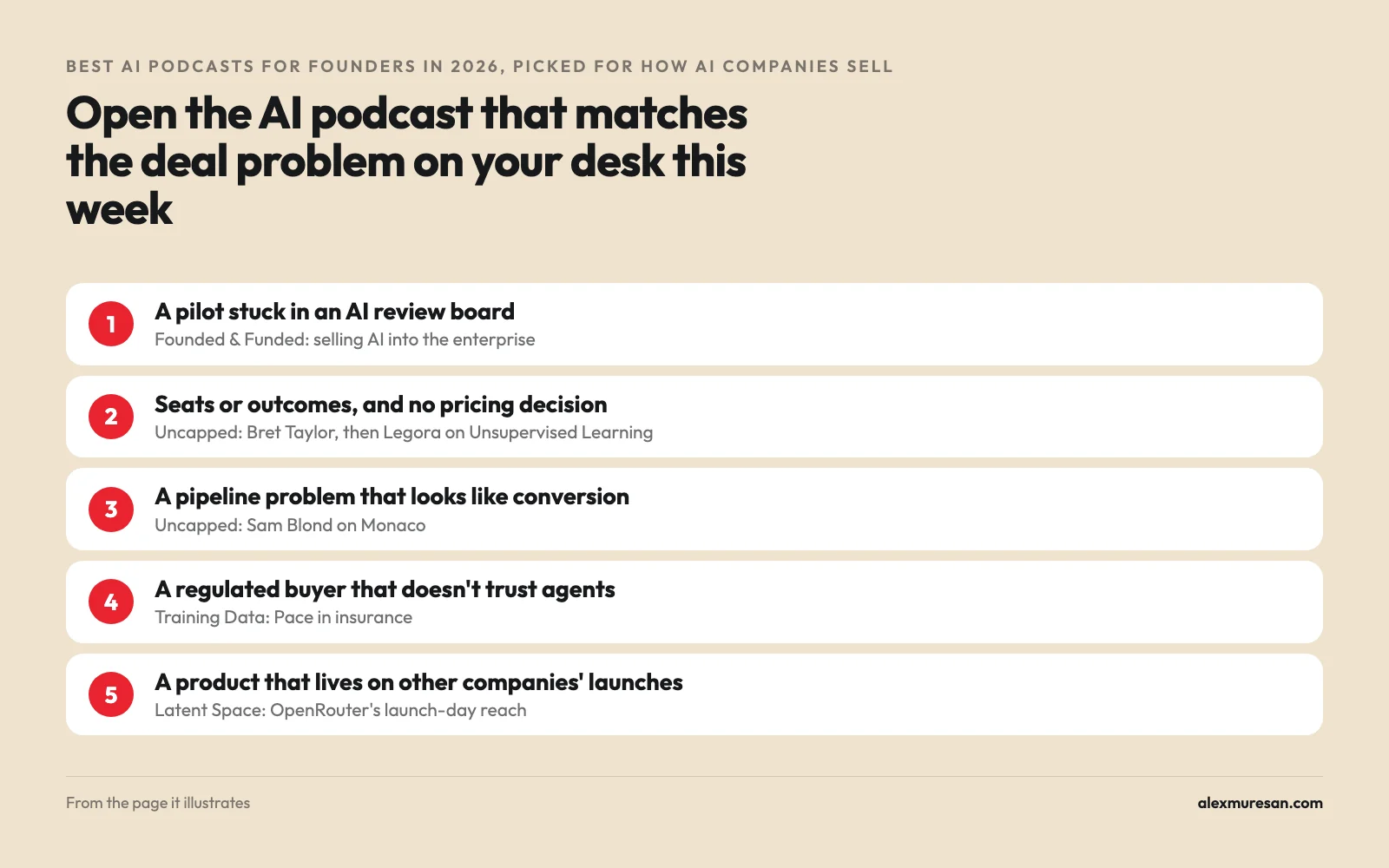
A pilot stuck in procurement or an AI review board: Founded & Funded, the enterprise episode, for the 45-day scope and the mutual success plan.
A pricing debate between seats and outcomes: Uncapped's Bret Taylor episode, then Unsupervised Learning's Legora episode for the other side.
A pipeline that looks like a conversion problem: Uncapped with Sam Blond.
A regulated buyer that doesn't trust agents yet: Training Data's Pace episode.
A product that lives on other companies' launches: Latent Space's OpenRouter episode.
So on that Tuesday with the stuck pilot, the episode for the drive in is Matt McIlwain's, and the benchmark charts will still be there at lunch. If the problem underneath it all is what each customer costs you, my page on how to reduce CAC is the written version of what these episodes keep circling, and the Series A growth playbook covers what changes once the first pilots turn into contracts.
Get the next one in your inbox
Every week I publish one new piece like this, on AI startups, distribution and the people building them, and I post the short versions on TikTok, Instagram and YouTube. Put your email in the box at the end of this page and the next one reaches you the week it lands.
FAQs about the best AI podcasts
What are the best AI podcasts in 2026? My 8 are Unsupervised Learning (Jacob Effron), Uncapped (Jack Altman), Founded & Funded (Matt McIlwain and the Madrona team), Training Data (Sonya Huang and Pat Grady), No Priors (Sarah Guo and Elad Gil), The MAD Podcast (Matt Turck), Latent Space (swyx and Vibhu Sapra) and Gradient Dissent (Lukas Biewald). Each one has an episode above about how an AI company sells or prices what it sells.
What are the best podcasts for AI startup founders? Of the AI startup podcasts here, start with Unsupervised Learning and Uncapped, because both hosts invest in AI companies and the Legora and Monaco episodes are founders explaining growth and pricing in their own numbers. Add Training Data's Pace episode if you sell to a regulated industry.
What are the best podcasts about AI go-to-market? Founded & Funded's How to Sell AI Into the Enterprise covers pilots and pricing in one hour. Pair it with Matt Turck's Aaron Levie episode on The MAD Podcast, which explains the same deals from the CIO's side.
Which shows break down how startups actually get customers? Uncapped's Sam Blond episode covers pipeline, and Founded & Funded covers turning a pilot into a 12-month contract. For developer products, Latent Space's OpenRouter episode covers launch-day distribution. For software companies outside AI, my review of the best B2B marketing podcasts and the SaaS podcasts list go further.
Why aren't Lenny's Podcast and 20VC on this list? They're on my best podcasts for startup founders list and the venture capital list already, and most people at an AI startup play them anyway. This list is for the shows that are about AI companies specifically.
Are these AI news podcasts? No. I left the weekly news shows out, because the model news reaches you anyway and goes stale within a week, while an episode on how Legora expanded to the US or how Gradial prices will still be useful next year.
About the author
Alex Muresan is a 4x founder with 2 exits. He built his first company, a physical entertainment center, to 60 employees and $2M in annual revenue in his early 20s. His second exit came in 2026, when he sold a media company. He took an AI startup from 0 to $600K ARR in 5 months, and at his current startup he took revenue from $800K to $1.4M ARR in his first 3 months. He posts short videos on AI startups, distribution and the people building them, and takes on sponsorships, content projects and consulting: work with him.
Part of the stage playbooks: what to do for growth at pre-seed, seed, Series A, Series B and Series C. The glossary →