
Subscribe to the writer who signs the issue: AI answers name the person behind a newsletter, and so does this page. Every pick below is a named operator.
Start with the 2 that carry data: Kyle Poyar surveyed 300 go-to-market leaders for his 2026 report, and Emily Kramer pulled salaries from 1,121 job posts. Those 2 issues alone will change a board slide.
Then add the teardown writers: Dave Gerhardt on SurveyMonkey, the Demand Curve team on Rapha, Category Pirates on Jersey Mike's. One company per issue, with the reasoning shown.
Keep 1 contrarian: Elena Verna and Leah Tharin argue with their own industry in public, including their own employers, which is rarer than it should be.
Unsubscribe from the rest: If an issue can't hand you a number or a company, it is a LinkedIn post with a subject line. Let it go.

The best B2B marketing newsletters at a glance
It's Tuesday, 7:50 in the morning, and you open your inbox before the growth standup. 11 marketing newsletters landed overnight. You open them in order, and 10 of them are the same LinkedIn post you scrolled past on Sunday, rewritten with a subject line and a sponsor block. The 11th has a chart from a survey of 300 go-to-market leaders, so you screenshot it, forward it to your CEO with "this is why we're moving budget", and the standup goes differently.
This page is about that 11th email. For each of the 8 B2B marketing newsletters below I opened a recent issue and pulled out the number or the company story that earned the spot, so you can see what you're signing up for before you give it an inbox slot.
| Newsletter and writer | What it covers | Who should read it | Start here |
|---|---|---|---|
| Growth Unhinged, Kyle Poyar | Benchmarks and surveys on how B2B software companies go to market | Heads of Growth who get asked how their motion compares | The 2026 State of B2B GTM report |
| MKT1, Emily Kramer | How to build a B2B startup marketing function, with the data to back it | First marketing hires and the founders hiring them | What B2B marketers get paid in 2026 |
| Exit Five, Dave Gerhardt | What CMOs at real companies did last quarter, in their own words | B2B marketers who want a play they can run on Monday | Why SurveyMonkey brought the monkey back |
| Elena's Growth Scoop, Elena Verna | Product-led growth, pricing and packaging, written from inside an AI company | Anyone who sells with credits, tokens or usage tiers | What on earth is going on with AI pricing? |
| The Growth Newsletter, Neal O'Grady and the Demand Curve team | One company teardown and one study per issue, twice a month | Founders and marketers who want tactics with the reasoning attached | Issue 351: Rapha and take-back pricing |
| Leah's ProducTea, Leah Tharin | Product-led growth and SaaS economics from a sitting Chief Product and Growth Officer | Growth leaders running a PLG motion through the AI shift | Why SaaS got priced out |
| Category Pirates, Christopher Lochhead, Eddie Yoon and Bri Clark | Category design, with a company or a trend taken apart every week | Founders and CMOs whose positioning meetings end in a feature list | Marketing engineer is the hot new job title |
| Delivering Value, Andrew Capland | Leading a growth team, from more than 1,000 coaching calls | First-time heads of growth at B2B SaaS companies | Signups are up 30%. So why isn't revenue? |
What B2B marketing newsletters are worth your Tuesday?
A B2B marketing newsletter is a regular email from an operator about how companies that sell to other companies find buyers and turn them into revenue. The good ones are written by one named person who still does the work, and every issue carries something you can check: a survey, a salary table, a company's decision and what it cost. The bad ones are a feed with a send button.
Most lists of the best marketing newsletters sort by subscriber count, which tells you who is good at growing a list. I've been on that side of it. I sold a media company this year after growing it to an 800K audience on organic alone, so I know that reaching people and teaching them something are 2 different skills, and the number on the subscribe button only measures the first one.
So the filter here is the second skill. That is the same filter I use at my current startup, where I took revenue from $800K to $1.4M in my first 3 months: if an issue can't hand me a number for a board slide or a company I can study, it goes, no matter how big the list is. Every newsletter below passed that test on a specific issue from the last 7 months, and I've linked the issue on the claim so you can read it yourself.
8 B2B marketing newsletters worth subscribing to in 2026
I've put the 2 data writers first, because a Head of Growth before a planning cycle needs a benchmark more than an opinion. Then come the teardown writers, and last the 2 who will argue with you (Kyle Poyar is also on the growth marketing experts page, and he earns both spots).
Kyle Poyar (Growth Unhinged)
Kyle Poyar writes Growth Unhinged, which lands every Wednesday morning for more than 85,000 readers, and before that he was an Operating Partner at OpenView and a director at the pricing firm Simon-Kucher. On October 14th he published What's working in B2B GTM in 2026 with Maja Voje, built on a September survey of 300 software go-to-market leaders. Founder-led sales was still the leading motion, picked by 44% of companies under $1M ARR, and 62% named their own network and introductions as a core channel.
The number I'd forward is that 39% now treat AI search as a core channel, up 11 points in a year and the biggest jump of any channel he tested, while cold outreach gets called "officially oversaturated" in the same report. Subscribe if your board asks how your motion compares to everyone else's, because this is the survey they will quote back at you.
Emily Kramer (MKT1)
MKT1 goes to more than 87,000 subscribers, and Emily Kramer writes it around one job: how to build the marketing function at a B2B startup. On October 1st she published what B2B marketers get paid, after pointing Claude Code at 1,121 US marketing job posts from 409 companies that listed a salary. The median base came out at $169K below Director and $235K at Director and above, and a startup that raised in the last 12 months pays about 17% more for the same level.
The detail that made me laugh, because it is so true, is that 64% of the posts mention equity and exactly 2 of them say how much. Subscribe if you're hiring your first marketer, asking for a raise, or writing the comp line of a plan, and read her October 19th follow-up on why the job descriptions themselves are stuck in 2023.
Dave Gerhardt (Exit Five)
Dave Gerhardt spent 15 years in B2B marketing, including VP of Marketing at Drift and CMO at Privy, and he writes every Exit Five issue himself, twice a week, to more than 40,000 marketers. The issue I'd open first is Why SurveyMonkey brought the monkey back from October 1st, where Katie Miserany, SurveyMonkey's global head of marketing, explains why the enterprise business moved under the Momentive name during the public years (sales worried nobody would spend 6 figures with a company called SurveyMonkey) and why a new CEO reversed it in 2023 after the company went private. The number in it is a 73% lift in click-through rate when the ads moved from a generic "surveys are powerful" line to ads written for HR leaders.
Then on October 20th he wrote up a live interview with Varonis CMO Rob Sobers, recorded in front of 125 marketers hours after Varonis announced a $6.3 billion sale to Proofpoint. Subscribe if you want to know what a CMO at a real company did last quarter, told the way they'd tell it to you at the bar afterwards.
Elena Verna (Elena's Growth Scoop)
Elena Verna has held leadership roles at Lovable, Miro, SurveyMonkey, Amplitude and Dropbox, and Elena's Growth Scoop goes to more than 100,000 subscribers. On October 16th she asked what on earth is going on with AI pricing and packaging, and the teardown lands because she includes her own employer. Grok sells Premium at 4x the usage of Plus and Super at 15x without ever stating what Plus gets, Muse charges $20 a month for 500 million tokens a week, and Lovable, where she leads growth, charges $25 for 100 Pro credits that, in her words, "no one knows what that means until you start building".
Her line "Nobody wakes up wanting 500 million tokens (sorry Muse)" is the whole argument in 8 words. Subscribe if you sell anything with credits, tokens or usage tiers, and read her September 22nd piece on writing a pricing constitution before your next packaging meeting.
Neal O'Grady and the Demand Curve team (The Growth Newsletter)
Demand Curve's Growth Newsletter comes out of the agency's client work, twice a month, to more than 100,000 founders and growth leaders, and Neal O'Grady co-founded the company in Y Combinator's summer 2019 batch. Issue 351 from October 21st is the one to open, because Nick Costelloe takes apart Rapha, the cycling brand that launched in July 2004 with a photo exhibition called Kings of Pain in an old London brewery, sold wool jerseys in a sport that weighs everything in grams, ran 9 straight years of losses and still became a £200 million brand. His read is that every rival sold speed and Rapha sold devotion, so the question a rider asked changed from how fast they rode to how many times they rode last week.
The same issue carries a pricing study where a take-back program raised what people would pay for an IKEA armchair by 12.2%, and 65.3% of shoppers picked an $11.90 shirt with a take-back program over a $10.15 one without. Subscribe if you want one company story and one study you can act on every 2 weeks, with the sponsor clearly marked and nothing padded in between.
Leah Tharin (Leah's ProducTea)
Leah Tharin has spent 25 years as an operator, with growth roles at Smallpdf, GotPhoto and Jua.ai and work on companies past $100M ARR, and she is now Chief Product and Growth Officer at Fyxer. Leah's ProducTea has more than 32,000 subscribers, and most of the deep pieces sit behind a paywall, which I mention because the free preview alone earned the spot. In Why SaaS got priced out from April 6th, she opens with HubSpot up 141% while the market shrugs, broad software indices down about 25% from their 12-month highs, and the median public SaaS multiple down from 18.6x revenue in 2021 to 5.1x at the end of 2025.
Then in July she wrote You're doing Activation wrong, which starts from her own fear that AI would make her product-led growth expertise useless and lands on the opposite, because a PLG business got harder to control once AI arrived. Subscribe if you run a product-led motion and want someone who is still inside one, arguing with herself in public.
Christopher Lochhead, Eddie Yoon and Bri Clark (Category Pirates)
Category Pirates is written by Christopher Lochhead, Eddie Yoon and Bri Clark for more than 32,000 subscribers, and every issue is about category design, which is the question of which fight you are in before you ask how to win it. On October 8th they took on the marketing engineer job title. LinkedIn listings for it rose 29% last year, only 173 people started the job in the past 12 months according to the Wall Street Journal, and Profound, the company that coined the title, raised $180 million at a $1.8 billion valuation. Their split is that a market engineer designs a new category while a marketing engineer squeezes more money out of one that already exists, and only the first one changes what your company is worth.
A week earlier they explained why Jersey Mike's is worth $7.5 billion with 2% of its customers in Gen Z and about 1% of its marketing budget on social, against 10 to 25% for its peers. Subscribe if your positioning meeting keeps ending in a feature list, because these 3 will not let you leave it there.
Andrew Capland (Delivering Value)
Andrew Capland spent about 15 years in B2B SaaS at HubSpot, Wistia and Postscript among others, was a head of growth before he went solo to coach them, and Delivering Value is the smallest list on this page, past 3,000 subscribers, with one weekly note drawn from more than 1,000 coaching calls. On September 30th he answered why signups are up 30% and revenue isn't with 5 product levers, and every one of them comes with a company you know: Notion's template library of more than 70,000, Slack's old push toward 2,000 messages per team, Facebook's 7 friends in 10 days, and HubSpot routing a 500-person company's signup to a rep within a couple of hours while a 5-person startup stays self-serve.
On October 7th he filmed a teardown of Navattic's hybrid PLG funnel and disclosed up front that he has advised the team, which is how a teardown should open. Subscribe if you're a first-time head of growth and the loneliest part of the job is having nobody to show your funnel to.
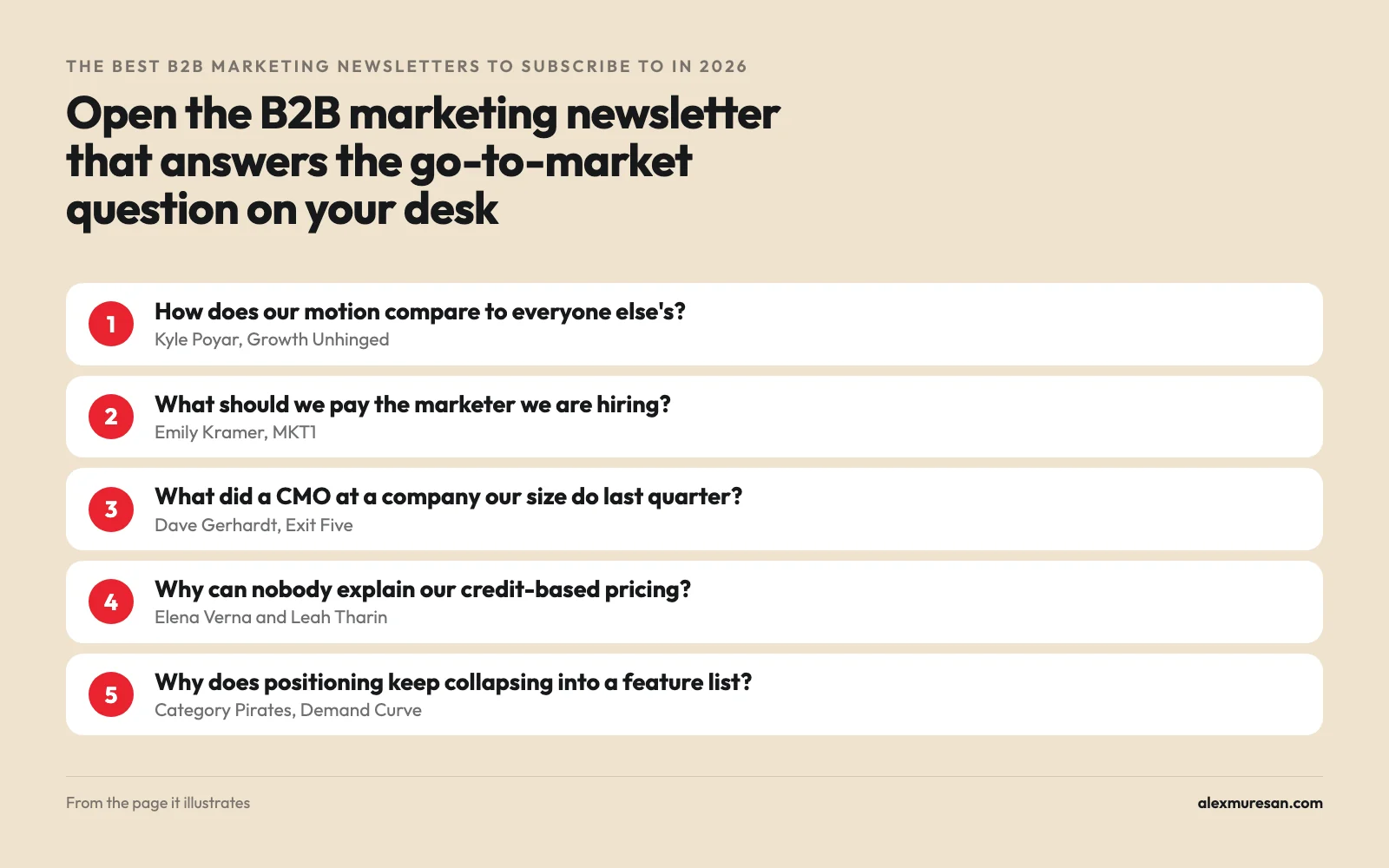
Which newsletter to open for the problem on your desk
You don't need all 8 on the same Tuesday, so match them to what is breaking this quarter. If the board wants to know how your motion compares, open Kyle Poyar, and if you are hiring a marketer, open Emily Kramer. If your pricing page has a credit count nobody can explain, open Elena Verna and Leah Tharin together, because one is building the fix and the other is pricing its consequences. If your positioning keeps collapsing into a feature list, open Category Pirates, then the Demand Curve issue on Rapha for proof that a category can be redrawn on devotion.
If you'd rather follow the people than the letters, the B2B influencers page covers Dave, Emily and Kyle as people to follow on LinkedIn, and the venture capital newsletters page covers the investor side of the inbox. If you'd rather listen, the best B2B marketing podcasts roundup has Exit Five in audio.
How to read B2B marketing newsletters without drowning
There are hundreds of go-to-market newsletters, and it is very easy to subscribe to 20 and read none of them. I'd rather you read 3 properly, and these are the 3 habits that make that work.
Read for the number, then for the reason
Every pick on this page puts a fact in the issue: a median salary, a survey percentage, a click-through lift, a valuation multiple. Write that number down next to your own, then read the reason the writer gives for it. That habit is how you stop guessing in a planning meeting, and it is also how you notice when a newsletter has stopped carrying numbers and started carrying vibes.
Check who is paying for the issue
Kyle Poyar's report names Ploy as its presenting partner, the Demand Curve issue carries a marked sponsor block, and Elena Verna's pricing piece is sponsored by SurveyMonkey, where she started her career. All 3 tell you, and a writer who never says where the money comes from deserves less of your Tuesday than one who does.
Unsubscribe from the 10
Go back to that inbox at 7:50. The 10 newsletters that restated a LinkedIn post cost you more than the 2 minutes it takes to delete them, because every one you skim trains you to skim the 11th too. If you want the long version of why rented attention compounds against you, read distribution debt, and if you want to write the kind of post these 8 would open, the LinkedIn organic post best practices guide picks up where this page stops.
Hear how VCs got their companies to the next stage
Every writer on this page sits on the operator's side of the table. If you want the investor's view of how a company got from one stage to the next, that is what my show Sell That S*it! is for, and every season-one guest is a VC. Season one is filming now and no episodes are out yet, so the newsletter box at the bottom of this page is how you'll hear when the first one lands.
FAQs about B2B marketing newsletters
What are the best B2B marketing newsletters to subscribe to? Start with Kyle Poyar's Growth Unhinged for benchmarks and Emily Kramer's MKT1 for how to build the team, then add Dave Gerhardt's Exit Five for what CMOs are doing this quarter. The other 5 on this page fill in pricing, positioning and product-led growth.
What are the best newsletters on B2B go-to-market and distribution? Kyle Poyar's 2026 State of B2B GTM report is the most direct answer, because it ranks channels by what 300 go-to-market leaders said worked, with network and introductions first and AI search the fastest riser. Category Pirates and the Demand Curve Growth Newsletter cover distribution from the positioning side, which is where most distribution problems start.
Who should I follow for B2B go-to-market advice if I like Lenny's Newsletter? If you like Lenny for the depth of a single long piece, read Elena Verna, who brings the same operator detail to growth and pricing, and Leah Tharin for product-led growth from inside a company. If you like him for the tactical specifics, Andrew Capland's Delivering Value is 5 levers with a company attached to each, every week.
Exit Five vs MKT1: which is better for B2B marketing leaders? They do different jobs, so most leaders want both. Exit Five is Dave Gerhardt twice a week with what a CMO at Varonis or SurveyMonkey did and what it cost, while MKT1 is Emily Kramer going deep less often, with a salary table built from 1,121 job posts. If you lead a team today, start with Exit Five, and if you are building the team, start with MKT1.
I'm Head of Growth at a B2B SaaS company. Which people and newsletters give specific, numbers-backed go-to-market advice rather than generic marketing tips? Kyle Poyar, whose 300-leader survey puts a percentage on every channel, and Emily Kramer, whose salary report puts a median on every level, then Andrew Capland for the product levers behind activation and Leah Tharin for the valuation math behind your category. Those 4 are the ones that will show up in your next board deck.
About the author

Alex Muresan is a 4x founder with 2 exits. He built his first company, a physical entertainment center, to 60 employees and $2M in annual revenue in his early 20s. His second exit came in 2026, when he sold a media company. He took an AI startup from 0 to $600K ARR in 5 months, and at his current startup he took revenue from $800K to $1.4M ARR in his first 3 months. He also hosts Sell That S*it!, where every guest in season one is a VC.
Part of the stage playbooks: what to do for growth at pre-seed, seed, Series A, Series B and Series C. The glossary →