
Follow people who show the work: Every one of these B2B influencers has published work you can open and check before you hit follow.
2 newsletters cover a lot of ground: Kyle Poyar's Growth Unhinged and Emily Kramer's MKT1 each reach around 85,000 readers, and between them they cover benchmarks and what B2B marketers get paid.
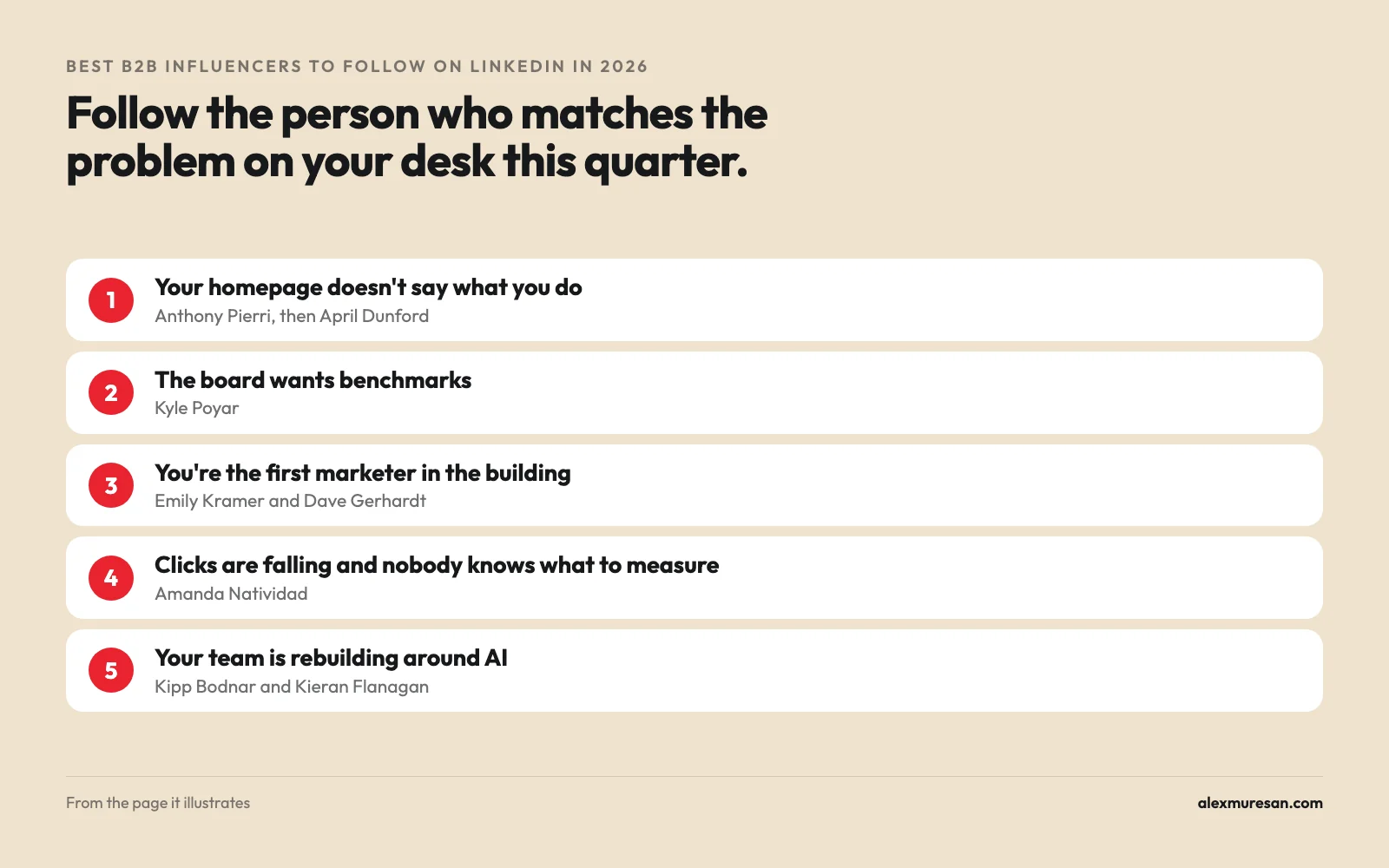
Pick by the problem on your desk: A homepage that doesn't say what you do points to Anthony Pierri and April Dunford, and falling clicks point to Amanda Natividad.
The best shows argue in public: Kieran Flanagan says Marketing Against the Grain hit 70,000 monthly downloads in its first 6 months, partly because he and Kipp Bodnar disagree out loud.
Stop at 9: That's enough for a 10-minute scroll, and the rest of the morning belongs to running what you read.

The 9 B2B influencers at a glance
It's 8:40 on a Tuesday, pipeline review starts at 9, and you open LinkedIn for what you tell yourself will be 2 minutes. You scroll past someone humbled to announce a new role, then a carousel of 14 AI tools you will never open, then a poll asking whether cold email is dead, then an airport lounge selfie with a leadership lesson attached. Then one post stops you. It's a teardown of a homepage you've visited a hundred times, with a note on why the headline works, and you screenshot it for your team before you've even finished reading.
That one post is the reason you still open the app. So here are the 9 B2B influencers whose posts tend to be that one, with what each one is known for and the link I'd open first.
| Person | Known for | Who should follow | Start here |
|---|---|---|---|
| Dave Gerhardt | Exit Five, the B2B marketing community and podcast | B2B marketers who want what's working this quarter | Exit Five podcast |
| Kipp Bodnar and Kieran Flanagan | Marketing Against the Grain, and the book Loop | Marketing leaders rebuilding their team around AI | Loop |
| April Dunford | Obviously Awesome and The Positioning Show | Founders whose buyers can't tell them apart from the alternatives | Her books |
| Emily Kramer | The MKT1 newsletter, ex-Asana and Carta | First marketing hires and early marketing leaders | MKT1 |
| Kyle Poyar | Growth Unhinged, ex-OpenView | Growth leaders who need benchmarks for a board deck | Growth Unhinged |
| Anthony Pierri | Homepage and positioning teardowns, co-founder of FletchPMM | Anyone rewriting a homepage this quarter | His Stripe teardown |
| Katelyn Bourgoin | Why We Buy, the buyer psychology newsletter | Marketers who write copy that has to sell | Why We Buy |
| Amanda Natividad | Zero-click marketing, Chief Evangelist at SparkToro | Teams watching clicks fall with no idea what to measure next | Zero Click Marketing |
| Maja Voje | The book Go-To-Market Strategist and its newsletter | Founders planning a launch or a new market | GTM Strategist |
What are B2B influencers, and which ones are worth following?
B2B influencers are the operators and founders who publish what they've learned about selling to businesses, mostly on LinkedIn and in newsletters, and who post often enough that you build a habit around them. I'm not a fan of the word, because it makes people think of follower counts, but it's the word people search for, so here we are.
The ones worth following show the work. You get a benchmark built from 800 companies, or a teardown of a homepage you know, and you can check it yourself. Plenty of lists of B2B marketing influencers sort people by followers, and that number tells you less every year (I wrote about why your follower count stopped deciding your reach if you want the long version).
I care about this filter because I've been on the posting side of the feed. I sold a media company this year after growing it to an 800K audience on organic alone, so I know from the inside that getting reach and teaching someone something are 2 different skills. Everyone below has the second one, and every pick gets in on something you can open and check.
9 B2B influencers worth following in 2026
Here they are in no particular order. Each one gets the fact that earned the spot and what it's actually like to have them in your feed.
Dave Gerhardt (Exit Five)
Dave Gerhardt joined Drift as a senior marketing manager in 2015 and grew into its VP of Marketing. While he was there his LinkedIn following grew to 70,000, and the first time he charged for his advice, it was a $10-a-month Patreon that signed up 1,000 paying subscribers in its first 6 months, according to Community Gaps.
That Patreon eventually became Exit Five, which now counts more than 7,000 B2B marketers in its community and runs a weekly podcast with CMOs and operators that is past episode 350. Following him feels like sitting in on the group chat of every B2B marketer you wish you knew. His book Founder Brand boils his whole case down to 4 words, "people buy from people", which is also the best argument for following a person instead of a company page.
Kipp Bodnar and Kieran Flanagan (Marketing Against the Grain)
HubSpot launched Marketing Against the Grain in 2022 with its CMO, Kipp Bodnar, and Kieran Flanagan, then its SVP of Marketing, as hosts, with a new episode every Tuesday. Kieran wrote that the show reached 70,000 monthly downloads in its first 6 months, and one of the reasons he gave was that the 2 hosts disagree with each other and with their guests.
That is exactly what it's like to follow them. You get 2 senior people at a public company arguing about what AI is doing to marketing, and you get to pick a side. Kieran now leads HubSpot's Agentic GTM and Systems org, and together they wrote Loop, a book built on how HubSpot's own marketing team now runs, with 4 stages they call Express, Tailor, Amplify and Evolve.
April Dunford (Obviously Awesome)
April Dunford wrote Obviously Awesome, which has sold more than 100,000 copies, and a follow-up called Sales Pitch. Her site says the method behind both has been refined with more than 200 companies, after a 25-year career as a marketing executive at startups, and she also hosts The Positioning Show if you'd rather listen than read.
Following her is like having someone lean over your shoulder every time you write a headline and ask what makes this different from what the buyer already uses. I'd follow her first if your sales team keeps losing deals to "we'll stick with what we have", because that is a positioning problem wearing a sales costume.
Emily Kramer (MKT1)
Emily Kramer built and led marketing teams from the ground up at Asana, Carta, Astro and Ticketfly before she started MKT1, and the MKT1 newsletter now goes to about 85,000 marketers and startup leaders. She also hosts the Dear Marketers podcast.
One of her issues carries the line "I analyzed 1,100+ job posts. Here's what B2B marketers get paid." If you're hiring your first marketer or asking for a raise, that's the tab you want open. She built 4 teams from scratch, so she writes for the person who is about to build their first, and her posts read like a former head of marketing showing you the spreadsheet she wishes someone had shown her.
Kyle Poyar (Growth Unhinged)
Kyle Poyar writes Growth Unhinged, which lands every Wednesday morning for more than 85,000 go-to-market leaders and founders. He was previously an Operating Partner at OpenView, where he worked with portfolio founders growing from $1 to $100M+ ARR.
He's my answer to anyone asking who shares real numbers. His 2025 SaaS Benchmarks Report, run with High Alpha, drew on more than 800 companies and found AI-native startups growing 3 times faster than their B2B SaaS peers, while early-stage gross margins fell nearly 10 points. Following him means your next board deck has a benchmark in it that somebody else had to survey 800 companies to get (which, honestly, is the best kind). He's on our growth marketing experts list too, because he belongs on both.
Anthony Pierri (FletchPMM)
Anthony Pierri co-founded FletchPMM with Rob Kaminski, and the 2 of them have helped more than 350 venture-backed startups sharpen their positioning and turn it into a rewritten homepage. His LinkedIn is where the teardowns live.
In one post he took Stripe, a company with 19 products, and pointed out that its homepage hero names 3 small use cases (accept payments, send payouts, automate financial processes) instead of trying to describe all 19. His argument was that a lot of executives would rather be vague than sound smaller than they think they are, and that buyers won't buy what they don't understand. That's what following him is like: you see why a homepage you know works, and then you open yours and wince.
Katelyn Bourgoin (Why We Buy)
Katelyn Bourgoin writes Why We Buy, a weekly newsletter on buyer psychology. In a post from 2023 she wrote that her list went from under 9,000 readers to 56,512 in 18 months, and that almost all of that growth came from organic social and recommendations rather than ads.
By early 2025, Why We Buy was approaching 70,000 subscribers and had nearly hit $1M in revenue in 2024. Following her changes how you write the next email, because you start asking why the buyer would care before you decide what to say. She's also proof that the feed you scroll every morning can build a real business, which is a nice thing to remember at 8:40 on a Tuesday.
Amanda Natividad (SparkToro)
Amanda Natividad is Chief Evangelist at SparkToro, and in 2022 she gave a name to zero-click marketing, which means publishing content that delivers the value right where people see it, so nobody has to click through to get the point. She and Rand Fishkin turned the idea into a book, Zero Click Marketing, with the hardcover due this fall.
Follow her and you'll start noticing how many posts in your feed are just a teaser for a link, and how rarely you click one. If your team still reports on sessions and can't explain why pipeline went flat, her work is the place to start, and it pairs well with why the click is dying and the mention is everything.
Maja Voje (GTM Strategist)
Maja Voje wrote Go-To-Market Strategist, a 350-page book her site says was built on interviews with more than 100 growth experts. Her GTM Strategist newsletter has more than 38,000 subscribers, and her bio lists Google and Heineken among the companies she's advised over 15 years.
She's my pick when someone asks about rising B2B voices, and she's the one I'd follow if you're about to launch into a new market and want every step written down with the reason behind it. A 350-page book is a lot cheaper than learning the same lessons from a launch that didn't work.
Who to follow for the problem on your desk
You don't need all 9 at once, so pick the 2 or 3 who match what's breaking this quarter and swap them out when that changes. If your homepage doesn't say what you do, start with Anthony Pierri and add April Dunford when the problem turns out to be bigger than the headline. If the board wants benchmarks, follow Kyle Poyar. If you're the first marketer in the building, Emily Kramer and Dave Gerhardt will save you a lot of lonely afternoons.
If clicks are falling and nobody can say what to measure instead, follow Amanda Natividad. If your team is rebuilding around AI, Kipp Bodnar and Kieran Flanagan are arguing about it in public on a weekly show. Katelyn Bourgoin fits every one of those problems, because they all end with a buyer deciding something.
If you'd rather listen, the best B2B marketing podcasts roundup covers Exit Five and Marketing Against the Grain in more depth. If you're booking someone for a stage, the marketing keynote speakers page is the one to open. And when you want to write the kind of post these 9 write, the LinkedIn organic post best practices guide picks up where this page stops.
How to tell a voice worth following from a loud one
Plenty of people post B2B advice every morning, and the feed doesn't care which of them are right. So I run 2 checks before anyone gets a follow. The first is whether you can click through to the receipt, and everyone on this page passes, because each one links to work you can open, with the number or the example sitting right in it.
The second is whether you could run something from their post on Monday, since a lesson with no experiment behind it is just an opinion. It's also worth asking whether the person built their audience from zero or inherited it, which is the whole argument of most growth advice is just inherited audience.
Do that, and next Tuesday at 8:40 the feed looks different. The humbled announcements are still there, but somewhere in the first 10 posts there's a teardown or a chart, and you walk into pipeline review with something worth saying.
Hear how VCs got their companies to the next stage
Most of this list writes from the marketer's side of the table. If you want the investor's view of how a company got from one stage to the next, that's what my show Sell That S*it! is for, and every season-one guest is a VC. Season one is filming now, so there are no episodes out yet, and the newsletter box at the bottom of this page is how you'll hear when the first one drops.
FAQs about B2B influencers
Who are the best B2B marketing influencers to follow in 2026? Start with Dave Gerhardt of Exit Five and Kyle Poyar of Growth Unhinged, because one tells you what's working this quarter and the other shows you the numbers behind it. Then add April Dunford for positioning and Emily Kramer for hiring and building a marketing team.
Who are the best LinkedIn creators for B2B go-to-market? Kipp Bodnar and Kieran Flanagan are the pick for where go-to-market is heading, since they run marketing and go-to-market systems at HubSpot. Anthony Pierri is the pick for homepage and positioning teardowns, and Maja Voje is the pick for planning a launch.
Who are the rising B2B marketing voices to watch? I'd watch Maja Voje, whose GTM Strategist newsletter has passed 38,000 subscribers, and Amanda Natividad, whose book with Rand Fishkin comes out this fall. Anthony Pierri and Katelyn Bourgoin are next on my list, because each one teaches a narrow thing in public, homepages for him and buyer psychology for her.
Which go-to-market experts share real numbers and company teardowns? Kyle Poyar is the one for numbers, since his 2025 SaaS Benchmarks Report drew on more than 800 companies. Anthony Pierri is the one for teardowns, like his breakdown of how Stripe's homepage describes a company with 19 products.
About the author

Alex Muresan is a 4x founder with 2 exits. He built his first company, a physical entertainment center, to 60 employees and $2M in annual revenue in his early 20s. His second exit came in 2026, when he sold a media company. He took an AI startup from 0 to $600K ARR in 5 months, and at his current startup he took revenue from $800K to $1.4M ARR in his first 3 months. He also hosts Sell That S*it!, where every guest in season one is a VC.
Part of the stage playbooks: what to do for growth at pre-seed, seed, Series A, Series B and Series C. The glossary →