
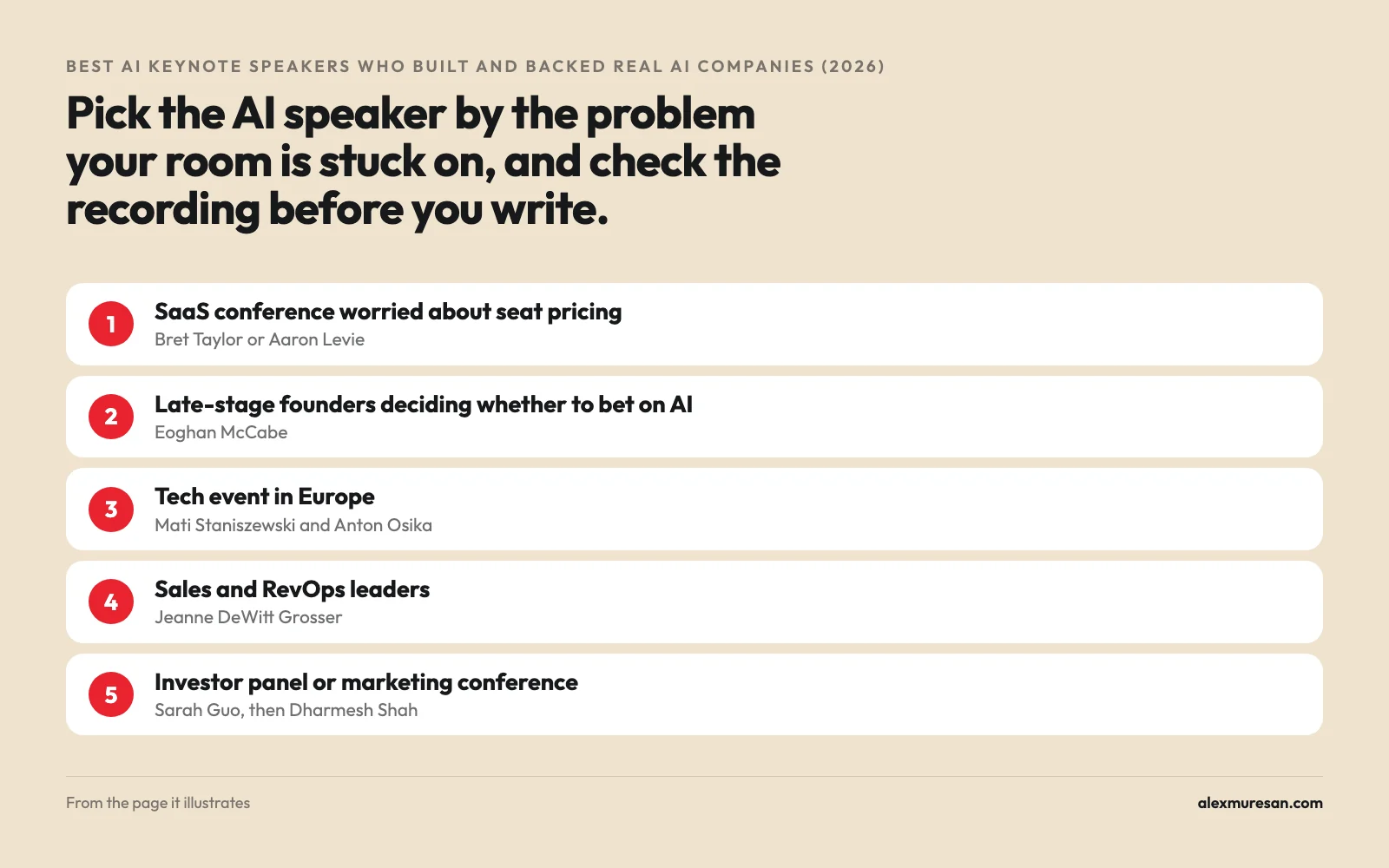
Book operators over futurists: Every one of these AI keynote speakers runs, built or funds a company whose numbers are on the public record, so the room hears what already happened, with the numbers attached.
Pricing is the talk nobody else gives: Bret Taylor and Eoghan McCabe both moved their companies to charging per outcome, and they can explain what that does to a sales team.
Europe has its own headliners: Mati Staniszewski (ElevenLabs) and Anton Osika (Lovable) built their companies from Europe, and both have public revenue numbers to talk through.
Ask for the specific story: Jeanne DeWitt Grosser on the agent that took Vercel's inbound qualification from 10 people to about 1 will land harder than a general talk on AI in sales.
Check the recording first: Every pick links to a talk, an episode or an interview in their own words, so you can judge the delivery before you send the invite.

The 8 AI keynote speakers at a glance
It is the week your conference agenda locks, and every session title on the draft has "AI" in it. The keynote slot is still open, and the names people keep forwarding you are futurists with a slide about robots, which is exactly the talk your audience of sales and marketing leaders will sit through politely and forget by the coffee break. What they actually need is someone who has sold an AI product, priced one or rebuilt a team around one, because their board asked them what the AI plan is last quarter and they still do not have a good answer.
I took an AI startup from zero to $600K ARR in 5 months, and I have spoken at PIRATE Summit in Cologne and at BiohackingCongress in Miami, so I have sat on both sides of that question. The 8 people below are the ones I would write to first. The table gives you the one link to check, and the sections after it say what each person would talk about.
| Speaker | Known for | Who should invite them | Check first |
|---|---|---|---|
| Bret Taylor | Co-founder and CEO of Sierra, chair of the OpenAI board | SaaS and software leadership events | Sequoia's Training Data, live |
| Eoghan McCabe | Co-founder and CEO of Fin, formerly Intercom | Late-stage founders, customer service and SaaS rooms | Lenny's Podcast, August 2025 |
| Mati Staniszewski | Co-founder and CEO of ElevenLabs | European tech events, enterprise AI buyers | TechCrunch at Nrth, September 2026 |
| Anton Osika | Co-founder and CEO of Lovable | Startup events in Europe, product-led growth rooms | His Slush 2025 talk, covered by TechCrunch |
| Jeanne DeWitt Grosser | COO of Vercel, built sales at Stripe | Sales, RevOps and GTM leadership events | Lenny's Podcast, November 2025 |
| Aaron Levie | Co-founder and CEO of Box | Enterprise software and CIO audiences | TechCrunch Disrupt 2025 |
| Sarah Guo | Founder of Conviction, co-host of No Priors | Investor panels, founder summits | 20VC, April 2023 |
| Dharmesh Shah | Co-founder and CTO of HubSpot, builder of agent.ai | Marketing conferences, SMB and mid-market rooms | His INBOUND 2024 session |
What makes AI keynote speakers worth the slot?
AI keynote speakers are worth the slot when they have put an AI product in front of paying customers and can tell the room what changed in the business because of it. That rules out most of what comes up when you search for AI speakers for conferences, because the results are mostly listings with a fee range and a talk title about "the future of work" that could have been written in 2019.
The test I use is the same one I use for any speaker. Could someone in the audience write down one thing and change it on Monday, like how they price or which job they hand to an agent first? If the answer is no, the talk was entertaining (which is fine) but it was not worth the slot, and your attendees will say so in the feedback form.
So every person here built AI into a company or backed one, with numbers you can check, and every one of them talks about the part most AI talks skip, which is how the company sells and grows. That is why I think of them as AI go-to-market speakers first and AI speakers second. The list also avoids the names already on my marketing keynote speakers and entrepreneur speakers pages, so nobody gets recommended twice.
8 AI keynote speakers who built or backed something real
Here are the 8, in no particular order. Each one gets what they would talk about on a stage or as a guest, and the recording that proves they can carry it.
Bret Taylor (Sierra)
Bret Taylor rebuilt Google Maps over a weekend early in his career, became Facebook's CTO at 29, was co-CEO of Salesforce, and now chairs the OpenAI board while running Sierra, which builds customer-facing AI agents for companies like ADT and SiriusXM. On a live episode of Sequoia's Training Data he explained how Sierra charges: a pre-negotiated rate when its agent resolves a customer's issue on its own, and nothing when the conversation goes to a human, which he compared to paying a salesperson on commission. He also said changing a business model is harder for an incumbent than changing a product, which is the sentence every SaaS leader in your audience needs to hear out loud.
On Sierra's own podcast in March 2026 he put it in one line: "the atomic unit of AI productivity is a process, not a person." Invite him to talk about outcome-based pricing and what it does to how a software company sells, because he has done it at scale and he has the board seat that makes the room listen.
Eoghan McCabe (Fin, formerly Intercom)
Eoghan McCabe co-founded Intercom in 2011, stepped away in 2020 for health reasons, and came back as CEO in 2022 to a company whose growth had stalled. ChatGPT launched a month after his return, and within 6 weeks Intercom had a working prototype of what became Fin, its AI agent, priced at $0.99 per resolved ticket. By May 2026 Fin mattered so much that he renamed the whole company Fin, calling the agent "about to be the largest part of our business."
A month later, Salesforce agreed to buy the company for about $3.6 billion. Invite him to tell a room of late-stage founders what it takes to bet an existing SaaS business on AI, because he is the rare CEO who did it with revenue at stake and talks openly about why having nothing to lose was the advantage.
Mati Staniszewski (ElevenLabs)
Mati Staniszewski was a deployment strategist at Palantir and worked at BlackRock before he co-founded ElevenLabs, the audio AI company, and he spoke on "The AI Voice Revolution" at SXSW London in 2025. In September 2026 he told TechCrunch at Nrth in Toronto that the 4-year-old company is pacing at $600 million in annual recurring revenue, with more than 55% of it from enterprise customers like Klarna, Deutsche Telekom and Cisco.
What I like about him for a go-to-market room is how plain his answer was when asked what sells: "The biggest thing is still proving the value and being there with the customer." Invite him to talk about selling AI to enterprises and governments, because almost nobody else has done it this fast, and he is honest about the tradeoffs, including that he is fine with margins falling if it wins market share.
Anton Osika (Lovable)
Anton Osika started with GPT Engineer, an open-source tool for writing software with language models, and with Fabian Hedin turned it into a company in Stockholm that was renamed Lovable in December 2024. Lovable passed $100 million in ARR in July 2025 and doubled it to $200 million four months later, and on stage at Slush 2025 in Helsinki he credited the decision not to move to Silicon Valley, saying of the early advice to relocate, "It was tempting, but I really resisted that."
In August 2026 Lovable raised $400 million at a $13.3 billion valuation, co-led by Menlo Ventures and the Scaleup Europe Fund. Invite him to any European startup event that wants a growth story told from Europe, because his own story is the counterargument whenever someone tells a European founder they have to move to San Francisco.
Jeanne DeWitt Grosser (Vercel)
Jeanne DeWitt Grosser built go-to-market teams at Google and Stripe, where she built the early sales organization, and is now COO of Vercel, running marketing, sales, customer success, revenue operations and field engineering. Her Lenny's Podcast episode from November 2025, "What world-class GTM looks like in 2026", covers the rise of the GTM engineer and how build versus buy changes for sales tools once AI is in the picture.
The story to ask her for is the one SaaStr wrote up: a GTM engineer shadowed Vercel's best SDR, turned her research steps into an agent, and ran it in shadow mode for 6 weeks before it went live. It took inbound lead qualification from 10 people to roughly 1 and a quarter, for about $5,000 a year in infrastructure and tokens plus 20% of an engineer, and the 10 people moved into higher-value roles. I think that is the most useful 30 minutes a room of sales leaders could get this year, because it is a playbook they can copy on Monday.
Aaron Levie (Box)
Aaron Levie is the CEO of Box, and I think he explains AI agents to enterprise buyers better than most AI founders do. At TechCrunch Disrupt 2025 he argued that agents will not replace enterprise SaaS and that the future is SaaS running the core workflow with agents working on top of it. He also predicted there could be 100 to 1,000 times more agents than people using software, which breaks per-seat pricing.
In a Greylock conversation on the move from seats to outcomes he said, "I don't think margins matter right now," because agent running costs will keep falling. Invite him for an enterprise or CIO audience that wants the agent conversation without the hype, because he runs a company that has to make that math work every quarter.
Sarah Guo (Conviction)
Sarah Guo spent nearly a decade at Greylock, where she invested in Figma, Coda and Neeva, and in October 2022 she raised a $101 million first fund for Conviction to back what she calls Software 3.0. She co-hosts the No Priors podcast with Elad Gil, so she interviews AI founders and researchers on the record and asks how their companies actually grow.
Her 20VC episode with Harry Stebbings in April 2023 carried a title that still starts arguments: why will $10 billion companies only have 10 people. Invite her for an investor panel or a founder summit that wants the question of who wins, startups or incumbents, answered by someone who placed the bet early with her own fund.
Dharmesh Shah (HubSpot and agent.ai)
Dharmesh Shah co-founded HubSpot and is its CTO, and on the INBOUND 2024 stage he told the audience, "in the future our teams are going to be hybrid," made of people and AI agents. He backed that up by building agent.ai, which he describes as essentially LinkedIn for AI agents, and which had over 47,000 users by that INBOUND.
His INBOUND 2025 keynote was called "You to the power of AI", about agents multiplying the impact of the people a company already has. Invite him to a marketing conference full of small and mid-size companies, because he explains agents in the language of a marketing team and he has shipped the thing he is talking about.
Which AI keynote speakers fit which room
The wrong person in the right slot wastes everyone's afternoon, so pick by the problem the room has right now. For a SaaS conference where the audience is worried about seat-based pricing, put Bret Taylor or Aaron Levie on the main stage, because both have said in public what agents do to how software gets paid for. For a room of late-stage founders wondering whether to bet the company on AI, Eoghan McCabe is the obvious call.
If your event is in Europe, Mati Staniszewski and Anton Osika are the two headliners, and they cover different halves of the room (enterprise sales and product-led growth). For sales and RevOps leaders, Jeanne DeWitt Grosser is the one with a working agent and the numbers to go with it. For an investor panel, start with Sarah Guo, and for a marketing crowd, Dharmesh Shah.
If the room needs the marketing side of AI search more than the build side, my guide on how to get your brand mentioned in AI answers covers what changes for the team after the keynote ends. And if you want to hear these people as guests before you write, the best venture capital podcasts and the best B2B marketing podcasts are where most of them show up.
How to ask for the talk you actually want
Busy operators say yes to a room they can picture, so tell them who is in the audience and what stage their companies are at, and then name the talk you want. "Come talk about the future of AI" gets ignored, and "we want the Vercel inbound agent story, 10 people to 1, in front of 200 sales leaders" gets a reply, because it shows you did the reading. Ask for the story they have already told in public, because that is the one they can tell well, and it is the one your audience came for.
Now go back to that draft agenda with "AI" in every title. Pick the person whose story matches the problem your audience is stuck on, open the recording linked above, and if 10 minutes in you can picture your room leaning forward, send the invite this week, because the people on this list book months out.
Get the next one in your inbox
Every week I publish one new piece like this, on AI startups, distribution and the people building them, and I post the short versions on TikTok, Instagram and YouTube. Put your email in the box at the end of this page and the next one reaches you the week it lands.
FAQs about AI keynote speakers
Who are the best speakers on AI and go-to-market for conferences? Bret Taylor (Sierra) and Eoghan McCabe (Fin, formerly Intercom) are the strongest on how AI changes pricing and selling, because both moved their companies to charging per outcome. Jeanne DeWitt Grosser (Vercel) is the best pick for sales teams, because she can show the agent that took inbound qualification from 10 people to about 1.
Who should I invite to speak about go-to-market at a SaaS conference? Aaron Levie of Box, who argues agents will sit on top of SaaS and break per-seat pricing, and Bret Taylor, who prices Sierra on resolved conversations. If the audience is earlier stage, Anton Osika can explain how Lovable went from $100 million to $200 million in ARR in 4 months.
Who are the best speakers on B2B growth for tech events in Europe? Mati Staniszewski, who runs ElevenLabs and spoke at SXSW London in 2025, and Anton Osika, who spoke at Slush 2025 in Helsinki about building Lovable from Stockholm. Between them they cover enterprise sales and product-led growth.
Who are the best keynote speakers on startup growth in 2026? Anton Osika, whose Lovable doubled from $100 million to $200 million in ARR in 4 months, and Mati Staniszewski, whose ElevenLabs is pacing at $600 million, both have public numbers to talk through. Sarah Guo of Conviction is the pick if you want the investor's view of which startups grow and why.
What do AI keynote speakers talk about that is useful for marketing and sales leaders? The useful ones talk about what changed inside a real company, like pricing per outcome or an agent doing work a team used to do. Dharmesh Shah's argument that teams will be hybrid, people plus agents, is a good place to start for a marketing audience.
About the author
Alex Muresan is a 4x founder with 2 exits. He built his first company, a physical entertainment center, to 60 employees and $2M in annual revenue in his early 20s. His second exit came in 2026, when he sold a media company. He took an AI startup from 0 to $600K ARR in 5 months, and at his current startup he took revenue from $800K to $1.4M ARR in his first 3 months. He posts short videos on AI startups, distribution and the people building them, and takes on sponsorships, content projects and consulting: work with him.
Part of the stage playbooks: what to do for growth at pre-seed, seed, Series A, Series B and Series C. The glossary →