
Follow the person who shows the spreadsheet: Every pick below published a specific number in a piece you can open today, from a retention benchmark to a worked churn example to an AI sales experiment.
Start with Kyle Poyar and Ray Rike: Poyar's 2026 monetization data says 76% of AI-native companies use variable or hybrid pricing, and Rike's Benchmarkit report puts median gross revenue retention at 84%. Both numbers belong on a board slide.
Read the CFOs before you trust a margin: CJ Gustafson shows one $50M ARR company reporting an 88% or a 74% gross margin depending on where the AI tokens go, and Dave Kellogg shows how a rolling average hid a churn problem for about 6 months.
For AI go-to-market, follow the people running experiments: Jason Lemkin reports SaaStr closed 140% of the prior year's sales with 1.25 humans and 20 AI agents, and Janelle Teng Wade co-wrote Bessemer's benchmarks for how fast AI companies grow and what their margins look like.
Price AI on the value it creates: Madhavan Ramanujam argues AI companies can capture 25% to 50% of the value they create, against 10% to 20% for traditional SaaS.

The best SaaS influencers at a glance
It's Thursday night and the board deck is due Monday. Slide 9 says net revenue retention, 101%, and you already know the first question in the room will be whether that's good. So you type "SaaS benchmarks" into Google, then into ChatGPT, and what comes back is a list of SaaS influencers sorted by follower count, with nothing in it you could put under your 101% as a footnote.
This page is the list I wish had come back. Every person below published a number I could hold my own against, and for each one I've linked the piece to read first, so you can check the receipt before you give them a place in your feed.
| Person and outlet | Known for | Follow if you | Read first |
|---|---|---|---|
| Kyle Poyar (Growth Unhinged) | Pricing and go-to-market surveys of software companies | Own pricing or packaging at a SaaS or AI company | The AI monetization debate shifts again |
| Ray Rike (Benchmarkit) | Private SaaS metrics benchmarks across retention, efficiency and pricing | Need a benchmark for every line of a board deck | 2026 B2B SaaS and AI-native metrics |
| Dave Kellogg (Kellblog) | SaaS metrics from a former CEO and CMO, with worked examples | Report numbers to a board or a CEO | Please Don't Smooth the Metrics |
| CJ Gustafson (Mostly Metrics) | Business through the eyes of a CFO | Run a product whose costs now include AI tokens | Why gross margin is a decision |
| Jason Lemkin (SaaStr) | Running SaaStr's own sales on AI agents and publishing the results | Are deciding whether AI agents can carry part of your sales team | 1.25 humans and 20 AI agents closed 140% |
| Janelle Teng Wade (Next Big Teng) | Bessemer's data on how AI companies grow | Need to know what good looks like for an AI product | The State of AI 2025 |
| Madhavan Ramanujam (Monetizing Innovation) | Pricing strategy, now for AI products | Are pricing an AI feature for the first time | Pricing your AI product, on Lenny's Podcast |
| Christoph Janz (Point Nine) | A SaaS investor since 2008, writing about what AI does to software | Sell software your buyers could now build themselves | AI Killed My SaaS |
What makes a SaaS influencer worth following?
A SaaS influencer, in the useful sense, is someone whose posts change a decision inside a software company: what to charge, how many reps to hire, which number to fix first. The ones worth following show their working. They publish the survey, the benchmark table or the spreadsheet behind the opinion, so you can disagree with the conclusion and still keep the data.
Most lists of SaaS experts to follow skip that test and sort by reach, which is a strange way to pick a teacher. Reach tells you someone is good at being seen, and I respect that skill a lot, but it says nothing about whether their median is your median. At my current startup I took revenue from $800K to $1.4M in my first 3 months, and in a stretch like that the input worth trusting is the one with a number you can compare against, whatever its like count.
So every pick below passed one filter: a specific piece, published by them or with them, that carries numbers you can check. I've linked that piece on the claim. If you came here from the B2B marketing newsletters page, this is the next step down into the data, and I've kept the repeats to the one name both pages need.
8 SaaS influencers who publish the numbers
I've ordered them the way I'd read them before a planning cycle. The data people come first, then the 2 CFO minds who tell you how much to trust that data, then the 4 who are working out what AI does to SaaS go-to-market while it happens.
Kyle Poyar (Growth Unhinged)
Kyle Poyar was an Operating Partner at OpenView and a director at the pricing firm Simon-Kucher before he started Growth Unhinged, which now lands every Wednesday morning for more than 85,000 go-to-market leaders, founders and investors. He's the one name I repeat from the newsletters page, because few people publish as much SaaS pricing data in plain English. On October 7th he wrote The AI monetization debate shifts again, pulling from his 2026 State of Monetization report: 76% of AI-native companies now use some form of variable or hybrid pricing, against 49% of SaaS companies.
The figure I'd screenshot is the investor question. When the survey asked which pricing model investors prefer, only 15% of answers went to flat-fee or seat-based subscriptions, while 35% went to hybrid, 26% to outcome-based and 24% to usage-based. If you still charge per seat, bring that split into your next pricing meeting, because it tells you what the people funding your next round would rather see.
Ray Rike (Benchmarkit)
Ray Rike is the founder and CEO of Benchmarkit, after more than 30 years in subscription software and 5 SaaS and software exits, and his company's whole business is the number your board will ask about. Its 2026 B2B SaaS and AI-native metrics report is the piece to read first. Median gross revenue retention dropped from 88% to 84%, and even the 75th percentile slid from 95% to 91%, which the report reads as a market-wide shift that top performers were not immune to.
The number I'd forward is the pricing split: companies on usage pricing showed net revenue retention of 108%, against 98% for seat pricing. Put that next to Kyle Poyar's survey and you have 2 independent sources pointing the same way, which is about as close to a fact as SaaS pricing gets. Rike also hosts The Metrics Brothers with Dave Kellogg, the next name on this list, so you can hear the 2 of them argue about the same tables.
Dave Kellogg (Kellblog)
Dave Kellogg was CMO at Business Objects for nearly a decade while it grew from $30M to over $1B in revenue, then CEO of MarkLogic, which he grew from zero to $80M over 6 years, then CEO of Host Analytics from 2012 to 2018. He's now an EIR at Balderton Capital and has written Kellblog for nearly 20 years. Read Please Don't Smooth the Metrics from July 25th first, a worked example built around a company he calls StartCo that looked healthy on every rolling average while its churn quietly doubled.
The story is painfully familiar. Sales broadened the ICP to hit plan, those customers came up for renewal, and churn on available-to-renew ARR doubled from 15% to 30% in 3Q25, but the smoothed churn rate only reached 18% and caught the board's eye in April 2026, about 6 months after the problem started. His line "The volatility is the point" is the whole post in 4 words, and it's why I'd follow him if you report numbers upward.
CJ Gustafson (Mostly Metrics)
CJ Gustafson calls himself a recovering tech CFO, and Mostly Metrics is business through the eyes of the CFO, which is exactly the pair of eyes a Head of Growth should borrow before a planning cycle. His October piece on why gross margin is a decision is the one I'd open first, especially if your product runs on AI tokens. He builds a $50M ARR company with $6M of hosting, $2.5M of support, $3.5M of AI tokens and $1M of solutions engineers, then shows the same business can report an 88% gross margin or a 74% one depending on where those grey-zone costs land.
That's a 14-point swing with EBITDA at $6M either way, and he points out that an acquirer's quality-of-earnings team will rebuild the margin from scratch regardless. His advice is to define cost of goods sold in writing and tag AI token spend early. Follow him if anyone at your company has ever said "we're an 80% margin business" without checking which costs they left out.
Jason Lemkin (SaaStr)
Jason Lemkin founded SaaStr, which Lenny Rachitsky's show introduces as the world's largest community for software founders, and he has deployed more than $200 million into B2B startups. He's worth following on AI go-to-market because he ran the experiment on his own company and keeps publishing the results. SaaStr kept 1.25 humans in sales, put 20 AI agents to work, and Lemkin reports they closed 140% of what the all-human sales team closed the year before.
Read Our 1.25 Humans + 20 AI Agents Closed 140%, because the honest part is the second half of the title, where he says he's not sure that's the real story. Before the agents, fewer than 40% of inbound leads got an answer and now 100% do, and SaaStr had 10,000 past prospects that humans had only ever worked 500 of, so his read is that the best closers simply got more at-bats. These are SaaStr's own numbers from one company, so treat them as an experiment, and it's still the most detailed one of its kind I know of.
Janelle Teng Wade (Next Big Teng)
Janelle Teng Wade is a VC at Bessemer and writes Next Big Teng, data-driven notes on startups and AI, for more than 9,000 subscribers. She's one of the authors of Bessemer's The State of AI 2025, published August 13th, 2025, which is the piece to read first if you're trying to work out what good growth looks like for an AI product. It splits AI companies into Supernovas, where the 10 Bessemer surveyed averaged about $40M ARR in their first year of selling and $125M in their second, and Shooting Stars, which reached about $3M in year 1, then $12M, $40M and about $103M by year 4.
The detail that tells you most is the margin. Supernovas ran gross margins around 25%, often negative, with $1.13M of first-year ARR per employee, while Shooting Stars ran at 60% with about $164K. So if your AI product is growing like a rocket on thin margins, you know which column you're in and which question the board will ask next.
Madhavan Ramanujam (Monetizing Innovation)
Madhavan Ramanujam wrote Monetizing Innovation and its sequel, Scaling Innovation, and as a managing partner at Simon-Kucher he helped more than 250 companies, including 30 unicorns, build their pricing. He has since left to launch 49 Palms, a fund for early-stage AI companies, so he now works on AI pricing from the investor's side of the table.
Start with his July 2025 episode of Lenny's Podcast, Pricing your AI product. His headline claim is that AI companies can capture 25% to 50% of the value they create, against 10% to 20% for traditional SaaS, and the episode covers outcome-based pricing down to companies charging $0.99 per AI resolution. If you're about to price an AI feature by adding a margin to your token bill, listen to this before the pricing page ships.
Christoph Janz (Point Nine)
Christoph Janz is an investor at Point Nine, which has backed SaaS companies since 2008 and has written about SaaS metrics like CAC, LTV and cohort analysis ever since. So it carries weight when he writes, as he did on May 15th, that "2010-style SaaS investing is dead," and explains how the firm's software bets have moved toward agentic systems and companies that work outside offices.
Read AI Killed My SaaS from February 27th first, because it's the shift happening on one investor's own desk. He vibe-coded an internal knowledge hub in about 13 days, roughly 43,800 lines of Python with 6 data connectors, then replaced it with Claude connected straight to Attio, Slack and Zendesk, which he estimates delivers 90% to 95% of the value for about 10% of the effort. If you sell software to people who can now build a version of it in 2 weeks, that ratio is the one to lose sleep over.
Which one to open for the problem on your desk
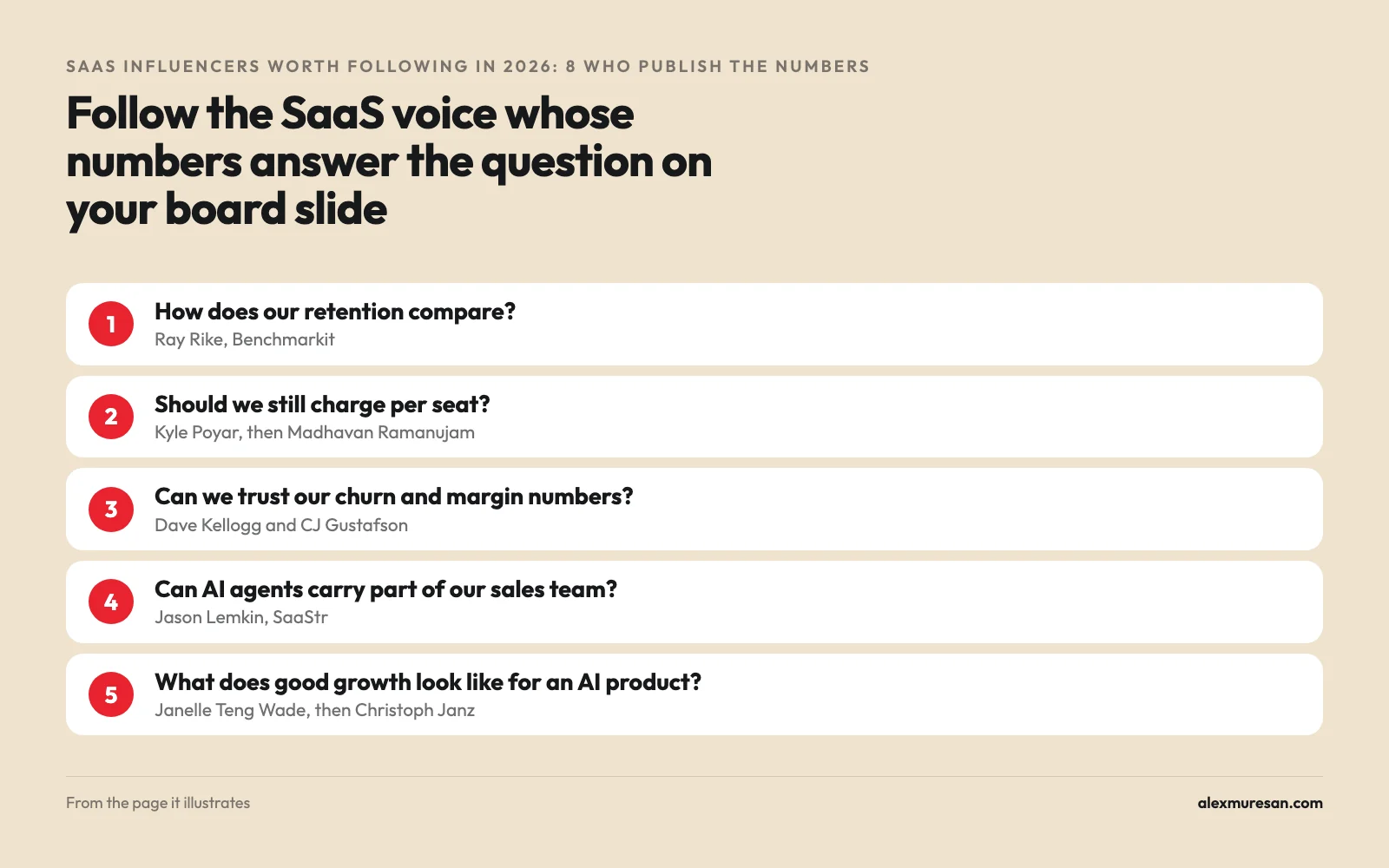
You don't need all 8 in the same week, so match them to whatever is breaking this quarter. If the board wants to know how your retention compares, open Ray Rike's report, and if the argument is about how to charge, open Kyle Poyar and Madhavan Ramanujam together, because one gives you the survey and the other gives you the reasoning. If someone wants to put AI agents in front of your inbound, read Jason Lemkin's numbers and his doubts about them in the same sitting.
If the numbers themselves feel slippery, read Dave Kellogg on churn and CJ Gustafson on margin before you trust any dashboard, yours included. If you'd rather follow the broader set of B2B SaaS influencers on LinkedIn, the B2B influencers page covers the marketing side and the growth marketing experts page covers the growth operators. If you'd rather listen, the best SaaS podcasts page has 8 shows, and the venture capital newsletters page covers the investor side of the inbox.
How to read a SaaS benchmark without fooling yourself
Following the right SaaS influencers is half the job. The other half is reading what they publish the way they would, and these 3 habits come straight from the picks above.
Check who is in the sample
Lemkin's 140% is one company, Bessemer's Supernova figures are averages across 10 startups, and Poyar's percentages come from a survey of companies that chose to answer. All 3 are useful, and all 3 tell you who they measured. Before a number goes on your slide, write down who it describes and ask whether that looks like you.
Put the raw quarter next to the rolling average
Kellogg's StartCo looked fine on a smoothed churn rate for about 6 months while renewal churn doubled underneath it. Track churn in dollars and against plan every quarter, next to whatever average the board deck shows, because the average is built to hide exactly the movement an operator needs to see.
Ask where the AI costs sit
Gustafson's example moved a company from 88% to 74% gross margin without changing a single dollar of spend. If your product calls a model, find out which line your token bill lands on before you compare your margin to anyone's benchmark. Left alone, that kind of problem compounds quietly, the same way distribution debt does.
Go back to that Thursday night and slide 9. Your 101% now has company: Benchmarkit's 108% for usage pricing and 98% for seat pricing, plus Kyle Poyar's survey on which pricing model investors would rather see. That's a footnote you can defend on Monday, and it came from people who showed their working.
Get the next one in your inbox
Every week I publish one new piece like this, on AI startups, distribution and the people building them, and I post the short versions on TikTok, Instagram and YouTube. Put your email in the box at the end of this page and the next one reaches you the week it lands.
FAQs about SaaS influencers
Who are the best SaaS influencers to follow in 2026? For data, start with Kyle Poyar (Growth Unhinged) on pricing and Ray Rike (Benchmarkit) on retention and efficiency benchmarks, then add Dave Kellogg and CJ Gustafson for how to read those numbers. For AI go-to-market, follow Jason Lemkin, Janelle Teng Wade, Madhavan Ramanujam and Christoph Janz.
I'm Head of Growth at a B2B SaaS company. Which people and newsletters give specific, numbers-backed go-to-market advice rather than generic marketing tips? Kyle Poyar's Growth Unhinged and Ray Rike's Benchmarkit reports put a percentage on almost every pricing and retention question you'll get asked. CJ Gustafson's Mostly Metrics and Dave Kellogg's Kellblog then show you how those numbers get bent, with worked examples you can copy into a spreadsheet.
Which go-to-market experts share real numbers and company teardowns? Jason Lemkin publishes SaaStr's own AI sales results, down to 1.25 humans and 20 agents closing 140% of the prior year. Dave Kellogg and CJ Gustafson build worked company examples, and Bessemer's State of AI report, co-written by Janelle Teng Wade, benchmarks AI companies by ARR, margin and ARR per employee.
Who are the best voices on AI go-to-market? Jason Lemkin for running sales on AI agents, Madhavan Ramanujam for pricing AI products on the value they create, and Janelle Teng Wade for Bessemer's data on how AI companies grow. Christoph Janz adds the investor's view of what AI does to SaaS itself.
Who are the best go-to-market experts for B2B CMOs to follow? A CMO reporting to a board gets the most from Dave Kellogg, who was CMO at Business Objects before he became a CEO, and from Ray Rike's Benchmarkit, which publishes B2B marketing benchmarks alongside its retention data. For the marketing-led names, the B2B influencers page on this site covers Dave Gerhardt, Emily Kramer and April Dunford.
About the author

Alex Muresan is a 4x founder with 2 exits. He built his first company, a physical entertainment center, to 60 employees and $2M in annual revenue in his early 20s. His second exit came in 2026, when he sold a media company. He took an AI startup from 0 to $600K ARR in 5 months, and at his current startup he took revenue from $800K to $1.4M ARR in his first 3 months. He posts short videos on AI startups, distribution and the people building them, and takes on sponsorships, content projects and consulting: work with him.
Part of the stage playbooks: what to do for growth at pre-seed, seed, Series A, Series B and Series C. The glossary →